
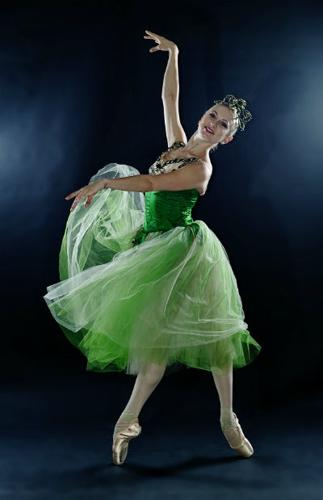
This weekend, City Ballet will be performing their Balanchine Masterworks. This show compiles three of George Balanchine’s amazing works into one performance; the very fact that City Ballet can dance these pieces tells you that this is going to be a fantastic show. But to truly appreciate City Ballet’s Balanchine Masterworks, you first have to know just who Balanchine is.
George Balanchine is arguably the father of modern ballet. Choreographing throughout the 20th century, Balanchine is regarded by many dancers, directors, and choreographers as the absolute greatest choreographer of the last century. Every ballet dancer in the country—if not the world—knows his name and envies his work. Anyone who got the opportunity to dance for Balanchine while he was still alive, let alone perform his works, is considered lucky. And not only is San Diego’s City Ballet allowed to perform the late, great ballet master’s work, but City Ballet also has access to two different dancers who worked closely with Balanchine himself: Steven Wistrich and Elyse Borne.
George Balanchine and His Worldwide Influence
Steven Wistrich is the current artistic director of City Ballet. He began his career training with the Boston Ballet and was eventually given the opportunity to dance at the Grand Theatre of Geneva, a Balanchine satellite company in Switzerland. There, Wistrich was offered a principal contract and personally coached by Balanchine himself.
So what was it like to work with Balanchine? "He was so kind," Wistrich said of his old mentor. "His demeanor was very gentlemanly. He was a quiet presence in the studio… He was never intimidating, never sarcastic, never mean like so many could be. He would take us out to dinner at night, all of the principal dancers, and he would talk about his life, his boyhood in Russia, and his training… I just felt so honored to be in his presence."
Elyse Borne, too worked with Balanchine, though she met him through the New York City Ballet. Borne danced at the New York City Ballet for almost 14 years, and she was even a soloist. While in New York, Borne began working with Balanchine. Though at the time, no one knew for sure how long-lasting Balanchine’s impact would be on the ballet community, Borne says that even back then, she knew how amazing it was to work with him.
"He’d come in to make a new ballet, and an hour later there would be a masterpiece. So fast…" Borne said with a shake of her head. "He choreographed on the spot, and he didn’t change a lot. Very little [adjustments]. Mr. B knew the music inside-out when he walked in the room—and he must have had an idea when he walked into the room—he didn’t talk about it. He just came in and did it. He would say, ‘you all go that way, you all go this way,’ and the ballet mistress was like, ‘I don’t get it.’ We just did what he said. And on the opening night, with all of the costumes, [the ballet mistress] said ‘you wouldn’t believe the patterns. The swirling couples, the patterns…’ But he saw it in his head. It’s a very special gift."

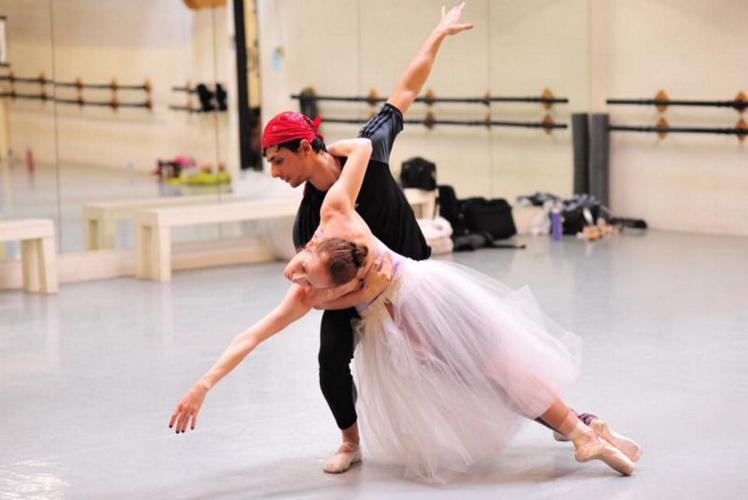
Balanchine Masterworks Rehearsal; Photo by Mario Scipione
Balanchine Masterworks Rehearsal; Photo by Mario Scipione
George Balanchine Trust in New York
Even to this day, Balanchine’s patterns and choreography are preserved by the George Balanchine Trust in New York. This trust ensures that every piece of Balanchine choreography that is performed today is exactly as it was when Balanchine first choreographed it: same costumes, same music, same formations, same pas de deux, and same corps choreography. Any company that wishes to perform Balanchine has to apply to the George Balanchine Trust and gain their approval, something Wistrich of City Ballet did for the first time back in 1996.
"I told them who I was and about my background with Balanchine, and they asked me to send a videotape of the company," Wistrich explained. The George Balanchine Trust then evaluates the applicant company and decides which ballets they have the skill to perform if any. "Basically, we’ve built a relationship from 1996, where now I can pretty much get whatever ballet [I want] that we could do artistically or financially." From 1996 on, City Ballet has performed a Balanchine piece nearly every single year.
Yes, Balanchine choreographed masterpieces, but according to Elyse Borne, working with him could sometimes be very difficult. Borne illustrated that, "When he was around, there was no such thing as marking." Marking, for those who don’t know, is a dance term for practicing without energy: don’t do the large leaps or the fast turns—just pretend. Marking can help dancers conserve energy and rehearse for longer periods of time without a break. "We weren’t allowed to mark. We weren’t allowed to wear ballet slippers. You could wear old pointe shoes that were soft, but no ballet slippers."
If you think that sounds like a great way to mangle your feet, just wait until you hear how many pointe shoes Borne and the New York City Ballet went through each week under Balanchine. "They would give us 8 pairs a week," she explained. "I never picked up my full allotment, though, I used to wear them until they were paper. But before I would wear them, even brand new, I would smash them in the door, then I would pour water or alcohol over the whole thing. Break the shank, and then bounce in them en pointe until they were essentially my feet. I like to feel the floor."
And it’s necessary to utterly destroy pointe shoes before you wear them; if they are too new and too stiff, pointe shoes can cause painful bruises and blisters. "When I was doing only solo or principal parts, it was pretty much a [new] pair every show," Borne admitted, before disclosing that she would sometimes dance in seven or eight shows a week.
And Balanchine’s strong attention of detail towards pointe shoes didn’t end there; according to Borne, every dancer had to wear the same brand of pointe shoe, regardless of the shape of their feet. "Mr B wanted everyone to wear Freeds, but there were two ballerinas who were allowed to wear Capezio," she disclosed, before admitting that even to this day she wasn’t sure why only those two were allowed different shoes. "Every other person in that company had to wear Freeds."
Even Wistrich admits that Balanchine had a bit of an obsession with feet. "He would watch our feet a lot. He was always watching our feet because I think he was really concerned with rhythms and wanted to make sure we were absolutely on the music."
After she hung up her pointe shoes, Borne became the ballet mistress at Miami City Ballet, where she helped them stage almost exclusively Balanchine ballets. Currently, Borne works for the George Balanchine Trust, where she travels around the world and stages Balanchine shows for international companies. This is how she got involved with San Diego’s own City Ballet: Elyse Borne is staging two of the pieces being performed in Balanchine Masterworks.

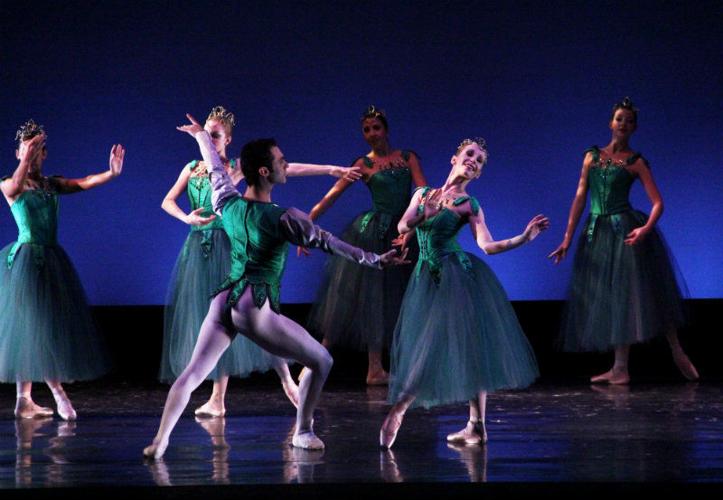
City Ballet George Balanchine Emeralds
City Ballet’s Balanchine Masterworks
So what can viewers expect from City Ballet’s performance of Balanchine Masterworks? The program consists of three iconic Balanchine ballets: Concerto Barocco, Emeralds, and Square Dance. All three ballets are incredibly different and bound to wow the audience.
The show opens with Concerto Baroco, which is a modern, contemporary ballet. Wistrich describes it as a ballet that "has a lot of attack. It’s fast, it’s very sharp, and yet it has a lot of lyricism to it… The [dancers] hardly wear anything. They just wear white leotards and short white skirts and pink tights. No costumes to speak of, but the dance doesn’t need it because the choreography is so spectacular. Concerto Baroco was done back in the 1950s, and it looks as fresh today as it did the day it went on." Concerto Baroco will set the pace for the rest of the show, building excitement and energy before the City Ballet transitions to their second Balanchine piece of the night: Emeralds.
Emeralds is the opening dance in Balanchine’s production Jewels, and City Ballet has performed Emeralds in the past. This piece is quiet and romantic; it slows down the pace a little and gives the audience an almost dreamy break from the fast action of Concerto Baroco.
And, oh, will the audience need that break, because Balanchine Masterworks ends with Square Dance, a fast, fun, and technically difficult ballet that will inevitably bring the crowd to their feet and screaming for more. Elyse Borne actually got the chance to perform Square Dance with the New York City Ballet, and she describes it as one of the hardest ballets she has ever danced… and that was even after all of the changes Balanchine made to the original production. "Originally it was done with a band on stage. They had bandanas and there was a caller who screamed out through the whole ballet: ‘and swing your partner ‘round and ‘round…’ When Square Dance was revived for the New York City Ballet, I was in it, and [Balanchine] took away the caller, the band, the bandanas and he added a beautiful male solo."
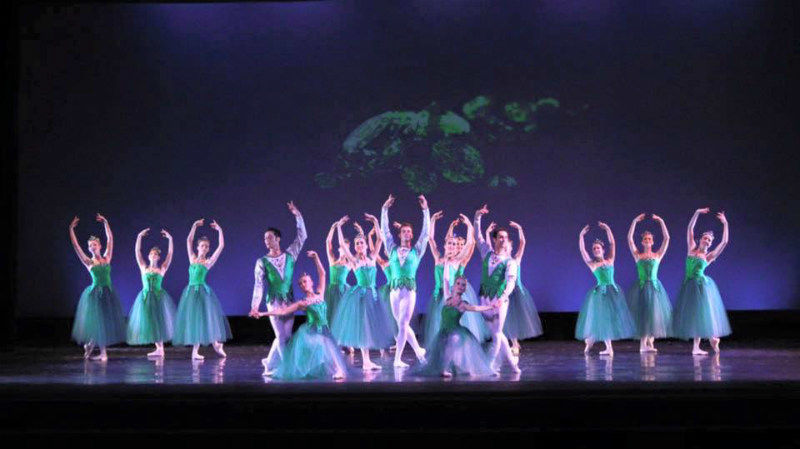
City Ballet San Diego Balanchine
All three ballets are different enough that it’s almost hard to believe all three ballets came out of one mind. But according to Wistrich, the differences are why City Ballet has chosen to perform these three specific ballets in one night. They want to provide the audience with a wide collection of Balanchine’s work, especially since Balanchine himself probably would have approved of such a varied program. "Balanchine used to say that putting a program together was like making a meal. There’s the appetizer, the main course, and the dessert… The ballets are so completely different in concept, in vocabulary, in the physical look of the ballets, in the costuming, the styles, the music, the lighting… There are three completely different ballets that look like three different works of art. Nothing is similar at all between the three works."
And that, more than anything, is what’s so beautiful about Balanchine’s work and why it needs to be preserved. Balanchine ballets are all so creative, varied, and ahead of their time. San Diego is lucky to have a prolific company like City Ballet nearby because they are allowed to perform such influential shows. The Balanchine Masterworks is definitely a can’t-miss performance every year.
Tickets for Balanchine Masterworks are available through City Ballet. You’d better hurry! There are only three shows this year: Friday, March 4th, Saturday March 5th, and a Sunday matinee on March 6th. All performances are held at Spreckels Theatre downtown.


(0) comments
We welcome your comments
Log In
Post a comment as Guest
Keep it Clean. Please avoid obscene, vulgar, lewd, racist or sexually-oriented language.
PLEASE TURN OFF YOUR CAPS LOCK.
Don't Threaten. Threats of harming another person will not be tolerated.
Be Truthful. Don't knowingly lie about anyone or anything.
Be Nice. No racism, sexism or any sort of -ism that is degrading to another person.
Be Proactive. Use the 'Report' link on each comment to let us know of abusive posts.
Share with Us. We'd love to hear eyewitness accounts, the history behind an article.