
Apps have come a long way since they first debuted on smartphones. Today apps run the gamut from games about peeved birds to fun ways to share phones and text your friends. But what if there was one that could detect when an earthquake was about to happen? Well, that’s exactly what scientists as UC Berkeley think they have created.
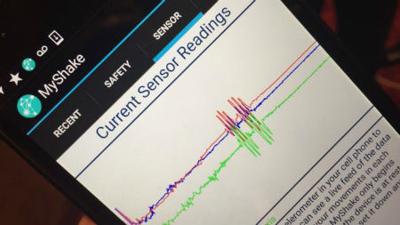
The app is called MyShake. It’s a crowd–sourcing project available on the Google Play store, with a version for the Apple App Store coming soon. How the app works is simple: inside modern–day smartphones like the Galaxy S6 or iPhone, there are built–in motion sensors called accelerometers that detect when the phone vibrates. Now, the app wouldn’t be much use if it were only picking up the data of an earthquake as it was going on. The scientists at Berkeley say they have coded the app in such a way that it is sensitive enough to pick up on the much more minute tremors that occur when an earthquake first starts to shake the ground.
The idea is that the app would then collect the data from all smartphones across the area of the quake to better determine the severity of the quake and give advance warning before it hits. The goal according to project lead Richard M. Allen, head of the Seismological Laboratory at Berkeley, is not to replace traditional detectors altogether. Instead, he told The San Francisco Chronicle, "we think it can make earthquake early warnings faster and more accurate in areas that do have a traditional seismic network."
The app is still in its early crowd–sourcing stages at the moment, but that doesn’t mean the technology isn’t out in the real world. The MyShake app has been testing quakes from more than 300 test phones across a 4,000 square mile area of California. It’s a good start, but Allen says, "About 3,000 would be a good number, and the system will always be better the more phones there are participating." The value of this app is not something that should be understated as it affects a vast number of people. The most obvious example, at least here in the U.S. would be in California, where quakes are relatively common. With enough time, this app could become like your email; popping up a little notification when it detects an earthquake that has information about where the center of the quake is and the severity. That’s not something that would seem out of the realm of possibility even in a few years if this technology continues to advance.
The real value of this technology, however, lies in the developing world. Who could forget the devastating Indian Ocean earthquake and tsunami of 2004 or the less devastating but still heartbreaking tsunami that hit Japan in 2011? Both of these were caused by earthquakes that occurred under the ocean floor and, had there been a greater warning system, many lives might have been saved.
The big issue for many of the poorer countries in regions prone to earthquakes and tsunamis, as well as for richer nations such as Japan, is that traditional earthquake detection tools are often very expensive to build and maintain. As Allen says, "There are hardly any conventional seismic stations in the region there, but a network of mobile phones in full operation would have detected that quake and saved many lives." The reality is that even in the developing world smartphones are becoming more commonplace. All of which makes the continued development of this app—and others like it—a societally relevant counterpoint to all those social media apps that allow for the sharing of photos of your cat or your night on the town.
(0) comments
We welcome your comments
Log In
Post a comment as Guest
Keep it Clean. Please avoid obscene, vulgar, lewd, racist or sexually-oriented language.
PLEASE TURN OFF YOUR CAPS LOCK.
Don't Threaten. Threats of harming another person will not be tolerated.
Be Truthful. Don't knowingly lie about anyone or anything.
Be Nice. No racism, sexism or any sort of -ism that is degrading to another person.
Be Proactive. Use the 'Report' link on each comment to let us know of abusive posts.
Share with Us. We'd love to hear eyewitness accounts, the history behind an article.