
Key Takeaways
- Personal discovery gifts are most meaningful when they suit the recipient's interests, boundaries, and comfort level.
- Family history projects can preserve stories, photographs, recipes, and memories that might otherwise go unshared.
- Any gift involving personal or genetic information requires consent and careful attention to privacy.
- Family discoveries can be emotional, so recipients should be free to explore at their own pace.
- A thoughtful follow-up activity can turn a single present into a lasting shared experience.
Some gifts are quickly enjoyed and set aside, while others invite a person to ask questions, share memories, and see familiar stories in a new way. For someone drawn to family history, science, culture, or personal discovery, options such as journals, archive visits, and DNA gifts can offer a starting point for a more personal experience.
The best choice is not necessarily the newest or most expensive one. It is the one that respects the recipient's interests and gives them a comfortable way to explore. A gift can be meaningful without involving technology at all, especially when it creates an opportunity to talk with relatives, organize old photographs, or record a story that deserves to be remembered.
Why These Gifts Matter
Curiosity-based gifts can create conversations that last beyond a holiday or birthday. A grandparent may recognize an old photograph, explain why a family moved to a certain town, or finally share the story behind a treasured recipe. Those moments can connect generations while giving younger relatives a clearer sense of the people and places that shaped their family.
They can also inspire an ongoing project. A family tree notebook may lead to interviews, a historical map may spark a weekend visit, and a photo album may become the beginning of a shared timeline. The lasting value often comes from the questions a gift encourages, not from receiving a single final answer.
Know The Recipient Before You Buy
Choose for the person, not for a trend or a sales pitch. Before buying, consider whether the recipient enjoys research, storytelling, travel, collecting, science, or quiet creative projects. Also consider whether they would prefer to work alone or invite relatives to join the experience.
Questions To Consider
- Do they enjoy family stories, local history, or historical research?
- Would they prefer a private project or an activity shared with relatives?
- Are they comfortable managing personal information online?
- Do they enjoy writing, recording interviews, visiting museums, or organizing keepsakes?
- Could family-related discoveries feel sensitive or unwelcome right now?
A gentle conversation can be more thoughtful than a complete surprise. Asking whether someone has ever wanted to learn more about family history gives them room to express interest, set boundaries, or suggest a different kind of gift.

Popular Gift Types For Curious Minds
For The Family Historian
- Archival photo boxes, document-safe folders, and labeled storage supplies.
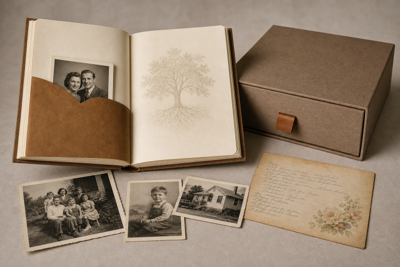
- A family tree notebook for names, dates, places, and research notes.
- Historical map prints connected to a hometown, migration route, or meaningful region.
- Admission to a local archive, historical society program, or genealogy workshop.
For The Storyteller
- A guided interview journal with prompts for childhood memories and family traditions.
- An easy-to-use audio recorder for oral histories.
- A custom album for photos, letters, postcards, and captions.
- A recipe journal that gathers dishes alongside the stories behind them.
For The Science Fan
- Accessible books about genetics, migration, and human history.
- Educational biology kits or museum memberships.
- Tickets to a public lecture, science center event, or university outreach program.
For The Traveler
- A heritage-inspired travel journal and a map marked with family locations.
- A walking tour of a historic neighborhood.
- A visit to a cultural museum, cemetery, archive, or regional history center.
Privacy Questions To Ask First
Gifts involving genetic or personal data deserve extra care. The Federal Trade Commission advises consumers to treat DNA information as sensitive and to review how a company will collect, protect, use, and share it before purchasing a service. Reading about privacy considerations for DNA testing services can help a buyer make a more informed choice.
Privacy Checklist
- Read the privacy policy and terms before purchasing.
- Check whether research participation is optional.
- Review settings for relative matching and profile visibility.
- Confirm whether an account, data, or sample can be deleted.
- Never register a kit or account for another adult without clear permission.
Convenience should never replace informed consent. The recipient should control their own account, results, sharing choices, and decision about whether to participate at all.
Think About Emotional Readiness
Family research can uncover more than names and dates. It may raise unexpected questions about relatives, parentage, adoption, or long-held family stories. That possibility does not make discovery gifts inappropriate, but it does mean the gift should be offered as an invitation rather than an obligation.
When To Pause Before Giving
- The recipient is grieving a recent loss.
- Family relationships are strained or emotionally complicated.
- Known adoption, fertility, or parentage questions are especially sensitive.
- The gift is intended as a joke, party activity, or forced group reveal.
Ways To Make The Gift More Personal
- Write a note explaining why the gift made you think of the recipient.
- Add a copied photograph, letter, recipe card, or family document.
- Include three conversation prompts for an older relative.
- Provide a notebook for recording stories, questions, and discoveries.
- Offer to help with the first interview, archive visit, or organizing session.
Plan A Follow-Up Activity
The strongest discovery gifts give people something meaningful to do after opening them. Host a family story night, cook a traditional meal, label photographs together, or create a simple family timeline. People who want structured guidance can also look for classes and online events, such as family history webinars and programs.
Common Gift-Giving Mistakes
- Ignoring consent: Private information gifts should not be forced on someone.
- Promising easy answers: Family history can be incomplete, complex, or open to interpretation.
- Overlooking privacy settings: Recipients should understand their choices before sharing information.
- Focusing only on results: The conversations and research process may be the most rewarding part.
- Making health claims: Consumer reports should not replace advice from a qualified health professional.
A Simple Gift Checklist
- Does the gift match the recipient's interests?
- Has the person shown interest in family, culture, science, or personal discovery?
- Could it reveal sensitive information?
- Have privacy and consent been considered?
- Can the gift lead to a shared activity or lasting project?
- Would a book, journal, class, or archive visit be a better fit?
The most meaningful gifts for curious minds create space for stories, questions, and connection. Whether the choice is a family journal, a history book, an interview project, an archive visit, or a personal discovery experience, the best gift respects the recipient's privacy, emotional readiness, and freedom to explore on their own terms.
Post a comment as Guest
Report
Watch this discussion.
(0) comments
We welcome your comments
Log In
Post a comment as Guest
Keep it Clean. Please avoid obscene, vulgar, lewd, racist or sexually-oriented language.
PLEASE TURN OFF YOUR CAPS LOCK.
Don't Threaten. Threats of harming another person will not be tolerated.
Be Truthful. Don't knowingly lie about anyone or anything.
Be Nice. No racism, sexism or any sort of -ism that is degrading to another person.
Be Proactive. Use the 'Report' link on each comment to let us know of abusive posts.
Share with Us. We'd love to hear eyewitness accounts, the history behind an article.