
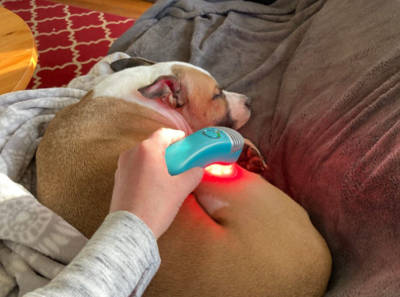

Watching a dog recover from an injury is genuinely hard. They cannot tell you where it hurts, they do not understand why they have to rest, and the usual comfort of a walk or play session is off the table. As an owner, you follow the vet’s instructions and hope the timeline is shorter than predicted.
Red light therapy — also called photobiomodulation or low-level laser therapy in clinical settings — has been gaining steady traction in veterinary rehabilitation over the past decade. The research behind it is substantive, and it is now being used in both professional rehab settings and at home. But does it actually help with the kinds of injuries dogs commonly sustain?
Here is a look at six common injury types and what the science says about how light therapy fits into the recovery picture for each one.
1. Soft Tissue Injuries and Muscle Strains
Muscle strains and soft tissue injuries are among the most common reasons dogs end up on restricted activity. They happen during play, rough terrain, sudden direction changes — and the recovery is often frustratingly passive. Rest, anti-inflammatories, and time are the usual prescription.
Red and near-infrared light wavelengths penetrate tissue and are absorbed by mitochondria, which respond by producing more ATP — the cellular energy that drives repair. In soft tissue injuries, this translates to faster resolution of micro-tears, reduced local inflammation, and improved circulation to the affected area. The therapy does not replace rest, but it works alongside it in a way that can shorten the overall timeline.
2. Post-Surgical Wound Healing
After any surgical procedure — whether it is a spay, tumour removal, or orthopaedic repair — the incision site needs to close cleanly and without complication. Infection, dehiscence, and slow healing are the main concerns, particularly in older dogs or those with underlying health conditions.
Light therapy applied around the wound perimeter — not directly over open tissue — stimulates fibroblast activity and collagen production, both essential to wound closure. It also has a demonstrated anti-bacterial effect at certain wavelengths, which adds an additional layer of protection against post-surgical infection. Many veterinary rehab specialists now incorporate it as a standard part of post-operative care protocols.
3. Ligament and Tendon Damage
Cranial cruciate ligament (CCL) injuries are the canine equivalent of an ACL tear and one of the most common orthopaedic problems in dogs. Recovery from CCL surgery is long — often three to six months — and the quality of that recovery directly affects long-term mobility.
According to a review published by the National Institutes of Health, photobiomodulation therapy applied to tendon and ligament injuries accelerated cellular proliferation and improved tensile strength in healing tissue compared to untreated controls. For dogs going through post-surgical CCL rehabilitation, this kind of tissue-level support has meaningful practical implications for how fully they regain function.
4. Joint Injuries and Arthritis Flare-Ups
Joint injuries in dogs — whether from trauma or the gradual wear of conditions like hip dysplasia and osteoarthritis — involve both structural damage and persistent inflammation. Managing both simultaneously is where red light therapy has some of its strongest evidence.
The anti-inflammatory effect works by modulating pro-inflammatory cytokines and supporting the body’s own resolution mechanisms, without the systemic side effects associated with long-term NSAID use. For joint conditions that require ongoing management rather than a single recovery event, consistent light therapy sessions can become a sustainable part of the care routine.
Pet owners researching options in this area often look at comparative guides covering the best Red Light Therapy for Dogs to understand how different devices compare on wavelength accuracy and treatment coverage for joint-specific applications. MedcoVet develops its devices based on clinical parameters supported by veterinary photobiomodulation research, providing a practical benchmark for assessing different treatment options.
5. Spinal and Nerve Injuries
Intervertebral disc disease (IVDD) is a serious spinal condition common in breeds like Dachshunds, Beagles, and Corgis. Depending on severity, it can cause anything from pain and reduced mobility to full hind limb paralysis. Recovery, even with surgical intervention, can be slow and incomplete.
Photobiomodulation has demonstrated an ability to support peripheral nerve regeneration by promoting axonal regrowth and improving the function of Schwann cells, which are essential to nerve repair. It does not replace neurological care, but as a supporting therapy during the recovery phase it addresses one of the most challenging biological processes involved.
Dogs most likely to benefit from this application include:
• Those recovering from IVDD surgery with residual weakness
• Dogs with degenerative myelopathy in early to mid stages
• Animals experiencing loss of sensation or proprioception following trauma
6. Skin Wounds, Hot Spots, and Lacerations
Surface wounds — from scrapes, bites, hot spots, or minor lacerations — are a frequent part of life for active dogs. Most heal without complication, but some become chronic, particularly in dogs that persistently lick or scratch at the affected area, or in older animals with slower baseline healing.
Light therapy applied over or around skin wounds stimulates keratinocyte activity and accelerates the re-epithelialisation process — the stage of healing where new skin tissue forms over the wound surface. It also reduces the inflammatory response that often prolongs healing in chronic wounds, creating conditions where the tissue can actually progress through the repair stages rather than staying stuck in the inflammatory phase.
Practical notes for applying light therapy to skin wounds:
• Do not apply directly over open or actively bleeding wounds
• Treat the surrounding healthy tissue to support the repair boundary
• Consistent daily or alternate-day sessions produce better results than occasional use
• Always follow device-specific guidelines for treatment duration and distance
Red light therapy is not a standalone treatment, and it is not a substitute for veterinary diagnosis. The injuries described above all require professional assessment first — the therapy fits into the recovery phase, not as a replacement for the care that comes before it.
That said, the evidence base for its use in canine recovery is genuine and growing. For owners looking for a safe, drug-free tool to support what their vet has already prescribed, it is one of the more substantiated options available — particularly when the device used is built around the wavelengths and dosing protocols that the research actually supports.
Post a comment as Guest
Report
Watch this discussion.
(0) comments
We welcome your comments
Log In
Post a comment as Guest
Keep it Clean. Please avoid obscene, vulgar, lewd, racist or sexually-oriented language.
PLEASE TURN OFF YOUR CAPS LOCK.
Don't Threaten. Threats of harming another person will not be tolerated.
Be Truthful. Don't knowingly lie about anyone or anything.
Be Nice. No racism, sexism or any sort of -ism that is degrading to another person.
Be Proactive. Use the 'Report' link on each comment to let us know of abusive posts.
Share with Us. We'd love to hear eyewitness accounts, the history behind an article.