
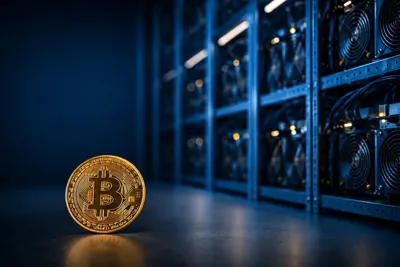

Bitcoin mining once had the appeal of a particularly nerdy side hustle. Plug in a computer, let it solve complicated problems in the background, and potentially earn Bitcoin for the effort.
Those days are largely gone.
In 2026, Bitcoin mining is a highly competitive global industry built around specialized equipment, enormous computing power and access to electricity at prices most homeowners can only dream about. That does not mean mining is disappearing. Quite the opposite. It remains essential to the Bitcoin network. What has changed is the economics of participating in it.
For investors intrigued by advertisements promising effortless Bitcoin income, understanding that distinction has become increasingly important.
What Bitcoin Mining Actually Does
Bitcoin does not have a central bank or company sitting in an office approving transactions. Instead, its network relies on miners to compete to add new blocks of transactions to the blockchain.
Mining uses a system known as proof of work. Specialized computers repeatedly perform calculations in an attempt to produce a valid block. The successful miner—or, more commonly today, a mining pool—can receive newly created Bitcoin along with transaction fees.
The process also helps protect the blockchain from alteration. Bitcoin's own developer documentation explains how mining adds blocks to the blockchain and how mining pools divide proceeds among participating miners.
That makes mining an important piece of Bitcoin's infrastructure. It does not, however, make every mining opportunity a good investment.
The Home Mining Era Has Changed
Early Bitcoin enthusiasts could mine using ordinary computers. As competition increased, miners moved first to more powerful graphics processors and eventually to ASICs, or application-specific integrated circuits, designed specifically for cryptocurrency mining.
The difference is substantial.
A serious Bitcoin mining operation today may contain thousands of machines running around the clock inside facilities designed around power delivery, ventilation, cooling and equipment maintenance.
A homeowner can technically purchase an ASIC miner and operate it at home. Whether that makes financial sense is another question.
Hardware cost is only the beginning. Electricity, cooling, noise, maintenance, mining difficulty and the market price of Bitcoin all influence whether the machine ultimately produces a profit.
And these are not quiet little computers tucked discreetly beneath a desk. High-performance mining equipment can produce considerable heat and noise, turning the idea of a sophisticated home Bitcoin operation into something considerably less glamorous.
Electricity Can Make or Break the Math
Electricity is one of the defining expenses of Bitcoin mining.
That helps explain why major mining companies pay close attention to where their facilities are located. Access to inexpensive power can dramatically change the economics of an operation.
The Cambridge Bitcoin Electricity Consumption Index tracks Bitcoin's estimated electricity demand and mining-hardware efficiency, illustrating the scale of computing resources now competing across the network.
For an individual considering mining, the important number is not simply how much Bitcoin a machine might produce. It is how much Bitcoin remains after the electricity bill, equipment cost, pool fees and other operating expenses are deducted.
A mining calculator can make profitability look attractive when Bitcoin prices are rising. Change the electricity rate, mining difficulty or Bitcoin price, however, and the calculation can look very different.
Mining Pools Changed the Game
Solo mining still exists, but the probability of an individual miner successfully discovering a Bitcoin block can be extremely small.
Mining pools address the problem by combining the computing power of many miners. When the pool successfully mines a block, participating miners receive a portion of the proceeds according to the pool's payment structure and the computational work they contributed.
The arrangement can produce smaller, more frequent payouts rather than forcing a miner to depend upon the remote possibility of finding an entire block alone.
But joining a pool does not eliminate the underlying economics. Hardware still depreciates. Electricity still costs money. Mining difficulty can change. Bitcoin's price remains volatile.
Pooling computing power changes how rewards are distributed. It does not turn mining into guaranteed income.
Be Especially Careful With Cloud Mining
This is where investors should pay particularly close attention.
Cloud-mining companies generally market contracts that allow customers to purchase or rent mining power without personally owning and operating the equipment. The pitch is understandably attractive. No noisy machines, electrical work or cooling system—just an account supposedly generating cryptocurrency.
The problem is that the customer may have considerably less visibility into the actual mining operation.
Before sending money, investors should understand exactly who operates the facility, where it is located, what equipment exists, how fees are calculated, whether withdrawals have restrictions and what happens if mining becomes unprofitable.
Advertisements promising unusually high daily returns, guaranteed profits, large signup bonuses or essentially risk-free passive income deserve particular scrutiny.
There is a considerable difference between owning mining hardware whose economics you can calculate and transferring money to an online company because a website displays a rapidly increasing earnings counter.
Buying Bitcoin and Mining Bitcoin Are Different Bets
Someone who believes Bitcoin will rise in value does not necessarily need to become a miner.
Buying Bitcoin is primarily an investment in the future price of the asset. Mining introduces an entirely different collection of variables, including equipment costs, electricity prices, machine efficiency, maintenance, network competition and operational expertise.
For some sophisticated operators, those additional variables create opportunity. For the average investor, they create additional ways for the investment thesis to go wrong.
This distinction is particularly relevant as cryptocurrency becomes more intertwined with mainstream luxury commerce. As we explored in FINE Magazine's article on why luxury brands are becoming more open to crypto payments, digital assets are finding increasingly practical uses beyond speculation alone.
Mining is only one part of that much larger ecosystem.
So Is Bitcoin Mining Worth It in 2026?
For professional operators with efficient hardware, favorable electricity contracts, sufficient scale and experienced management, Bitcoin mining can still be a viable business.
For someone considering putting a miner in the spare bedroom, the hurdle is considerably higher.
The better question may not be whether Bitcoin mining is profitable in general, but whether your particular mining operation can remain profitable after every expense is included.
That calculation should include the purchase price of the equipment, electricity, cooling, pool fees, maintenance, downtime and the declining value of hardware that becomes less competitive as newer machines arrive.
It should also leave room for something cryptocurrency has repeatedly demonstrated it can deliver exceptionally well: unpredictability.
Bitcoin mining has evolved from an experimental hobby into serious digital infrastructure. Investors interested in participating should approach it accordingly—not as effortless passive income, but as a capital-intensive business whose returns depend on technology, energy costs and a famously volatile asset.
Post a comment as Guest
Report
Watch this discussion.
(0) comments
We welcome your comments
Log In
Post a comment as Guest
Keep it Clean. Please avoid obscene, vulgar, lewd, racist or sexually-oriented language.
PLEASE TURN OFF YOUR CAPS LOCK.
Don't Threaten. Threats of harming another person will not be tolerated.
Be Truthful. Don't knowingly lie about anyone or anything.
Be Nice. No racism, sexism or any sort of -ism that is degrading to another person.
Be Proactive. Use the 'Report' link on each comment to let us know of abusive posts.
Share with Us. We'd love to hear eyewitness accounts, the history behind an article.