
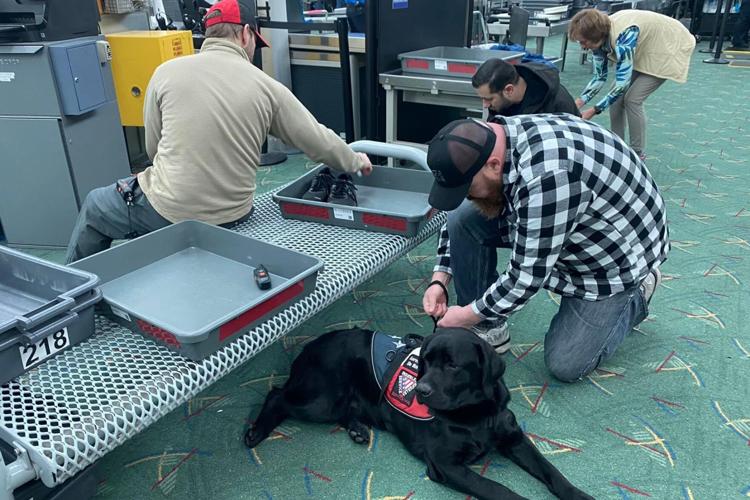
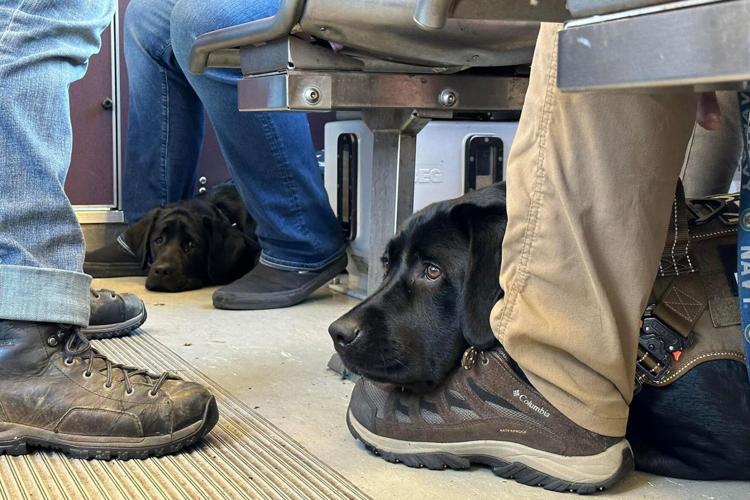
Public spaces can be uniquely demanding for Veterans living with PTSD, and airports are among the most demanding environments a handler and service dog will navigate together. Crowds, security checkpoints, gate changes, long waits, and tight cabin spaces test the bond and the training behind every team.
For Veterans paired with a professionally trained PTSD service dog through Northwest Battle Buddies (NWBB), the goal is to make travel possible and predictable through preparation, federal protections, and a training process designed for real-world public access.
Here is what Veterans and their families should know before traveling with a service dog by air.

What Qualifies as a Service Dog Under Federal Law
The Air Carrier Access Act (ACAA) defines a service animal on U.S. flights as "a dog, regardless of breed or type, that's individually trained to do work or perform tasks for the benefit of a qualified individual with a disability." That definition explicitly includes psychiatric disabilities, which is the legal basis for Veterans with PTSD to fly with their service dogs.
The law also draws clear lines around what doesn't qualify as a service dog. Emotional support animals, comfort animals, companionship animals, animals other than dogs, and service animals still in training aren't recognized as service animals under the ACAA. Knowing the distinction matters at the gate.
Documentation to Have Ready Before You Fly
The U.S. Department of Transportation permits airlines to require specific paperwork before a flight. Veterans flying with a service dog should be prepared to submit:
- A DOT form attesting to the dog's health, behavior, and training.
- A second DOT form attesting that the dog can either refrain from relieving itself in the cabin or do so in a sanitary way. This second form applies only to flights of eight hours or longer.
Beyond these two forms, airlines cannot require additional documentation from service dog handlers, except where a federal agency, U.S. territory, or foreign government has its own transport requirements.
Pro tip: Submit forms early. Many carriers require them 48 hours before departure, and missing paperwork is one of the few legal reasons a carrier can deny boarding to a service dog team.

What to Expect When Traveling with a Service Dog
Federal rules give service dog teams clear protections and clear responsibilities. If a service dog needs to relieve itself in the terminal, handlers can ask any airport or airline staff member to point them to the nearest service animal relief area.
Once you’re onboard the aircraft:
- The dog must be allowed to ride in the floor space directly in front of the handler's seat.
- Small service dogs may be permitted on the handler's lap when it is safe to do so.
- The dog can't occupy any space that needs to stay clear for safety, including aisles or paths to emergency exits.
- Airlines aren't obligated to move handlers into a different class of service to make room for a service dog.
- Discomfort from other passengers or crew isn't a valid reason to refuse a service dog.
The dog must also behave appropriately throughout the flight. A dog that barks, snarls, runs around, or jumps on other passengers without provocation can lose its recognition as a service animal.
Airlines can also refuse transport when a dog presents a direct safety threat, causes significant disruption in the cabin or at the gate, or fails to meet health requirements for the destination.
If something goes wrong, you can ask to speak with a Complaints Resolution Official (CRO). Every airline must keep a CRO available at no charge, either in person at the airport or by phone during operating hours, to handle disability accommodation issues on the spot.
How NWBB Prepares Veterans for the Airport
Travel readiness is built into the NWBB training process. Veterans paired with a NWBB service dog complete public access training at Portland International Airport (PDX), where they practice moving through terminal corridors, security screening areas, escalators, and gate environments with their service dog. The goal is for both handler and dog to be confident in one of the most demanding public settings a team will encounter.
This kind of exposure is part of why NWBB service dogs perform reliably across public access settings. Each dog completes roughly five months of professional training, followed by another five weeks of training alongside their Veteran handler.
Public access work is what allows teams to move through the world, including airports, and it supports the broader social participation that service dogs make possible for Veterans with PTSD.
Considerations for International Travel with a Service Dog
Traveling with a service dog outside the United States adds another layer of planning. When a U.S. airline flies to another country, it has to follow that country's rules on service animals, and not every country accepts service dogs from abroad.
Before booking an international trip, verify in advance whether your destination country allows your service dog to enter and what entry and exit requirements apply.
The USDA APHIS Pet Travel website is the best starting point for country-specific rules, including required vaccinations, health certificates, microchipping standards, and quarantine windows.
Some countries require months of advance preparation, so begin the research as early as possible and confirm the latest requirements directly with the destination country's embassy.
Key Points:
- Know the legal definition. Under the Air Carrier Access Act, only dogs individually trained to perform a task for a disability, including psychiatric disabilities like PTSD, count as service animals. Emotional support animals, comfort animals, or dogs still in training don't qualify, and that distinction matters at the gate.
- Get the paperwork sorted early. Airlines can require two DOT forms - one on the dog's health, behaviour, and training, and a second (for flights of eight hours or more) confirming the dog can either hold it or relieve itself sanitarily. Most carriers want these 48 hours ahead of departure, and missing forms is one of the few valid reasons a team can be denied boarding.
- Understand your in-flight rights and responsibilities. The dog must be allowed to sit in the floor space in front of the handler (or on their lap if small and safe), can't block aisles or emergency exits, and other passengers' discomfort isn't grounds for refusal, but the dog also has to behave, and disruptive conduct can cost it its service animal status for that flight.
- Use the Complaints Resolution Official if something goes wrong. Every airline must have a CRO available, in person or by phone, specifically to resolve disability accommodation issues on the spot.
- International travel needs extra lead time. Airlines have to follow the destination country's rules, not every country accepts incoming service dogs, and requirements (vaccinations, health certificates, microchipping, quarantine) should be checked via USDA APHIS and the destination's embassy well in advance.
About: Northwest Battle Buddies (NWBB) is a nonprofit founded in 2012 by Shannon Walker to pair Veterans managing PTSD with professionally trained service dogs, completely free of charge. Based in Battle Ground, Washington, NWBB's dogs undergo more than 360 hours of training to interrupt anxiety attacks, alert on adrenaline spikes, wake veterans from nightmares, and act as a social buffer in public, followed by five weeks of bonding and handler training before certification. NWBB continues to support each Veteran-dog team for life through liaison services, refresher training, and community engagement.
Post a comment as Guest
Report
Watch this discussion.
(0) comments
We welcome your comments
Log In
Post a comment as Guest
Keep it Clean. Please avoid obscene, vulgar, lewd, racist or sexually-oriented language.
PLEASE TURN OFF YOUR CAPS LOCK.
Don't Threaten. Threats of harming another person will not be tolerated.
Be Truthful. Don't knowingly lie about anyone or anything.
Be Nice. No racism, sexism or any sort of -ism that is degrading to another person.
Be Proactive. Use the 'Report' link on each comment to let us know of abusive posts.
Share with Us. We'd love to hear eyewitness accounts, the history behind an article.