
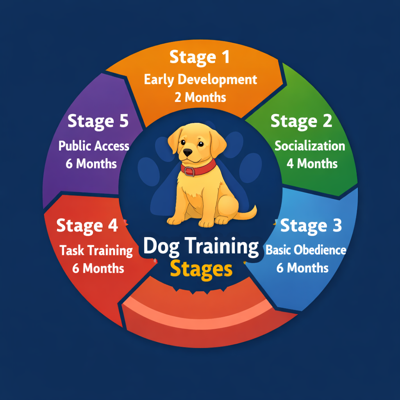
Bringing a service dog for autism into one’s family is undoubtedly an important moment, although many families realize that training these incredible animals is not done in just several months. Training such a reliable and safe service dog involves a well-thought-out process and usually takes from 18 to 24 months.
Organizations like https://pawswithacause.org/ demonstrate how structured, professional training prepares candidate dogs for lifelong support partnerships.
Why Autism Service Dog Training Takes So Long
Service dogs operate within sensory intensive surroundings and environments that are uncertain, whether it be crowded hallways at schools or crowded airports. In contrast to common pets, an autism service dog should maintain total control in the face of loud sounds, dropped food, and breakdowns in behavior.
Developing such reliability takes time. Positive reinforcement, reward-based training, and desensitization through a period of several months are employed by trainers. This will ensure that the dog remains confident and able to perform emergency safety procedures upon command, even in very distracting environments.
The 18–24 Month Autism Service Dog Training Timeline

Stage 1 (0–8 Weeks): Early Development
Professional breeding programs focus on early neurological stimulation and gentle handling. Health screenings begin here to ensure working candidates have sound eyes, hearts, and joints.
Stage 2 (8 Weeks–6 Months): Socialization
Puppy raisers introduce candidates to diverse environments using gentle, positive exposures.
- Navigating slick floors, stairs, and elevators
- Encountering sirens, vacuum cleaners, and crowds
- Interacting appropriately with children and animals
- Building core confidence through low-stress exploration
Stage 3 (6–12 Months): Basic Obedience
The young dog moves into structured obedience instruction:
- Flawless recall under distraction
- Loose-leash walking alongside strollers or wheelchairs
- Reliable impulse control around dropped food or toys
- Instant response to core commands (sit, stay, down, place)
Stage 4 (12–18 Months): Advanced Service Dog Skills
Trainers introduce specialized skills tailored to autism support needs:
- Deep Pressure Therapy (DPT): Resting their weight on a handler's lap or chest to soothe sensory overload.
- Elopement Prevention & Tethering: Acting as a physical anchor to prevent a child from wandering into traffic.
- Behavior Interruption: Gently nudging a handler to stop repetitive self-harming behaviors.
- Tension Sensing: Recognizing early physiological signs of anxiety before a full meltdown occurs.
Stage 5 (18–24 Months): Public Access Training
The candidates use their abilities in real-life situations, for instance, in restaurants, schools, and transit points. The dog demonstrates that it can disregard the ambient sounds, maintain control, and perform tasks when called upon.
Sample Training Timeline
Age | Main Focus | Primary Objectives |
|---|---|---|
0–2 Months | Early Development | Health checks, gentle handling, early stimulation |
2–6 Months | Socialization | Environmental exposure, sound conditioning, basic manners |
6–12 Months | Basic Obedience | Precision leash work, impulse control, reliable recall |
12–18 Months | Autism-Specific Tasks | Deep pressure therapy, behavior interruption, tethering |
18–24 Months | Public Access | Real-world testing, airport/school readiness, team matching |
Factors That Affect Training Duration
Not every dog develops at the same speed. Several variables influence final placement timelines:
- Individual Temperament: Sensitive dogs may require extra time to build public access confidence.
- Task Complexity: Teaching multi-step safety tasks requires longer conditioning than single-action commands.
- Public Access Readiness: A dog that excels at home might still need months to stay calm near heavy traffic or loud crowds.
- Health and Growth: Young working dogs must reach physical maturity before taking on physical tethering or bracing work.
Why Professional Training Matters
Training of a service dog requires specific knowledge of canine behavior, task shaping, and legislation on public safety. Non-profit organizations and professional agencies follow the standards established by the Assistance Dogs International (ADI).
With well-organized programs such as those organized by pawswithacause.org, the candidate dogs have to undergo frequent health tests and temperament evaluations. This ensures that there is no career burnout and that the placed candidates are ready for the job.
What Happens After Placement?
When a dog completes its 18–24-month preparation, the focus shifts to the family.
- Handler Training: Caregivers learn command structures, task cues, and public access laws.
- Home Integration: Trainers supervise early bonding to integrate the dog into daily routines smoothly.
- Ongoing Practice: Families run daily maintenance drills so the dog keeps its skills sharp.
- Annual Evaluations: Programs offer re-certification testing to maintain safety standards over the dog's working life.
Frequently Asked Questions
Is it possible to train the dog in one year?
Not really. Although simple obedience may be achieved within one year, physical maturation, mental stability, and advanced autism-related jobs take the full 18 to 24 months.
Is it possible for owners to train the autism service dog?
While owner-training is legal in many places, the dogs have a very high release rate because of difficult behavioral problems. Training in collaboration with a professional trainer is highly advised.
What will happen if the dog doesn’t make it?
The dogs that are released from the service programs for minor anxiety or low drive are usually re-homed as pets or therapy dogs for facilities.
While the 18 to 24-month process may seem long to families seeking assistance, each stage is crucial for ensuring that both the dog and the handler are safe. This initial investment of time ensures a sturdy companion with confidence who can lead an autistic child through a loud environment.
Post a comment as Guest
Report
Watch this discussion.
(0) comments
We welcome your comments
Log In
Post a comment as Guest
Keep it Clean. Please avoid obscene, vulgar, lewd, racist or sexually-oriented language.
PLEASE TURN OFF YOUR CAPS LOCK.
Don't Threaten. Threats of harming another person will not be tolerated.
Be Truthful. Don't knowingly lie about anyone or anything.
Be Nice. No racism, sexism or any sort of -ism that is degrading to another person.
Be Proactive. Use the 'Report' link on each comment to let us know of abusive posts.
Share with Us. We'd love to hear eyewitness accounts, the history behind an article.