
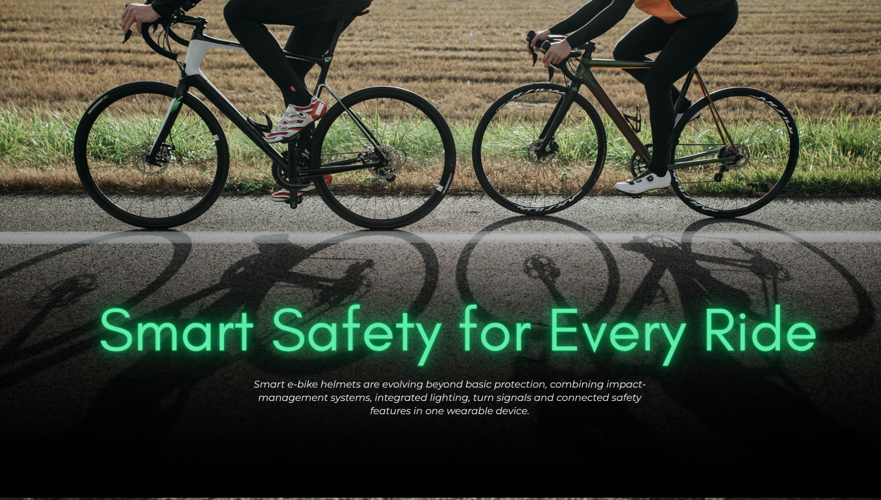

As electric bicycles continue to redefine urban transit and modern leisure, our daily commuting habits are undergoing a quiet revolution.
E-bikes allow riders to travel farther, faster, and across more varied terrain with minimal effort. Yet, while e-bike motor technology, frame design, and battery efficiency have advanced by leaps and bounds, personal safety gear has spent years attempting to catch up.
Riding an e-bike at speeds easily exceeding 20 miles per hour in dense city traffic presents safety challenges that traditional foam-and-plastic helmets were simply never engineered to handle.
Fortunately, a new generation of headwear has emerged, bridging the gap between passive impact protection and active safety technology.
Today’s smart e-bike helmets are no longer just styrofoam shells with a chin strap; they are sophisticated, connected safety hubs designed to prevent accidents before they happen and summon help if the worst occurs.
Why traditional helmets are no longer enough
To understand the rise of smart helmets, one must first look at how e-bikes alter the dynamics of riding.
On a standard commuter bicycle, average speeds hover around 10 to 12 mph. On an e-bike, riders routinely maintain speeds between 18 and 28 mph, often merging seamlessly into vehicular lanes and navigating complex intersections alongside multi-ton automobiles.
This shift creates two distinct challenges:
- Higher impact energy: Kinetic energy increases exponentially with speed. A fall at 22 mph delivers significantly more force than a spill at 10 mph.
- Speed-disparity & Visibility issues: Drivers are notoriously poor at estimating the speed of approaching bicycles. When an e-bike approaches an intersection faster than expected, drivers making left turns or opening car doors often fail to notice them in time.
To address these modern realities, helmet design required a complete rethink and combining heavy-duty impact engineering with proactive digital features.
1. MIPS and Next-gen structural safety
At the foundation of any helmet is mechanical impact absorption.

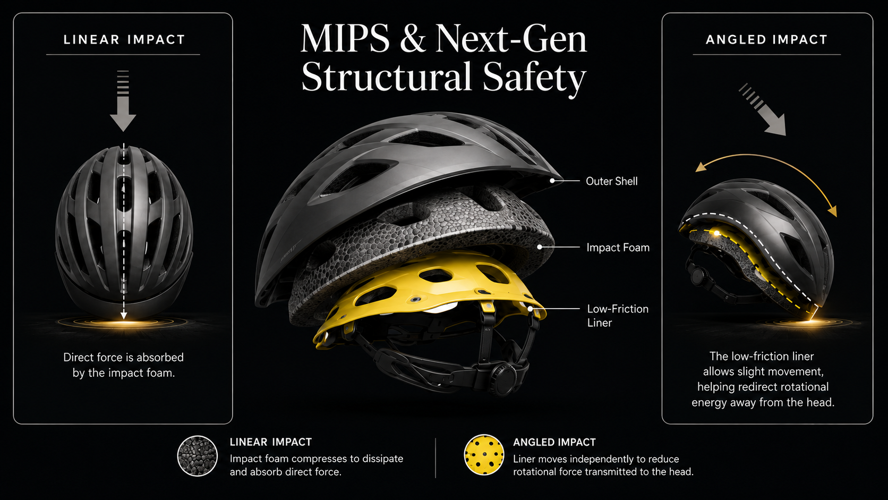
For decades, safety testing focused almost exclusively on direct, linear impacts, dropping a helmet straight down onto a flat surface.
However, real-world cycling crashes rarely happen at a perfect 90-degree angle.
Most falls involve an angled impact where the rider’s head strikes the pavement while moving forward, causing a rapid rotation of the skull and brain. This rotational force is a leading cause of severe traumatic brain injuries and concussions.
Enter MIPS (Multi-directional Impact Protection System). MIPS integrates a low-friction layer inside the helmet structure, allowing the outer shell to slide 10 to 15 millimeters relative to the head during an angled impact. This brief rotation redirects hazardous energy away from the brain.
Leading tech-forward brands have taken this a step further by pairing MIPS technology with specialized e-bike certifications.
Standard bicycle helmets are tested under the EN 1078 or CPSC guidelines.
Higher-speed e-bike helmets, however, seek compliance with rigorous standards such as NTA 8776; the Dutch speed-pedelec standard designed specifically for higher impact speeds and providing greater coverage around the temporal and occipital regions of the head.
2. Active Safety: 360-degree lighting and turn signals
While MIPS handles passive safety (mitigating damage during a crash), smart helmets prioritize active safety, preventing the crash from happening in the first place.
Traditional bike lights are often mounted low on the frame or handlebars, where they can be blocked by parked cars, street furniture, or other cyclists.
By placing lighting at eye level on the rider's head, smart helmets dramatically increase a cyclist’s visual footprint in traffic.
Leading models incorporate expansive 360-degree light bars that blend effortlessly into the helmet's design. Rather than projecting a harsh, pinpoint glare, these diffuse light panels make the rider visible from hundreds of feet away, regardless of light conditions or weather.
Furthermore, modern smart helmets tackle the age-old dilemma of hand signals. Taking a hand off the handlebars to signal a turn on a fast-moving e-bike; especially on uneven pavement or in wet conditions can compromise stability.
Through wireless, handlebar-mounted remotes, riders can actuate bright, turn-signal indicators directly on the back and sides of their helmet without loosening their grip.
Integrated accelerometers even detect rapid deceleration, automatically triggering bright brake lights when you slow down to alert traffic behind you.
3. Onboard crash alerts and emergency SOS
What happens when an accident is unavoidable? This is where connectivity turns a helmet into a literal lifesaver.
Equipped with onboard tri-axial accelerometers and gyroscopes, smart e-bike helmets can continuously monitor motion parameters.
In the event of a severe fall or hard impact, the sensor array detects the sudden deceleration followed by a lack of movement.
Hard Impact Detected ➔ App Initiates Safety Countdown ➔ No Response from Rider ➔ [Emergency SOS Sent with Live GPS Coordinates
If the rider does not dismiss the alert within a designated grace period (preventing false alarms when a helmet is accidentally dropped), the companion smartphone app automatically transmits an emergency SOS text message.
This message includes the rider's exact GPS coordinates sent directly to pre-selected emergency contacts, ensuring rapid assistance even if the rider is incapacitated on an unlit road or isolated trail.
The Intersection of Style and Innovation: UNIT 1
For years, safety gear suffered from an aesthetic dilemma: protective equipment was often bulky, awkward, or overtly utilitarian, causing many urban commuters to skip wearing it altogether.

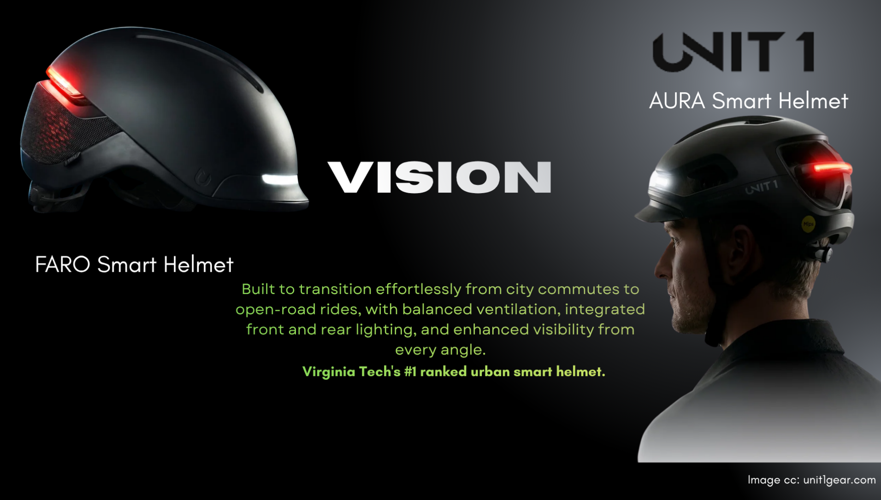
Pushing back against this compromise is UNIT 1 gear, an innovative pioneer in modern urban mobility.
UNIT 1 was founded on a distinct philosophy: that high-tech safety accessories should be as aesthetically refined as they are technologically advanced.
By pairing sleek, award-winning industrial design with Virginia Tech 5-star rated protection, their lineup including models like AURA and FARO has earned accolades like the Red Dot and iF Design Awards.
"The goal was clear to us from the get-go: safety plus style," explains Juan Garcia Mansilla, Co-Founder at UNIT 1. "In other words, creating a smart helmet people will actually want to wear. We set out to bridge the gap between aesthetics and life-saving tech, creating a seamless ecosystem where lighting, crash detection, and rotational impact protection work together to make urban streets fundamentally safer."
By combining certified MIPS protection with NTA-8776 e-bike standards, directional lighting, and instant crash notification, a premium UNIT 1 smart electric bike helmet showcases how modern engineering can elevate the daily ride into a safer, more sophisticated experience.
Summary comparison: Traditional vs. Smart E-Bike helmets
Feature | Standard Bicycle Helmet | Today's Smart E-Bike Helmet |
|---|---|---|
Rotational Impact Tech | Optional / Basic EPS | Integrated MIPS Low-Friction Liner |
E-Bike Certification | EN 1078 / CPSC only | NTA 8776 (Tested for higher speed impacts) |
Visibility | None (Requires clip-on lights) | Built-in 360° diffuse LED light bars |
Signaling | Manual hand signaling | Remote-activated turn signals & auto brake lights |
Emergency Response | None | Automatic crash detection & SOS GPS alerts |
App Connectivity | None | Custom lighting modes, firmware updates, battery monitoring |
The future of modern cycling infrastructure
As cities invest heavily in micro-mobility lanes and green transport corridors, smart helmets represent the personal hardware side of modern traffic management.
By combining visibility, algorithmic sensor tracking, and biomechanical head protection, riders no longer need to choose between sleek high-end design and maximum safety.
For the modern e-bike rider navigating busy cityscapes, investing in a connected smart helmet is one of the smartest upgrades available today.


(0) comments
We welcome your comments
Log In
Post a comment as Guest
Keep it Clean. Please avoid obscene, vulgar, lewd, racist or sexually-oriented language.
PLEASE TURN OFF YOUR CAPS LOCK.
Don't Threaten. Threats of harming another person will not be tolerated.
Be Truthful. Don't knowingly lie about anyone or anything.
Be Nice. No racism, sexism or any sort of -ism that is degrading to another person.
Be Proactive. Use the 'Report' link on each comment to let us know of abusive posts.
Share with Us. We'd love to hear eyewitness accounts, the history behind an article.