

A comfortable home rarely calls attention to the systems maintaining it. The temperature feels right, rooms stay pleasant throughout the day, and the heating or cooling system works quietly in the background. Yet those everyday comforts can come with a significant energy bill, particularly when a home is heated or cooled while nobody is there to enjoy it.
Smart thermostats promise to make temperature control more responsive, using schedules, sensors, and connected technology to reduce unnecessary HVAC operation. But are they genuinely worth the investment? The answer depends less on how sophisticated the thermostat looks and more on how effectively it changes the way a household uses energy.
Do Smart Thermostats Actually Save Money?
The basic principle is straightforward: heating and cooling an empty home to the same temperature as an occupied one often uses energy unnecessarily. A smart thermostat helps address that by adjusting settings according to schedules, occupancy, and sometimes learned household routines. Homeowners can also monitor and change temperatures remotely rather than relying on manual adjustments at the wall.
There is credible evidence that the technology can make a difference. According to ENERGY STAR, certified smart thermostats save an average of approximately 8% on heating and cooling bills, or about $50 annually. That is an average, not a promise for every household. Actual results depend on climate, occupancy, comfort preferences, and the HVAC equipment being controlled.

Where the Energy Savings Come From
Automated scheduling is one of the most useful features. Homeowners can program lower heating settings or higher cooling settings during working hours and overnight, then return to preferred temperatures around the time people arrive home or wake up. The U.S. Department of Energy notes that adjusting a thermostat by 7–10°F for at least eight hours a day can save as much as 10% annually on heating and cooling costs. The actual result will vary, and homeowners with heat pumps should consult their system guidance before using substantial temperature setbacks.
Occupancy detection and remote access make those schedules more flexible. If plans change and the house is empty longer than expected, a thermostat can adjust without someone needing to remember to do it manually. Some systems also use room sensors to identify where people are spending time, helping avoid heating or cooling rooms that are rarely occupied. These features are most valuable when they lead to consistent changes in energy use rather than frequent manual overrides.
Two Premium Smart Thermostats Worth Considering
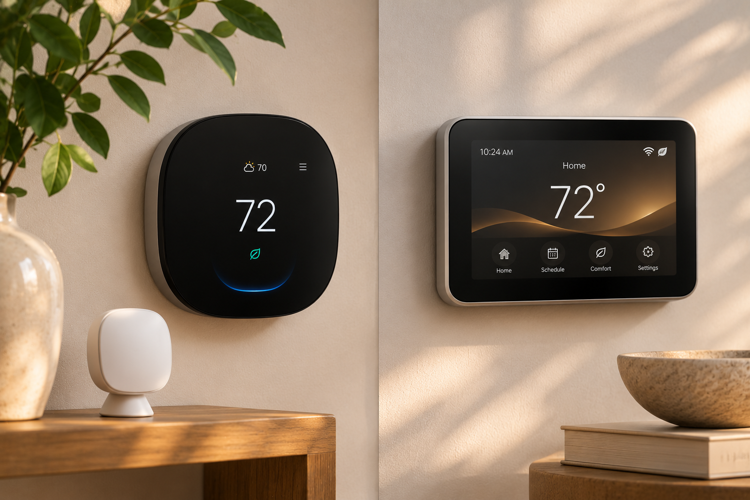
For homeowners who want more than basic scheduling, the ecobee Smart Thermostat Premium combines temperature management with occupancy sensing and indoor air quality monitoring. Its included SmartSensor measures temperature and occupancy in a selected room, helping the system prioritize comfort where it matters. The thermostat also has a built-in air quality monitor, humidity sensing, and eco+ features such as Smart Home & Away and Schedule Assistant. These tools can help reduce unnecessary HVAC operation while making it easier to manage comfort across different rooms.
The Honeywell Home X8S Smart Thermostat takes a different approach, with a prominent five-inch customizable touchscreen and a strong focus on connected-home control. Its radar-based occupancy detection can adjust settings through the Auto-Away feature, while Matter certification and compatibility with Apple Home, Amazon Alexa, and Google Assistant make it suitable for homes with multiple connected devices. It is also ENERGY STAR certified and offers humidity and ventilation controls for indoor air quality, although additional HVAC equipment or accessories may be required for some functions. Optional room sensors can help address temperature differences between spaces.

Are They Worth the Investment?
The financial case starts with the purchase price, installation, and the savings a household can realistically achieve. Ecobee currently lists the Smart Thermostat Premium at $259.99 on its U.S. website, while Honeywell Home directs shoppers to its product and retailer options for X8S pricing. Installation costs vary depending on wiring, HVAC configuration, and whether professional assistance is needed. The X8S requires a C-wire, so homeowners should check their existing setup before purchasing.
A simple payback calculation can help set expectations: divide the total purchase and installation cost by the estimated annual savings. For context, a $50 annual saving would take just over five years to recover a $259.99 purchase price, before installation costs. That is only an illustration using ENERGY STAR’s average figure, not a forecast for either featured model. Before buying, check the ENERGY STAR Rebate Finder and local utility programs. Incentives vary by location, product eligibility, and program rules; the Department of Energy’s Home Energy Rebates Program also offers information about broader qualifying home upgrades.
Smart Climate Control Meets Luxury Design
In a carefully designed home, technology should support the space rather than dominate it. A thermostat is a small detail, but it is often installed in a visible location, making its appearance and interface part of the interior environment. Premium models increasingly reflect that consideration through larger touchscreens, customizable displays, refined finishes, and controls that integrate with existing smart-home systems.
The ecobee Premium’s compact square display and zinc-alloy frame offer a restrained contemporary look, while the Honeywell Home X8S provides a larger screen with customizable colors and themes. Both can be managed remotely, reducing the need to interact with the wall-mounted device throughout the day. For homeowners planning a connected renovation, climate controls can also be considered alongside lighting, shades, and other automation. FINE’s coverage of smart home automation upgrades homeowners actually want explores how these systems can work together.
When a Smart Thermostat May Not Save Much
A smart thermostat cannot compensate for an inefficient heating or cooling system, poor insulation, leaky ducts, or windows that allow significant heat transfer. If the existing thermostat is already programmed carefully and household routines rarely change, the additional savings may be modest. Similarly, a home with minimal heating and cooling demand may take longer to recover the cost of a premium device.
Compatibility matters just as much as features. Not every thermostat works with every HVAC system, and some functions require specific wiring, sensors, or additional equipment. Placement can also influence performance: a thermostat exposed to direct sunlight, drafts, or heat from appliances may read the room inaccurately. Homeowners can review FINE’s practical guide to where to put a thermostat in the house before installation. Ultimately, the best investment is one that matches the home’s equipment and the household’s actual routines.
The FINE Take
Smart thermostats can make a home more comfortable and energy-conscious, but their value is not measured by features alone. The strongest return comes when thoughtful scheduling, accurate sensing, suitable HVAC equipment, and sensible energy habits work together. For homeowners who want greater control over their indoor environment, a premium thermostat can be a worthwhile upgrade provided the expected benefits justify the cost.

(0) comments
We welcome your comments
Log In
Post a comment as Guest
Keep it Clean. Please avoid obscene, vulgar, lewd, racist or sexually-oriented language.
PLEASE TURN OFF YOUR CAPS LOCK.
Don't Threaten. Threats of harming another person will not be tolerated.
Be Truthful. Don't knowingly lie about anyone or anything.
Be Nice. No racism, sexism or any sort of -ism that is degrading to another person.
Be Proactive. Use the 'Report' link on each comment to let us know of abusive posts.
Share with Us. We'd love to hear eyewitness accounts, the history behind an article.