
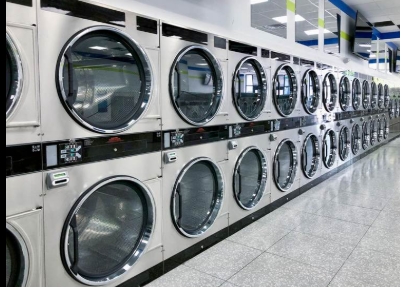
There’s a lot to consider when upgrading the equipment in your professional laundry room. As such, it’s all too easy to get things wrong, opting for appliances that fail to meet your short- and long-term needs.
From opting for smart features over perfect-fit appliances to failing to check efficiency ratings – many businesses are guilty of a few common mistakes when investing in new on-site laundry equipment. This post will explore what people get wrong the most, along with the key things to focus on and prioritise instead.
Mistake #1: Not considering capacity
Capacity is without question one of the most important factors in choosing commercial laundry equipment. Fail to consider your average per-day laundry volumes, and you could easily opt for an appliance that doesn’t meet your short- and long-term needs.
Of course, calculating your average laundry capacity can be quite challenging, and it differs broadly depending on the sector and the type of business. Care homes, hospitals, and hotels, for instance, will generally have significantly higher laundry demands than, say, a restaurant or bar, so you need to get a handle on your unique requirements.
Happily, there are a few useful means of calculating average capacity before purchasing new laundry equipment. Here are some suggestions that may help:
- Manually track your average laundry volumes: It’s worth keeping a manual record of your average laundry needs for at least a couple of weeks before purchasing new laundry equipment. That way you’ll have a good idea of your current throughput.
- Rely on auditing and monitoring programmes: It may be the case that your existing laundry equipment is equipped with in-built cycle monitoring, so this data will provide invaluable insight into current volumes. Alternatively, it’s possible to tap into energy consumption from your smart meter to track when and how often laundry appliances are used, providing a solid indicator of average daily usage.
- Take a look online for industry averages: Chances are that you’re not the first business owner or laundry manager to go looking for average laundry volumes for your industry on the web. This can be a powerful way to benchmark your average capacity needs, although you should still consider your own requirements carefully.
Tied into the mistake of not considering laundry capacity is the failure to plan for future volume. Your laundry room should have some headroom to accommodate higher long-term throughput, particularly if your business is growing or is subject to seasonal peaks and troughs in demand.
Generally, it’s recommended to opt for commercial laundry equipment that offers a higher capacity than your average day-to-day volumes. That way, you’ll have the scope to scale up and adapt to future demand, without the need for another costly and disruptive upgrade.
Mistake #2: Neglecting installation requirements
From washing machines and tumble dryers to industrial-grade ironing and finishing equipment – lots of appliances make up a commercial laundry suite, each with its own unique installation, venting, servicing, and maintenance requirements.
There are a surprising number of factors to consider to achieve the successful deployment of new laundry equipment. For instance, you’ll need an electrical supply that’s rated for the number of appliances in use, along with water connections, drainage, and ventilation routes. A gas service line may even be required for some equipment, further complicating the installation process.
It’s all too easy to overlook these requirements, opting for machines that, while good on paper, may not be compatible with your existing infrastructure and services. This ultimately leads to unnecessary time, money, and expense, compounded further by extended periods of disruption and downtime that could impact your bottom line.
Given the importance of efficient, fast, and safe laundry equipment installation, you should always opt for professional installation where possible. Indeed, it’s recommended to consult with a commercial laundry expert before purchasing any equipment, if only to ensure optimal compatibility.
Mistake #3: Choosing imperfect-fit equipment
It’s easy to get distracted by the spec sheet of laundry appliances, becoming blindsided by nice-to-have features and clever functionalities. However, there’s one critical thing you should consider above anything else when selecting new laundry equipment, and that’s the available space in your laundry room.
Sure, that bells-and-whistles washing machine that you’ve had your eye on may offer some fantastic features and programs, but that doesn’t mean it’s the right fit for your laundry room. Available floor space is essential when designing the layout of your professional laundry suite, and can hold significant sway over the long-term performance, safety, and efficiency of your on-site laundry operations.
A well-designed laundry room comprising perfect-fit equipment can be a real game-changer. It means you’re getting optimal capacity and volume from the space you have available, while also making life simpler – and safer – for your staff and stakeholders.
Even if a new washing machine or tumble dryer fits in your space, it doesn’t necessarily mean it’s the right fit. You should consider all the options carefully to set up your laundry room in the optimal way, perhaps even opting for stackable options and tower combinations if they’re the best fit for your space.
Of course, this is another reason to consult with a laundry expert before upgrading your equipment, who will be able to advise on the appliances that optimise your space to the fullest.
Mistake #4: Failing to check efficiency ratings
The energy efficiency ratings of different commercial laundry appliances vary significantly, with superior ratings often associated with higher-priced units. It’s easy to overlook energy ratings when selecting different laundry equipment, particularly when you have factors like capacity and features to consider, too.
Neglect to consider a machine’s overall efficiency, however, and you could be missing out on long-term cost savings that help offset the day-to-day running costs of your appliance. Note, too, that there are also certain compliance-related requirements associated with commercial laundry equipment, and these can vary by industry and sector.
Of course, there’s also the potential ESG impact to consider. Your customers, clients, residents, and other key stakeholders may want to see your business making responsible choices when it comes to on-site equipment upgrades, so opting for appliances with high efficiency ratings is a means of upholding your philosophy and ethos.
Mistake #5: Not exploring all the finance options
Upgrading commercial laundry equipment can be a costly endeavour, particularly when you factor in upfront costs and the potential downtime and disruption caused by your laundry room being out of action. However, it needn’t be the bank-breaking undertaking that you’ve envisioned, especially if you take the time to weigh up all the various finance options available.
In 2026, there’s no longer any need to put yourself on the financial backfoot simply to upgrade business-critical equipment. Laundry equipment suppliers often offer flexible financing solutions that mitigate any imposing upfront costs, replacing them with a more budget-friendly monthly payment plan.
Indeed, these plans often extend beyond simple financing and procurement, including things like equipment installation, servicing, maintenance, and on-demand repair costs. This removes any of the financial burden and stress associated with operating professional laundry equipment, so you needn’t worry about unexpected costs and budgeting constraints.
So, there you have it: five mistakes that many businesses get wrong when selecting new commercial laundry equipment. We hope this guide helps you to think differently about your on-site upgrades – it’s sound advice that could apply to different sectors and industries, too.


(0) comments
We welcome your comments
Log In
Post a comment as Guest
Keep it Clean. Please avoid obscene, vulgar, lewd, racist or sexually-oriented language.
PLEASE TURN OFF YOUR CAPS LOCK.
Don't Threaten. Threats of harming another person will not be tolerated.
Be Truthful. Don't knowingly lie about anyone or anything.
Be Nice. No racism, sexism or any sort of -ism that is degrading to another person.
Be Proactive. Use the 'Report' link on each comment to let us know of abusive posts.
Share with Us. We'd love to hear eyewitness accounts, the history behind an article.