
For years, retinol was the ingredient everyone was told to use if they wanted smoother, firmer, younger-looking skin. It earned that reputation. But beauty rarely stands still, and the newest generation of skincare is moving beyond the idea that one heroic active should do all the work.
Now the labels are getting more interesting.
Peptides are being pushed to center stage. EGF is moving from aesthetic-clinic conversations into at-home formulas. PDRN has gone from virtually unknown outside professional skincare circles to one of the buzziest acronyms in beauty. Even toner, once the forgettable bottle between cleanser and serum, is suddenly behaving like a treatment.
None of this means retinol is obsolete. It does mean the modern skincare routine is becoming more layered, more sophisticated, and frankly, more fun.
Toner Has Had a Serious Upgrade
Anyone who used toner in the 1990s probably remembers one thing about it: the sting.
Today’s formulas can be almost unrecognizable by comparison.
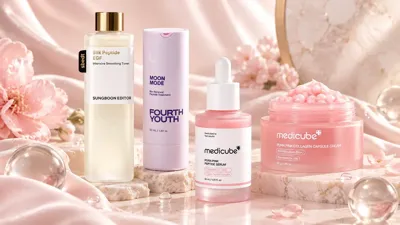
SUNGBOON EDITOR Silk Peptide EGF Intensive Smoothing Toner is a good example of how far the category has moved. Instead of simply removing whatever cleanser may have missed, this formula combines silk-derived ingredients, peptides, EGF and ceramide capsules in a step designed to prep and treat the skin before serum even enters the picture.
That makes toner feel less like cleanup and more like the opening move.
EGF, or epidermal growth factor, is particularly interesting because growth factors play a role in cellular communication. In skincare, topical growth-factor formulations have been studied for visible improvements in areas such as texture and fine lines, although formulations vary widely and the research is still developing.
The takeaway is not that EGF has replaced everything in your bathroom. It is that toner is no longer necessarily the boring part of the routine.
Peptides Are Having Their Main-Character Moment
Peptides have been around long enough that they are no longer truly new, but beauty brands are using them differently.
Rather than quietly burying them in a moisturizer, more products are making peptides the point.
Moon Mode Bio-Renewal Peptide Treatment does exactly that. The overnight treatment pairs peptide complexes and copper peptides with bakuchiol, tranexamic acid, niacinamide, kojic acid, hyaluronic-acid ingredients and squalane.
It sounds like a crowded guest list, but the concept is appealing: instead of going all-in on one aggressive active, the formula takes a more multi-pronged approach to tone, texture, hydration and the appearance of aging skin.
That reflects a larger shift happening in beauty. The smartest routines are becoming less about seeing how many powerful ingredients can be stacked together and more about finding combinations the skin can actually tolerate long enough to use consistently.
Because a product can have the most impressive ingredient list in the world and still be useless if it spends most of its life untouched on the bathroom shelf.
PDRN Is the Acronym Beauty Cannot Stop Talking About
Then there is PDRN.
Six months ago, plenty of beauty consumers would have had no idea what those four letters meant. Now they seem to be appearing everywhere.
PDRN stands for polydeoxyribonucleotide, a collection of DNA fragments that has attracted attention in regenerative medicine and dermatology. A large portion of the research involves professional or medical applications, which is important because those results should not automatically be transferred to a serum sitting on a vanity.
That has not slowed the beauty world down.
Medicube PDRN Pink Peptide Serum combines salmon-derived PDRN with peptides and niacinamide in a lightweight pink serum designed around radiance, elasticity and uneven-looking tone.
Part of PDRN's appeal is undoubtedly its connection to aesthetic medicine. Consumers are increasingly fascinated by skincare ingredients that sound as though they belong in a treatment room rather than a department-store beauty counter.
But this is also where separating excitement from evidence matters.
PDRN is promising. It is interesting. It is worth watching. It is not a license to believe every extraordinary before-and-after claim circulating online.
That distinction may be less glamorous, but good skincare has never really been about chasing the loudest promise.
Even Moisturizer Is Becoming Customizable
Medicube carries the same idea into its PDRN Pink Collagen Capsule Cream, and this may be the product in the group that feels most immediately futuristic.
Open the jar and it does not look like a conventional cream. Pink capsules sit suspended within a clear gel, and the two textures are blended together before application.
The interesting part is that the ratio can be adjusted.
Want something lighter? Use more gel. Want a richer finish? Blend in more of the capsules.
That kind of flexibility feels particularly relevant because skin does not behave the same way every day. A moisturizer that feels perfect after a long flight may feel excessive in humid weather. Skin that suddenly feels dry after actives may want more cushioning than it did the night before.
Luxury has always been partly about customization. Skincare appears to be catching up.
A Routine Does Not Need to Become a Chemistry Experiment
Put these products together and they tell a clear story about where skincare is headed.
The SUNGBOON EDITOR toner begins the routine with hydration, peptides and EGF. Moon Mode takes peptides into a more concentrated evening treatment. Medicube PDRN Pink Peptide Serum introduces PDRN and niacinamide, while the PDRN Pink Collagen Capsule Cream finishes with adjustable hydration.
That does not mean all four need to be layered together every night.
In fact, one of the smartest things anyone can do with sophisticated skincare is resist the urge to use everything at once.
Introduce products gradually. Pay attention to how your skin responds. Give a formula enough time to determine whether it deserves permanent real estate on the bathroom counter.
And during the day, sunscreen still outranks every fashionable acronym currently trending on social media.
So What Really Comes After Retinol?
Probably not one ingredient.
That may be the biggest change of all.
Retinoids remain among the best-studied ingredients in skincare, and nothing about the rise of peptides, EGF or PDRN changes that. What is changing is the idea that anti-aging skincare has to revolve around a single star.
The next generation is looking more collaborative.
Peptides support one part of the conversation. Growth-factor formulations bring another. PDRN is adding a new layer of intrigue. Barrier support, hydration and customizable textures are becoming just as important as aggressive resurfacing.
Some of the science is established. Some is still emerging. And some of the marketing is inevitably running a few steps ahead of both.
But that is also what makes skincare interesting right now.
The future does not look like one miracle bottle replacing another.
It looks more like a smarter beauty cabinet.

(0) comments
We welcome your comments
Log In
Post a comment as Guest
Keep it Clean. Please avoid obscene, vulgar, lewd, racist or sexually-oriented language.
PLEASE TURN OFF YOUR CAPS LOCK.
Don't Threaten. Threats of harming another person will not be tolerated.
Be Truthful. Don't knowingly lie about anyone or anything.
Be Nice. No racism, sexism or any sort of -ism that is degrading to another person.
Be Proactive. Use the 'Report' link on each comment to let us know of abusive posts.
Share with Us. We'd love to hear eyewitness accounts, the history behind an article.