
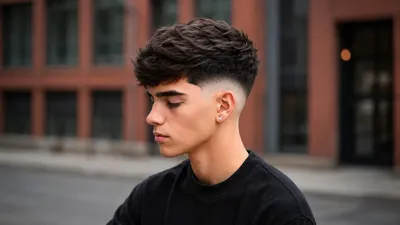

Some haircuts are easy to date. One look and you can tell exactly which decade—or regrettable phase—they belonged to. The mid fade has avoided that fate. Clean without being severe and modern without depending on a passing trend, it has become one of those rare men's haircuts that works almost anywhere. The defining feature is where the fade begins, roughly midway along the sides of the head before gradually shortening toward the ears and neckline. That placement gives a barber plenty of room to customize what happens on top. A mid fade can accompany a short crop, textured waves, a classic side part, longer curls or a polished quiff, making it less a single haircut than a foundation for several different looks.
Why the Mid Fade Keeps Working
Part of the appeal is balance. A high fade can create considerable contrast, while a low fade is more understated. The mid fade falls comfortably between the two, removing enough bulk around the sides to sharpen a haircut without exposing so much scalp that the fade becomes the entire story. It can look appropriate with a suit on Monday and just as natural with a T-shirt on Saturday. Hair texture matters as well. Thick hair benefits from having some of its weight removed through the sides, while wavy and curly hair can gain definition when the volume on top becomes the focal point. Men with finer hair may benefit from keeping additional length and texture above the fade rather than cutting everything equally short. A good barber should adjust the proportions rather than applying precisely the same fade to every head that reaches the chair.
Mid Fade Styles Worth Considering
For a relaxed look, the textured mid fade remains one of the most wearable choices. Instead of forcing the top into a perfectly controlled shape, the barber leaves enough length for natural movement. A short textured crop takes the idea in an even easier direction and works particularly well for men who would prefer not to devote a significant portion of every morning to their hair. Curly and wavy versions can be especially effective because the cleaner sides allow natural texture to stand out. For something more polished, the same fade can support a side part, quiff or slicked-back style. A side part offers a tailored appearance without looking overly conservative, while a quiff adds height and personality. Slicked-back hair works particularly well for evenings and more formal occasions, although the current approach is softer than the shellacked styles of previous decades. Hair should still look capable of moving.
Keeping a Mid Fade Sharp Between Barber Visits
A fade looks its sharpest immediately after an appointment, but the neckline and sideburns usually begin revealing new growth before the overall haircut actually needs to be redone. This is where sensible home maintenance can make a difference. Cleaning stray hairs around the edges can extend that fresh-cut appearance, but attempting to recreate the graduated fade itself is a considerably more ambitious undertaking. The **Cutting Edge Dual-Speed T-Blade Trimmer**, recently received by FINE, is particularly useful for detail work around hairlines, sideburns, beards and necklines. Used conservatively, it can help maintain the clean edges your barber created without attempting to recreate the entire fade at home. The distinction between maintenance and reconstruction is worth respecting.
Style the Top Without Overworking It
One of the easiest ways to make a good haircut look dated is too much product. The textured crop, side part and quiff all benefit from some control, but modern men's styling generally looks better when individual strands retain movement. Start with a small amount of product, distribute it through the hands first and then work gradually through the hair rather than applying a heavy layer in one area. **Baxter of California Clay Pomade** is one product FINE has previously had in the grooming rotation and fits naturally with this type of cut. It is most useful when a mid fade has enough length on top to need definition and control. For a side part, work the hair into its natural direction rather than carving out an unnaturally severe line. With a textured style, use your fingers instead of trying to make every strand agree with its neighbor.
A Good Haircut Still Starts at the Scalp
The fade may be what everyone sees, but the condition of the hair and scalp underneath it matters. Product buildup, excessive oil or an uncomfortably dry scalp can make even an excellent haircut harder to manage. The American Academy of Dermatology recommends adapting washing and hair-care habits to hair type rather than assuming one routine works for everyone. The **SH-RD Scalp Revival Kit** is another grooming product that makes more sense in this context than sitting in a generic product roundup. The three-part scalp collection is used after shampooing and is designed as a scalp-care step rather than a styling product. For men who pay attention to the cut but generally ignore everything underneath it, adding scalp care creates a more complete grooming routine.
How Often Should You Refresh a Mid Fade
Men who want an exceptionally crisp fade may find themselves back in the barber's chair every two or three weeks. Others can stretch appointments longer, particularly when the cut has been designed to grow out gracefully. Hair growth rate, the amount of contrast in the original fade and how precise you like the neckline all affect how quickly the haircut begins to feel overdue. Home detailing can buy time, but it has limits. Once the graduated transition through the sides begins disappearing, cleaning the perimeter will not magically restore it. This is also one of the reasons choosing a skilled barber matters. A good mid fade should not only look impressive when you leave the chair; the proportions should continue making sense as the hair grows.
Choosing the Right Mid Fade for You
Face shape can help determine what happens above the fade. Additional height through a quiff or textured top can flatter a rounder face, while longer faces often benefit from keeping that height more restrained. Square and oval faces usually accommodate a broad range of variations. Hair density, curl pattern and natural growth direction may ultimately matter more than following rigid rules about facial geometry. Bring a reference photograph to your barber, but use it as a conversation starter rather than an instruction manual. The person in the photograph may have completely different hair density, texture and growth patterns. A barber who suggests modifying the look for your hair is not refusing to give you what you asked for. Quite often, that is exactly what you are paying them to know.
A Classic Cut That Still Feels Current
The mid fade has lasted because it leaves room for individuality. It can be cropped and practical, textured and relaxed, paired with a beard or dressed up with a polished side part. What remains consistent is the clean structure through the sides and the ability to adapt the top to the man wearing it. Let the barber handle the architecture, keep the edges neat between appointments and use grooming products because they solve a specific problem rather than because there is room for another jar on the bathroom counter. A timeless haircut does not need much complication. It simply needs to be cut well and maintained intelligently.
(0) comments
We welcome your comments
Log In
Post a comment as Guest
Keep it Clean. Please avoid obscene, vulgar, lewd, racist or sexually-oriented language.
PLEASE TURN OFF YOUR CAPS LOCK.
Don't Threaten. Threats of harming another person will not be tolerated.
Be Truthful. Don't knowingly lie about anyone or anything.
Be Nice. No racism, sexism or any sort of -ism that is degrading to another person.
Be Proactive. Use the 'Report' link on each comment to let us know of abusive posts.
Share with Us. We'd love to hear eyewitness accounts, the history behind an article.