
Beauty gadgets have come a long way from the cleansing brushes and curling irons that once dominated our bathroom drawers. Today’s devices use LED light, targeted skincare technology, intelligent temperature control, and increasingly sophisticated engineering to bring a little more precision to everyday beauty routines.
That does not mean every glowing, vibrating gadget deserves a place on the vanity.
The beauty-tech market has become crowded enough that novelty is no longer particularly impressive. What matters is whether a device addresses a real concern, fits comfortably into an existing routine, and is convenient enough that you will continue using it after the initial excitement wears off.
For this year’s roundup, we are looking at three very different beauty tools that make a convincing argument for earning that valuable bathroom-counter space.
Aalok SKINMAX Makes Skincare More Targeted
Korean beauty has spent years influencing what we put on our faces. Aalok SKINMAX moves that conversation into beauty technology with a device designed to work alongside targeted skincare formulas.
Rather than treating the gadget and the serum applied with it as two unrelated purchases, Aalok has created three SKINMAX combinations around different skincare goals. The Radiance Glow formula includes niacinamide, glutathione, and vitamin C for the appearance of brightness and uneven tone. The Hydrating Soothing option combines hyaluronic acid, ceramide, and CICA, while the Rejuvenating Elasticity formula includes PDRN, collagen, and EGF.
The device-and-serum sets are currently priced at $129.
What makes the concept interesting is not simply that another skincare gadget has arrived. It reflects a broader shift toward beauty devices and topical skincare being designed to work as a coordinated routine rather than two separate categories.
That can be particularly appealing in a beauty market that has become increasingly complicated. Consumers now have access to more serums, actives, treatments, and devices than ever before, but owning more products does not necessarily result in a better routine.
A system built around a specific skin goal can remove some of the guesswork.
It also illustrates where at-home beauty technology appears to be heading. The next generation of devices is becoming less about owning an impressive gadget and more about creating a routine that is easy enough to repeat consistently.
For anyone whose bathroom cabinet is beginning to resemble a small cosmetics laboratory, a little simplification is welcome.
Dreame Chrona Brings LED Light Therapy Home
Few beauty tools look quite as futuristic as an LED face mask, but light therapy has moved well beyond the novelty stage.
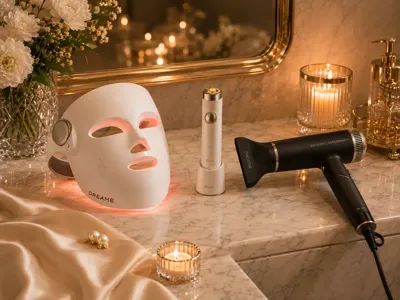
The Dreame Chrona LED Light Therapy Mask uses five targeted light modes in a flexible silicone mask and is designed for cordless treatments at home. Dreame lists the device as FDA-cleared and SGS-tested, with up to 90 minutes of cordless use.
Its real appeal may be practicality.
Beauty tools tend to divide into two groups: the ones we actually use and the ones that eventually become expensive residents of the bathroom drawer. A device that requires a complicated setup or an excessive amount of time has a much harder job becoming part of a normal routine.
Chrona is designed to make light therapy relatively easy to incorporate at home, while the flexible construction also makes it easier to store than some of the more rigid LED masks on the market.
The important part is keeping expectations realistic.
The American Academy of Dermatology notes that at-home red-light devices are less powerful than treatments used by dermatologists and that results can vary considerably depending on the device and the person using it. Dermatologists may recommend at-home red light as a complementary part of a broader skincare plan rather than as a replacement for professional treatment.
That is actually a healthier direction for the beauty-device category.
The most useful at-home tools are not the ones promising to make dermatologists obsolete. They are the ones that can fit sensibly between professional appointments and alongside a good skincare routine.
Bio Ionic AeroGravity Makes the Hair Dryer Better
Not every beauty innovation needs an LED panel, facial treatment mode, or complicated skincare protocol.
Sometimes the smartest technology simply improves something we already use.
The Bio Ionic AeroGravity Featherlight Dryer weighs less than one pound without the cord while offering three heat settings, three speed settings, a cool shot, digital LED display, memory and lock functions, and a foldable handle.
It is also universal voltage, which makes it particularly interesting for travelers who regularly bring their own styling tools rather than gambling on whatever happens to be hanging on the hotel bathroom wall.
Weight matters more than it sounds.
Anyone with long or thick hair—or anyone who has attempted a proper round-brush blowout at home—knows how quickly a heavy dryer starts feeling like an unexpected upper-body workout.
A lighter dryer does not require learning a new beauty routine. It simply makes an existing one easier.
That is an important distinction because beauty technology often gets the most attention when it looks futuristic. High-speed motors, smarter electronics, and improved engineering can be just as useful when they make an everyday tool lighter, more portable, and more comfortable to use.
AeroGravity also offers nine customizable settings, giving users more control over airflow and heat without turning the dryer into something that requires an instruction manual every morning.
Sometimes innovation is not adding another step.
It is improving the one you were already doing.
The Beauty Tool Test That Matters Most
The beauty industry will keep producing more devices. Some will use increasingly sophisticated light therapy. Others will pair technology with skincare, temperature control, advanced airflow, or features we have not even thought about yet.
That does not mean we need all of them.
Before bringing home another beauty gadget, consider how long each treatment takes, how often the manufacturer recommends using it, whether additional products or replacement supplies are required, how easily the device can be cleaned and stored, and whether it works with the routine you already have.
Travel matters too. A beautiful device that takes up half a suitcase is unlikely to become a favorite for someone frequently on the road, while a tool that folds, charges easily, or eliminates several other products may earn its space very quickly.
Price should also be considered in relation to actual use.
A sophisticated beauty tool used several times a week may make considerably more sense than an inexpensive gadget forgotten after two enthusiastic Sundays.
The same restraint applies to results. At-home devices can supplement skincare, styling, salon visits, and professional treatments, but shoppers should be skeptical of anything promising dramatic transformations with almost no effort.
The most interesting beauty technology now is not technology for technology’s sake.
It is technology that makes the routine easier, more targeted, and realistic enough to maintain.
And those are the beauty tools most likely to stay on the counter rather than disappearing into the drawer.
Related Articles You May Enjoy From FINE Magazine
Our Annual Round–Up of the Hottest New Beauty Tools
The beauty technology actually earning space on our bathroom counters


(0) comments
We welcome your comments
Log In
Post a comment as Guest
Keep it Clean. Please avoid obscene, vulgar, lewd, racist or sexually-oriented language.
PLEASE TURN OFF YOUR CAPS LOCK.
Don't Threaten. Threats of harming another person will not be tolerated.
Be Truthful. Don't knowingly lie about anyone or anything.
Be Nice. No racism, sexism or any sort of -ism that is degrading to another person.
Be Proactive. Use the 'Report' link on each comment to let us know of abusive posts.
Share with Us. We'd love to hear eyewitness accounts, the history behind an article.