
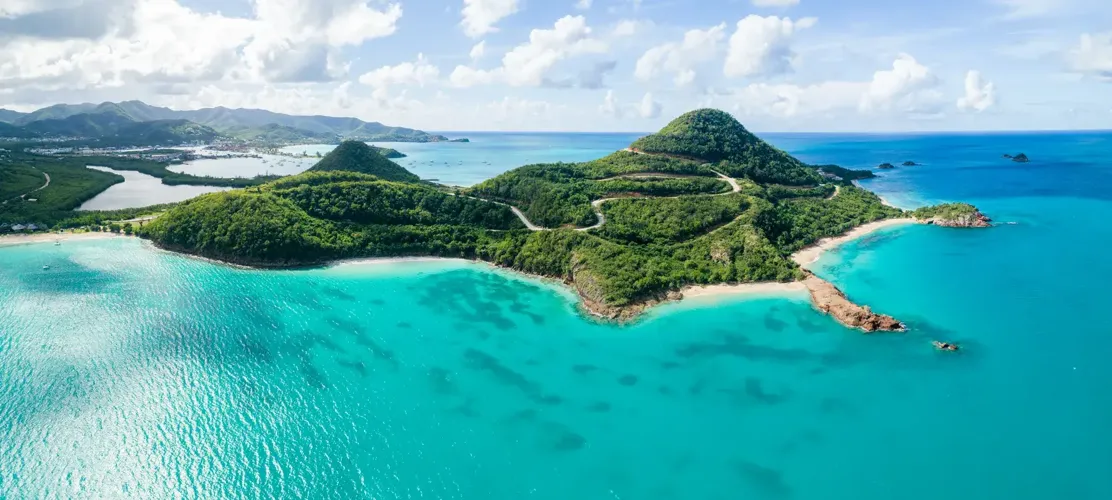
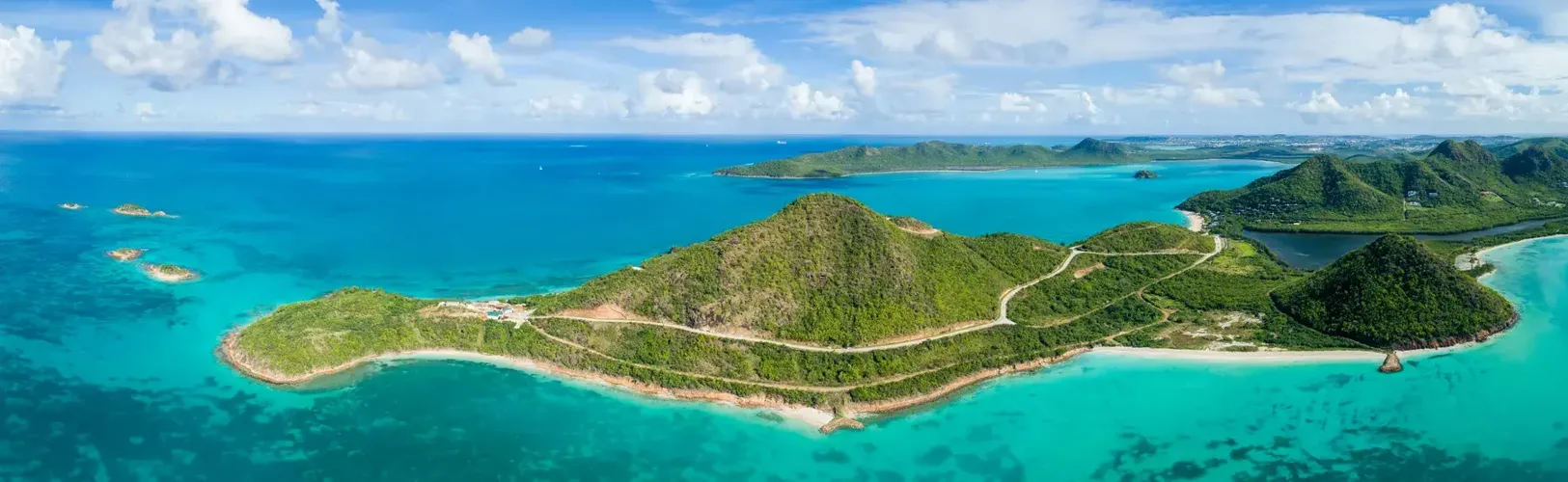
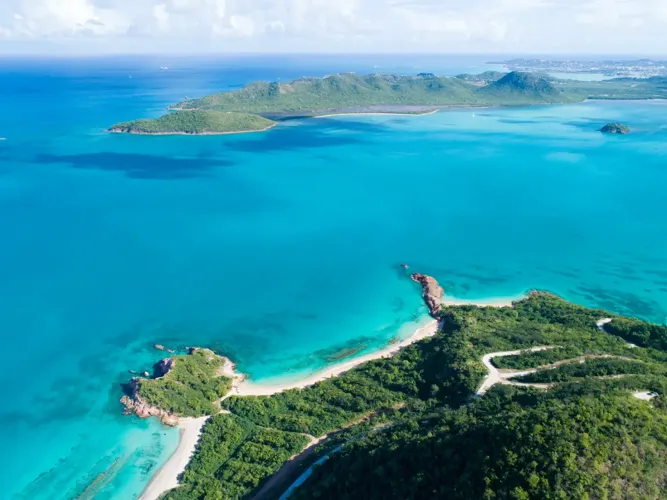

Pearns Point, Antigua, where Daniel Shamoon and Albert Hartog are developing a new low-density luxury resort and residential community.
For decades, luxury resorts competed by adding more. More restaurants. Larger spas. Bigger suites. Longer lists of amenities.
Daniel Shamoon believes the next generation of luxury may be moving in the opposite direction.
“The biggest misconception is that luxury is about adding more, when the most memorable experiences are often about simplicity, intimacy and having exactly what you need, when you need it,” Shamoon tells FINE Magazine.
That philosophy is taking shape at Pearns Point, a low-density resort and residential development on Antigua’s west coast, where Shamoon has partnered with Dutch entrepreneur Albert Hartog of Orange Limited to create a new boutique resort within the existing community.
Plans call for 20 single-story resort suites, 20 two-bedroom resort villas and 36 three- and four-bedroom residences for sale, with the latter expected to range from approximately $3 million to $6 million.
The more interesting story, however, is what Pearns Point may reveal about the changing meaning of luxury itself.
Luxury Without the Excess
Shamoon has spent more than three decades in high-end hospitality, with a portfolio connected to properties including Hermitage Bay in Antigua, Marbella Club and Puente Romano Marbella. He is also involved in The Beach Club, Barbuda, a forthcoming project with Robert De Niro.
That experience appears to have pushed him toward a quieter definition of exclusivity.
“True exclusivity comes from creating an experience that feels rare, personal and difficult to replicate,” he says. “At Pearns Point, we want that sense of exclusivity to come from the setting and the experience itself, rather than simply from the price point.”
It is a meaningful distinction in a luxury market where spectacular pools, private villas and elaborate spas are no longer particularly unusual.
Pearns Point occupies a 160-acre peninsula on Antigua’s western coast, with beaches, elevated viewpoints and broad views across the Caribbean. The setting, more than a long list of amenities, is central to the project’s appeal.
In other words, the land is supposed to do some of the work.
A Resort Designed Around Space

Pearns Point occupies a low-density peninsula on Antigua’s west coast, with sweeping Caribbean views and multiple stretches of shoreline.
The planned resort will not exist separately from Pearns Point’s residential community. Guests and homeowners will share many of the same amenities, including a beach club, restaurant, spa and fitness center, racquet facilities and watersports.
For a luxury development, that creates an interesting challenge. A hotel guest arriving for a week and someone who has purchased a multimillion-dollar Caribbean residence may be using the same spaces but have very different expectations about privacy and access.
Shamoon does not necessarily see those expectations as different.
“The definition of luxury is not necessarily different for a hotel guest and a homeowner,” he says. “Both value privacy, discretion, exceptional service and personalized experiences.”
The answer, he believes, lies less in separating the two groups than in designing the resort intelligently from the beginning.
“The challenge is to create an environment where those things are protected as the number of people utilizing a shared space increases,” he explains. “That comes down to thoughtful planning: the scale and placement of amenities, the flow of the property and how service is delivered.”
His goal is not to build two separate worlds.
“The objective isn’t to create two separate worlds, but to give each group a sense of privacy within a shared environment.”
When the Villa Becomes Part of the Resort
That blending of hospitality and residential living is central to Pearns Point.
Alongside the resort accommodations, the broader development also includes private homes and a turnkey villa program. The larger idea is familiar in luxury travel: a second home increasingly comes with the services and infrastructure of a resort.
That can mean arriving to a residence surrounded by dining, fitness, wellness and watersports rather than maintaining every element independently.
The model is less about owning a house beside a hotel and more about combining private residential life with hospitality services.
Antigua Is Part of the Product

The natural setting is central to the vision for Pearns Point, where beaches, hills and Caribbean views are intended to remain part of the guest and homeowner experience.
There is another reason Pearns Point cannot simply be replicated somewhere else.
Antigua itself is supposed to matter.
The development sits near Jolly Harbour on the island’s west coast, an area known for Caribbean water, beaches and sunset views.
FINE has previously explored the island’s resort scene in our look at Galley Bay Resort & Spa, while Jumby Bay Island offers another example of how privacy and a strong sense of place have become increasingly important in Caribbean travel.
Shamoon believes that connection to place will matter even more in the years ahead.
What the Next Luxury Traveler Will Want
Ask Shamoon what luxury travelers and second-home buyers may value a decade from now, and his answer has very little to do with material goods.
“People have greater access to luxury goods and experiences than ever before, so simply having something expensive is no longer particularly distinctive,” he says.
Instead, he believes scarcity is moving elsewhere.
“What is harder to find is time, privacy, authenticity and a genuine sense of place.”
Those priorities help explain why nature and wellness have become more central to high-end hospitality, but Shamoon believes travelers increasingly want something beyond beautiful surroundings as well.
“People want to understand where they are, not simply arrive somewhere beautiful,” he says. “They want to eat local food, spend time outdoors, connect with the culture and create memories that are personal to them.”
That may be the clearest explanation of what Pearns Point is trying to become.
Not simply another place where luxury can be purchased, but a place where the surrounding destination remains part of the experience.
The New Measure of Exclusivity
There will still be expensive villas, ocean views, private pools and the comforts expected at this end of the travel market.
But Shamoon’s argument is that none of those things, on their own, are enough anymore.
Luxury hospitality is moving toward something less tangible: space, privacy, landscape, personal attention and a convincing connection to place.
At Pearns Point, that shift is being built into the project from the beginning.
And perhaps that is the more interesting version of luxury now—not having more things, but having fewer reasons to want to be anywhere else.

(0) comments
We welcome your comments
Log In
Post a comment as Guest
Keep it Clean. Please avoid obscene, vulgar, lewd, racist or sexually-oriented language.
PLEASE TURN OFF YOUR CAPS LOCK.
Don't Threaten. Threats of harming another person will not be tolerated.
Be Truthful. Don't knowingly lie about anyone or anything.
Be Nice. No racism, sexism or any sort of -ism that is degrading to another person.
Be Proactive. Use the 'Report' link on each comment to let us know of abusive posts.
Share with Us. We'd love to hear eyewitness accounts, the history behind an article.