
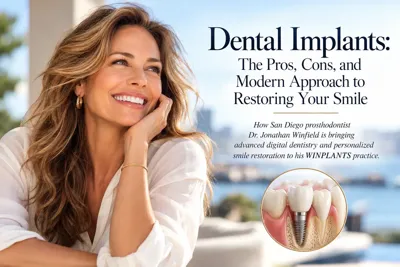
Losing a tooth can change more than the appearance of a smile. It may affect the way you chew, how clearly you speak, and even how comfortable you feel in everyday conversations. For people missing one tooth or facing more extensive dental problems, implants can offer a stable, natural-looking alternative to removable dentures or conventional bridges. But they are also a significant medical and financial decision.
As implant technology advances, so does the conversation about what patients can realistically expect. Dr. Jonathan M. Winfield, DDS, FACP, a board-certified prosthodontist and San Diego native, now leads implant and restorative care at WINPLANTS, a practice in downtown San Diego that uses digital imaging, treatment planning, and in-house fabrication for complex smile restoration.
Here is what to understand about dental implants before deciding whether they are right for you.
What Are Dental Implants, and How Do They Work?
A dental implant is a small post, generally made of titanium, that is surgically placed into the jawbone to act as an artificial tooth root. An attachment called an abutment connects the implant to a replacement tooth, bridge, or denture. During healing, the surrounding bone gradually bonds with the implant in a process known as osseointegration.
Implants can replace a single missing tooth, support several replacement teeth, or anchor a full arch of fixed teeth. The treatment depends on the number of missing or failing teeth, the condition of the gums and jawbone, and the patient's overall health. Unlike a conventional bridge, a single-tooth implant often avoids the need to reshape healthy neighboring teeth.
The Pros of Dental Implants
Greater Stability for Everyday Life
Because implants are anchored in bone, implant-supported teeth can provide a secure foundation for chewing and speaking. For people who struggle with loose dentures, that added stability can make meals and conversations feel more comfortable. The result varies with the type of restoration and each patient's anatomy.
A Natural-Looking Smile
Modern restorations are customized to complement a patient's existing teeth, facial proportions, and bite. Color, shape, and spacing all matter. The objective should not be a one-size-fits-all Hollywood smile, but a result that looks appropriate and functions well.
Support for Jawbone Health
Jawbone can shrink after a tooth is lost because it no longer receives the same stimulation from chewing. Properly integrated implants can help limit bone loss at the implant site. They do not reverse every change that has already occurred, and patients with significant bone loss may need additional treatment.
A Long-Term Replacement Option
Dental implants are designed for long-term use, and many perform well for years with appropriate care. However, no implant is guaranteed to last forever. The implant, crown, and surrounding tissues may need monitoring, repair, or replacement over time.
The Cons and Risks Worth Considering
Implant Placement Is Surgery
Placement requires a surgical procedure and a healing period. Potential complications include infection, injury to a nearby nerve or tooth, sinus-related issues in the upper jaw, and failure of the implant to integrate with bone. A thorough examination and individualized surgical plan are essential.
Treatment May Take Months
An attractive smile on the day of surgery is possible in selected cases, but that does not mean the entire treatment is finished. Bone healing and integration can take several months. Some patients need extractions, grafting, or other procedures before an implant can be placed, and the final restoration often comes later.
The Cost Is Significant
Implant treatment typically involves more upfront expense than a removable denture. The total can include diagnostic imaging, surgery, implants, temporary teeth, the final restoration, and follow-up visits. Dental insurance coverage varies considerably. Before committing, request an itemized written treatment plan and ask which costs, maintenance needs, and possible additional procedures are included.
Maintenance Is Not Optional
Implants cannot develop cavities, but the tissue around them can become inflamed or infected. Plaque buildup, gum disease, and inadequate maintenance can threaten long-term stability. Daily cleaning and regular professional evaluations remain essential, even when an entire arch of teeth has been replaced.
Can You Really Get New Teeth in One Day?
The phrase teeth in a day is appealing, but it needs context. For suitable patients, a dentist may place implants and attach a temporary, fixed set of teeth during the same treatment visit. This can mean leaving the office with a functioning smile rather than waiting without teeth during healing.
The temporary restoration is not necessarily the final one. As the implants integrate with the jawbone and tissues heal, the bite and restoration may need adjustment. A definitive set of teeth is typically designed and fitted after the healing phase. Not everyone qualifies for immediate loading, and the decision depends on bone quality, implant stability, bite forces, and other clinical factors.
Who Is a Good Candidate for Dental Implants?
Many adults with missing or failing teeth may be considered for implants, but suitability is determined by an examination—not by age or a before-and-after photograph. A clinician will assess gum health, available bone, medications, medical conditions, tobacco use, and the ability to keep implants clean.
Some patients with inadequate jawbone may still have options, including bone grafting or specialized implant approaches. For complex upper-jaw cases involving severe bone loss, zygomatic implants may be considered by clinicians with appropriate training. These treatments are not suitable for everyone and require careful risk assessment.
The best plan may also be something other than an implant. A bridge, removable denture, or treatment to preserve a natural tooth may be more appropriate depending on the circumstances.
Inside WINPLANTS: Dr. Jonathan Winfield's San Diego Practice
For patients considering advanced restoration, the experience and training of the treating clinician are part of the decision. Dr. Jonathan M. Winfield is a board-certified prosthodontist, a dental specialist with advanced training in restoring and replacing teeth. He earned his dental degree from the University of the Pacific and completed specialty training in prosthodontics at the University of Illinois Chicago.
At WINPLANTS, part of the Winfield Dental Group, Dr. Winfield focuses on treatments ranging from single-tooth implants to full-arch and full-mouth reconstruction. The practice describes a digital workflow incorporating cone-beam CT imaging, intraoral scanning, three-dimensional planning, and in-house digital fabrication. These tools can help the clinical team assess anatomy and plan individualized restorations; they do not eliminate the inherent risks of surgery or guarantee a particular result.
The practice also offers full-arch implant treatment and evaluates complex cases, including patients with substantial bone loss. Rather than treating the speed of a transformation as the only measure of success, patients should ask about long-term function, maintenance, and what happens after their initial surgery.
WINPLANTS is located at 1111 Sixth Avenue, Suite 102, San Diego, CA 92101. For practice information and consultations, visit advancedimplantspecialist.com.
Questions to Ask Before Choosing Dental Implants
A good consultation should leave you with more clarity, not more pressure. Consider asking:
- Am I a candidate for implants, and what alternatives should I consider?
- Who will plan the case, perform the surgery, and create the final restoration?
- Would I receive temporary teeth on the day of surgery, or would I need to wait?
- How long is the expected healing period for my specific treatment?
- What risks are particularly relevant to my health, gums, and jawbone?
- What does the quoted price include, and what might cost extra?
- What follow-up visits and ongoing maintenance will be required?
The U.S. Food and Drug Administration and the American Dental Association both emphasize understanding the benefits, risks, and healing process before proceeding with implant treatment.
A Smile Worth Planning For
Dental implants can be a meaningful investment in comfort, appearance, and oral function. They are not an instant solution for everyone, nor are they maintenance-free. The strongest decision begins with accurate diagnosis, a realistic explanation of treatment and recovery, and a provider whose experience matches the complexity of the case.
For San Diego patients exploring their options, Dr. Winfield's work at WINPLANTS illustrates how specialist training and digital tools are shaping modern implant dentistry. The goal is not simply a new smile for a photograph, but teeth that can serve everyday life well into the future.
Related Articles You May Enjoy From FINE Magazine
- Dental Veneers vs Teeth Whitening: Understanding Your Smile Enhancement Options
- How Choosing a Dentist Isn't Just About Location But Trust
- How Fitness Can Affect Your Teeth and Oral Health

(1) comment
This is great, thanks for sharing Dr Gregory. I'm glad to read and know that this resource provides a clear guide for all readers. I would like to add that dental implants are a reliable option even though the process is time consuming. I suggest my patients as well to go for Dental Implants In Mumbai and nearby area as they are the permanent solution for missing tooth
We welcome your comments
Log In
Post a comment as Guest
Keep it Clean. Please avoid obscene, vulgar, lewd, racist or sexually-oriented language.
PLEASE TURN OFF YOUR CAPS LOCK.
Don't Threaten. Threats of harming another person will not be tolerated.
Be Truthful. Don't knowingly lie about anyone or anything.
Be Nice. No racism, sexism or any sort of -ism that is degrading to another person.
Be Proactive. Use the 'Report' link on each comment to let us know of abusive posts.
Share with Us. We'd love to hear eyewitness accounts, the history behind an article.