
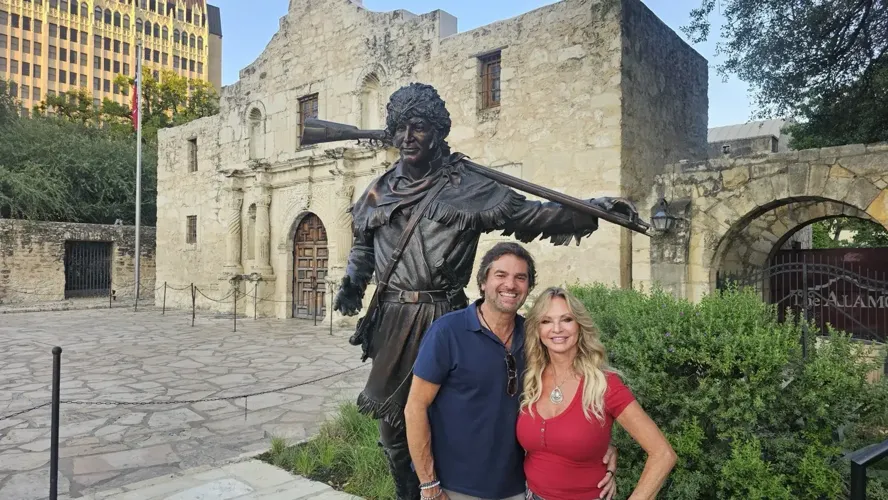
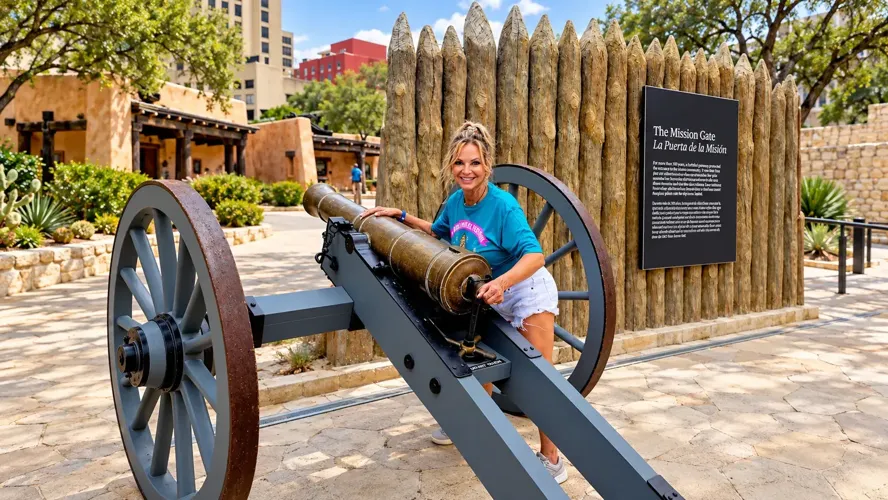


I thought I knew what I was going to see when we visited the Alamo.
The famous façade. A battlefield. A Texas landmark I had seen in photographs for most of my life.
What I did not expect was to walk away feeling like I had finally understood why this place matters so much to San Antonio — or to actually hold pieces of its history in my hands.
The Alamo is in the middle of a major transformation, and at first glance that means construction fences, work crews and portions of the surrounding area being rebuilt. Normally, that might make you wonder if you picked the wrong year to visit.
I felt exactly the opposite.
Once we understood what they were doing, the construction became part of the excitement.
They are not simply renovating the Alamo.
They are giving it back its sense of place.
The Alamo Was Much Bigger Than I Realized
Like a lot of people, when I pictured the Alamo, I pictured the church.
That is only a small part of the story.
The original Mission San Antonio de Valero was roughly a 4.5-acre community where people lived, worked, worshiped and farmed long before the battle that made the site famous.
One of the goals of the current Alamo Plan is to help visitors understand that larger footprint again.
Until just a few years ago, you could actually drive through an area that had once been part of the Alamo compound.
That amazed me.
Today, new interpretation around the plaza is beginning to show where walls, gates and other parts of the original mission once stood. Instead of looking at one building surrounded by a modern downtown, you start to understand that you are standing inside what was once an entire community.
And suddenly everything feels different.
You are no longer looking at the Alamo.
You are standing in it.
There Is a Lot More Here Than the Battle
The 1836 battle is obviously central to the story, but the Alamo has almost 300 years of history.
That was one of the biggest surprises for me.
The site began as a Spanish mission. It later became a military post. Then came the battle, commercial development, preservation efforts and eventually the historic site we know today.
Even the famous silhouette of the church was not exactly what soldiers saw during the battle.
The curved parapet that is now instantly recognizable was added later by the U.S. Army.
The Long Barrack is even older. Portions date back roughly three centuries and were originally part of the mission convento.
Those details kept knocking down the simplified version of the Alamo I had carried around in my head.
And I loved that.
I love history most when it starts becoming complicated and human.
Then the Archaeologists Started Talking
This is when I really got hooked.
We attended an archaeology workshop led by members of the Alamo archaeology team, and within a few minutes I realized that there is still an enormous amount being discovered here.
Before preservation work or construction happens in historically sensitive areas, archaeologists have to examine what is underneath.
And underneath the Alamo, apparently, is a lot.
During one major drainage project around the Long Barrack, archaeologists recovered approximately 230,000 artifacts.
That number almost sounds ridiculous until you see the work involved.
Ceramics. Musket balls. Bottles. Stone tools. Pieces of everyday life that had been buried for generations.
One archaeologist told us that one of her favorite discoveries was a fork with a handle made from animal bone.
A fork.
Not a cannonball. Not a weapon. Not some grand treasure.
A fork.
And the more she explained it, the more I understood why.
Somebody once ate with it.
Someone held it at a table, used it as part of an ordinary day and eventually discarded it.
That tiny object did something all the dramatic battle stories sometimes cannot.
It made the people real.
And Then They Let Me Hold the Artifacts
This was the moment that changed the visit for me.
The archaeologists began passing around ceramic fragments that had actually been excavated from the Alamo site.
I expected replicas.
They were not replicas.
These were real pieces of pottery that people had made, touched and used centuries ago.
And suddenly I was holding one.
For a California girl, that hit me harder than I expected.
California absolutely has important Indigenous and Spanish colonial history, but I did not grow up around this particular depth of surviving built history. In San Antonio, centuries of history are not somewhere far away.
They are underneath your feet.
I remember looking down at that little fragment in my hand and thinking:
I am touching history.
It sounds a little dramatic when you write it down.
It did not feel dramatic standing there.
It felt incredible.
The archaeologists explained that the color, glaze, decoration and even materials inside the pottery can help identify how it was made, when it may have been made and sometimes where influences came from.
A tiny broken piece can reveal trade, migration, cultural exchange or simply what people ate and drank from.
It was one of those rare museum experiences where the barrier between “then” and “now” suddenly disappears.
Some of the Most Exciting Things Are Still Underground
One discovery I especially loved was a group of mission-era adobe pavers.
They were found surprisingly close to the modern surface, beneath an area visitors walk over today.
Based partly on associated ceramics, the archaeology team believes they may date to around the 1740s.
And after carefully documenting them, they covered them back up.
My first thought was probably the same as everyone else's.
You found them and then buried them again?
But the explanation made perfect sense.
Sometimes the best way to preserve archaeology is to leave it in place.
The pavers were protected, mapped and covered so future generations — potentially with better technology than we have today — can study them without losing the original context.
After hearing that, walking through the plaza became a completely different experience.
Every few steps I found myself wondering what else might be underneath us.
The Construction Actually Makes Sense Once You See the Bigger Picture
There is still a lot happening around the Alamo, and the transformation will continue for some time.
The plan includes preservation of the historic Church and Long Barrack, reclaiming more of the original mission and battlefield footprint, and creating a major visitor center and museum that can tell a much fuller version of the Alamo's history.

That is important because the old experience sometimes asked visitors to understand a very large story from a relatively small piece of what remained.
The new approach is trying to restore context.
And that is what I think the Alamo has needed.
Not more spectacle.
More understanding.
San Antonio Is Very Proud of Where It Comes From

The Alamo also helped me understand something I kept noticing throughout our entire San Antonio trip.
This city is deeply proud of its history.
And San Antonio has a lot of it.
There are centuries-old missions, Indigenous history, Spanish colonization, Mexican rule, revolution, battles, immigration and the complicated evolution of Texas itself.
Some of that history is beautiful.
Some of it is bloody.
But people here do not seem interested in pretending it did not happen.
They talk about it.
They preserve it.
They argue about it, study it and continue uncovering it.
And underneath all of that is something else we noticed again and again: a very strong sense of civic pride, Texas pride and patriotism.
San Antonio is also incredibly diverse. You feel Mexican, Tejano, Indigenous, Spanish, German and other cultural influences throughout the city.
But those identities do not seem to cancel one another out.
People can be proud of where their families came from and equally proud of being Texans and Americans.
Coming from California, that stood out to me.
There is an openness about history here and a willingness to wear it.
Not just inside museums.
Everywhere.
This Is the History I Love
I thought I was going to the Alamo because it was one of those places you are supposed to see once in your life.
Instead, it became one of my favorite experiences in San Antonio.
Partly because of what they are doing to the site.
Partly because of what archaeologists are still finding.
But mostly because, for a few minutes, history stopped being something I was reading about.
Someone had walked across those adobe pavers.
Someone had eaten with that bone-handled fork.
Someone had once held the pottery that ended up in my hand.
That is the history I love.
Not dates lined up on a timeline.
People.
And standing at the Alamo, holding something another person had touched centuries earlier, I felt that connection more strongly than I expected.
I went there to see history.
Instead, for a few moments, I got to touch it.


(0) comments
We welcome your comments
Log In
Post a comment as Guest
Keep it Clean. Please avoid obscene, vulgar, lewd, racist or sexually-oriented language.
PLEASE TURN OFF YOUR CAPS LOCK.
Don't Threaten. Threats of harming another person will not be tolerated.
Be Truthful. Don't knowingly lie about anyone or anything.
Be Nice. No racism, sexism or any sort of -ism that is degrading to another person.
Be Proactive. Use the 'Report' link on each comment to let us know of abusive posts.
Share with Us. We'd love to hear eyewitness accounts, the history behind an article.