
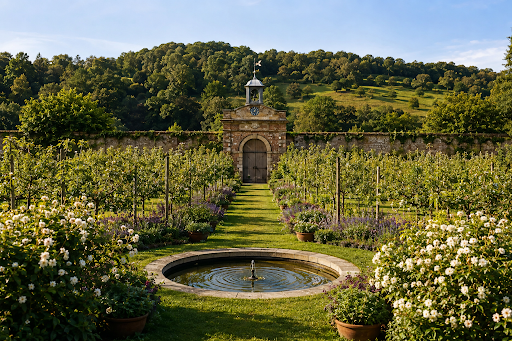
A new partnership between Brooklyn Botanic Garden and The Newt in Somerset turns a familiar membership card into an invitation to experience apple orchards, ancient woodland, garden history, estate-grown food, and a quieter side of England.
There are membership benefits you use on an ordinary Saturday, and there are membership benefits that quietly rearrange your future travel plans.
The newest benefit for members of Brooklyn Botanic Garden belongs firmly in the second category.
Beginning in July 2026, a valid Brooklyn Botanic Garden membership card provides complimentary general admission to The Newt in Somerset, a 2,000-acre garden estate in southwest England. Members can arrive, present their cards, and exchange the pace of New York for formal gardens, apple orchards, farmland, woodland, historic exhibitions, and long views across the Somerset countryside.
Children ages 17 and younger are included in the benefit, while non-member companions may purchase Guest Day passes upon arrival. Members of The Newt receive reciprocal admission when visiting Brooklyn Botanic Garden.
It may be described as a reciprocal garden partnership, but that rather understates the opportunity. This is not simply free admission to another attraction. It is an invitation to build an English country estate into a journey that might otherwise have ended at the edges of London.
The Membership Benefit at a Glance
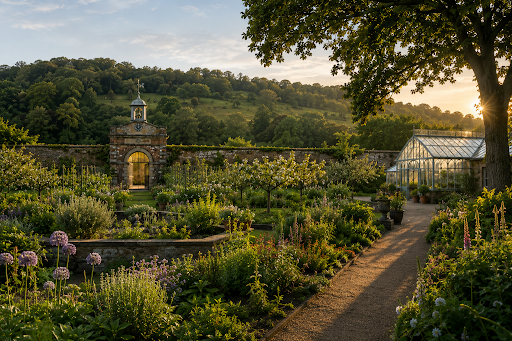
Brooklyn Botanic Garden members visiting The Newt can:
- Receive complimentary general admission during regular opening hours.
- Bring children ages 17 and younger at no additional admission cost.
- Present a current BBG membership card upon arrival.
- Purchase Guest Day passes for accompanying non-members at the Gatehouse.
Restaurant reservations, workshops, hotel stays, special events, and certain timed attractions may require separate bookings. Members should confirm current hours and visitor requirements before traveling through Brooklyn Botanic Garden’s membership page and The Newt’s visitor information.
Why This Partnership Is Bigger Than Free Admission
Reciprocal garden programs are not new. Brooklyn Botanic Garden already offers members free or discounted admission at hundreds of gardens and arboretums through its wider reciprocal network.
What makes this partnership feel more consequential is the contrast between the two destinations—and the scale of the experience it creates.
Brooklyn Botanic Garden is an urban refuge: 52 acres of cultivated landscape positioned beside Prospect Park and the Brooklyn Museum. It belongs to the cultural rhythm of the borough, where major institutions, brownstone neighborhoods, and public green spaces exist within a few subway stops of one another.
FINE previously explored how those cultural destinations and outdoor spaces contribute to the appeal ofliving in Brooklyn rather than Manhattan. The new partnership extends that appeal far beyond New York, connecting one of Brooklyn’s signature green spaces with an estate shaped by an entirely different landscape and pace of life.
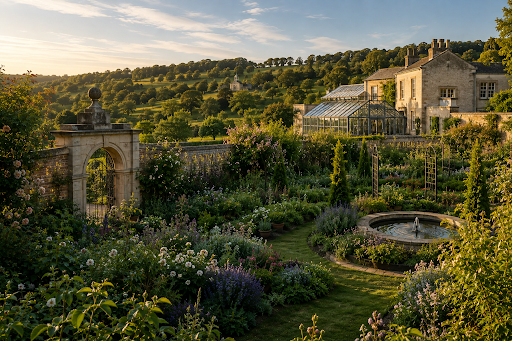
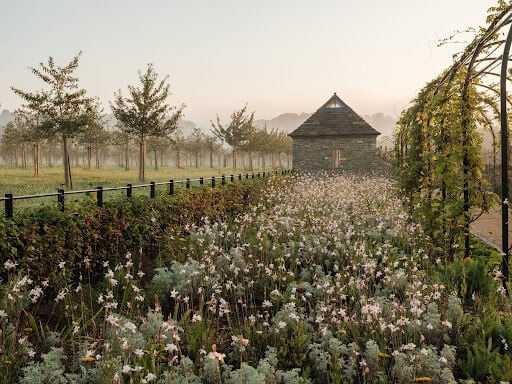
At The Newt, visitors do not discover a garden within a city. They enter an estate where gardens form part of a larger living system—one that includes farming, food, architecture, wildlife, hospitality, and Somerset’s agricultural traditions.
“Gardening has never thrived in isolation,” Harry Baldwin, head gardener at The Newt, observed in announcing the relationship.
The line captures why the partnership matters. Garden culture has always moved across borders through plants, ideas, techniques, and the people who care for the land. This new connection allows visitors to follow that exchange themselves, traveling from a Japanese garden, rose collection, or cherry walk in Brooklyn to cyder orchards and walled gardens in the West Country.
The Newt’s partner network also includes internationally recognized destinations such as Kew Gardens, Great Dixter, Chatsworth, the Eden Project, Winterthur in the United States, Chenshan Botanical Garden in China, and Babylonstoren in South Africa.
The Pleasure of The Newt Is in the Wandering
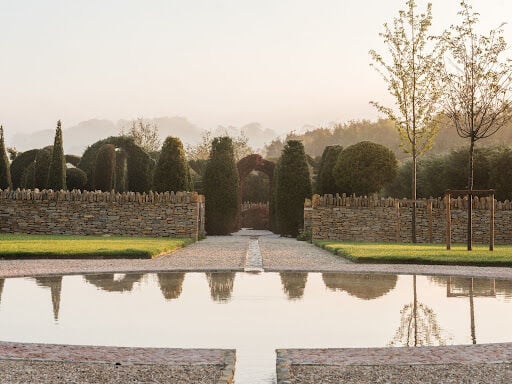
The Newt does not reveal itself all at once.
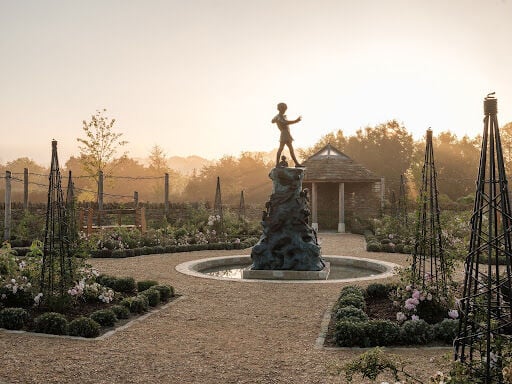
A path may lead from clipped geometry into woodland. An orderly kitchen garden may give way to an orchard, a deer park, or a view that appears to have been waiting several centuries for someone to pause and admire it.
At the heart of the estate’s gardens is the Parabola, a walled garden containing an apple-tree maze. Beyond the formal planting are productive gardens, ponds, and woodland habitats where visitors may encounter native deer or the great crested newts that helped inspire the estate’s name.
The garden experience is layered with history.
Inside The Story of Gardening, interactive rooms explore humanity’s enduring impulse to shape the natural world, moving through garden traditions from different periods and cultures. A walk farther across the estate leads to Villa Ventorum, a reimagined Romano-British villa inspired by the remains of a settlement discovered on the property.
Then there is the Beezantium, where observation hives reveal the relationship between bees, people, and the surrounding landscape. Nearby, the Grotto introduces a little underground theatre with crystals, volcanic rock, and a resident mythical creature that children are advised not to wake.
The result feels closer to a countryside narrative than a conventional garden visit. Each element adds another chapter: horticulture, archaeology, ecology, folklore, and food.
At The Newt, the Landscape Reaches the Table
A garden estate can become exhausting when its restaurant feels like an afterthought. At The Newt, stopping for lunch is part of understanding the place.
The glass-walled Garden Café overlooks the kitchen garden and orchards that influence its seasonal, vegetable-led menu. The Botanical Rooms serves modern British dishes in the Georgian house, drawing on estate-grown, estate-reared, and foraged ingredients. At the former dairy, Farmyard Kitchen takes a more convivial approach to seasonal plates and wood-fired cooking.
For something simpler, visitors can pause at the Cyder Bar for coffee, pastries, light dishes, and estate-made cyder—the traditional Somerset spelling is intentional—or pick up something sweet from the Gelateria before continuing through the grounds.
This relationship between landscape and table is central to The Newt’s appeal. The orchards are not decorative scenery placed behind a dining room. They produce the apples pressed into cyder. The kitchen gardens are not there merely to look productive. They influence what appears on the plate.
The experience feels polished without becoming detached from the soil beneath it.
Why Garden Tourism Belongs in the Luxury-Travel Conversation
The modern definition of luxury travel has become less interested in displaying abundance and more interested in granting access—to time, space, knowledge, and places with a distinct identity.
Garden tourism fits that shift particularly well.
A garden cannot be separated from its season, weather, or geography. The same path changes with the month. A border that appears restrained in winter can become theatrical in summer. An orchard that blossoms delicately in spring returns in autumn with fruit, harvest activity, and the scent of the cyder press.
This type of travel is also more economically significant than it may first appear. Research commissioned by the Royal Horticultural Society found that visits to UK parks and gardens generated an estimated £4.2 billion in domestic and international tourism spending in 2023, benefiting accommodations, restaurants, transportation, retailers, and cultural attractions.
The Newt embodies that broader form of garden tourism. A visitor may arrive because of the membership partnership, but the day naturally expands into architecture, food, rural history, wildlife, and local craft.
The garden opens the door. The destination does the rest.
How to Plan a Brooklyn-to-Somerset Garden Day
For BBG members adding The Newt to an England trip, the practical plan is refreshingly straightforward.
Bring a valid membership card and check The Newt’s current visitor hours before leaving. General admission is included, but it is worth reserving meals and reviewing which attractions require timed entry. Villa Ventorum and the Beezantium, for example, recommend booking a visiting slot through The Newt app or at the Threshing Barn.
Castle Cary is the nearest useful railway station. Travelers who would prefer to let someone else manage the logistics can consider The Newt’s separately ticketed Great Garden Escape.
Running on selected dates, the organized excursion includes first-class return rail travel from London Paddington, transfers, meals, garden experiences, tours, tastings, and a 12-month Newt membership. It is not included with the BBG benefit, but it demonstrates how easily the estate can become the centerpiece of a day outside London.
A more independent traveler may prefer to spend the night nearby and move at a gentler pace. That is where the reciprocal benefit becomes particularly valuable: admission is already taken care of, leaving more room in the itinerary for a lingering lunch, another walk through the orchards, or a detour into the surrounding countryside.
Why Somerset Deserves More Than a Day Trip
London has a habit of absorbing an England itinerary. There is always another exhibition, restaurant, neighborhood, or hotel bar waiting to be added.
Somerset offers the persuasive argument for leaving.
The county has its own rhythm, shaped by apple-growing country, market towns, medieval architecture, dairy farms, and landscapes that feel distinctly removed from the capital. The Newt lies near Castle Cary and Bruton, while Bath, Wells, Glastonbury, and the wider Somerset countryside can extend the journey into several days of architecture, food, and rural exploration.
A thoughtful itinerary might pair The Newt with the independent shops and galleries of Bruton, the cathedral and medieval streets of Wells, or the Roman and Georgian history of Bath.
Yet the best reason to stay longer is not the number of attractions that can be collected. It is the permission the region gives a traveler to do less.
There is time to walk without navigating a crowd. Time for lunch to remain lunch rather than become a scheduling obstacle. Time to understand why apples matter to Somerset, why a garden changes across the seasons, and why some places deserve to be experienced at the speed at which they grow.
The FINE Take
The most memorable travel benefits are rarely the ones that shave a few dollars from an admission price. They are the ones that place a new destination on the map.
For Brooklyn Botanic Garden members, The Newt partnership does precisely that.
A card carried through Brooklyn can now open the gate to an estate of orchards, woodlands, Roman history, cultivated beauty, and Somerset hospitality. What begins as complimentary garden admission can become the reason to take a westbound train, stay an extra night, and discover an England that exists beyond the familiar pull of London.
That is the real value of the partnership.
It does not merely offer access to another garden. It gives travelers a reason to follow the garden somewhere unexpected.


(0) comments
We welcome your comments
Log In
Post a comment as Guest
Keep it Clean. Please avoid obscene, vulgar, lewd, racist or sexually-oriented language.
PLEASE TURN OFF YOUR CAPS LOCK.
Don't Threaten. Threats of harming another person will not be tolerated.
Be Truthful. Don't knowingly lie about anyone or anything.
Be Nice. No racism, sexism or any sort of -ism that is degrading to another person.
Be Proactive. Use the 'Report' link on each comment to let us know of abusive posts.
Share with Us. We'd love to hear eyewitness accounts, the history behind an article.