
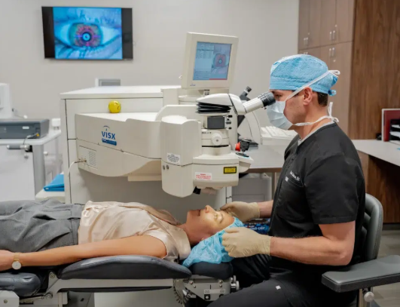

Vision correction is no longer one procedure with one set of promises. It is now a menu of approaches that can be matched to your lifestyle, your cornea, your prescription range, and your comfort priorities. Refractive-surgery decision-aid research reflects that same idea: people want recommendations based on their medical history and personal preferences, not a one-size-fits-all pitch.
At Houston LASIK & Eye, services like LASIK, PRK, phakic IOLs, and refractive lens exchange exist because different eyes and different goals need different solutions.
Start with what you want your vision to do
Vision goals should lead the plan. Distance clarity matters for driving and travel. Intermediate clarity matters for screens and cooking. Near clarity matters for reading and fine details. The EyeChoose decision-aid studies were built around exactly this kind of conversation, using medical history and user preferences to help compare options more practically.
Vision correction improves quality of life when it reduces friction in daily routines. The right procedure fits your Tuesday, not your fantasy.
LASIK, PRK, EVO ICL, and RLE (how to compare)
LASIK reshapes the cornea to correct refractive error and is one of the most common refractive procedures.
PRK also reshapes the cornea, but without creating a flap, and remains useful in selected eyes where LASIK is less ideal.
Phakic intraocular lenses expand refractive surgery to higher degrees of myopia, hyperopia, and astigmatism that may not be good fits for corneal laser treatment.
In the US FDA clinical trial, EVO ICL lenses showed accurate, predictable, and stable refractive correction with an excellent safety profile in moderate myopia with or without astigmatism.
Refractive lens exchange is a lens-based option that can restore uncorrected distance and near vision with modern presbyopia-correcting IOLs, and current review data identify fully presbyopic hyperopic patients as especially good candidates.
Options reduce regret when the “why” is explained clearly.
Candidacy is safety, not a sales pitch
Candidacy protects long-term vision. For corneal laser procedures, that means looking closely at corneal shape, thickness, ectasia risk, and ocular-surface stability. StatPearls notes that preoperative screening for LASIK includes corneal measurements and topography/tomography, while the dry-eye review emphasizes that preoperative screening and optimization of the ocular surface are key to minimizing postoperative dry eye.
Candidacy is the beginning of safety because it decides which risks apply to you.
Corneal screening that protects your long-term vision
Corneal screening matters because prevention matters. Corneal imaging guidance explains that topography evaluates the anterior corneal surface, while tomography adds posterior curvature and corneal thickness, making it more informative for keratorefractive-surgery candidacy and keratoconus risk.
The 2023 ectasia-risk study reinforces that point: preoperative risk assessment for post-LASIK ectasia focused heavily on topographic, tomographic, and pachymetric indices.
A safe plan protects your future self more than it impresses your present self.
Recovery planning that respects work and travel
Recovery is a lifestyle factor, not a footnote. LASIK is known for relatively fast recovery, which is one reason it became so popular.
PRK tends to have slower visual recovery and more early discomfort, even though it remains an excellent option for the right candidate.
Lens-based options such as refractive lens exchange bring a different set of considerations, including lens-specific complications and the need for careful counseling and follow-up.
Recovery planning protects results because it protects follow-through.
Cost and financing should feel transparent
Cost questions are normal in elective vision correction. In the evaluation of the EyeChoose decision aid, users specifically wanted more information on pricing alongside effectiveness and reversibility.
That is a useful reminder that transparent cost conversations reduce delay and regret because they are part of informed decision-making, not an awkward extra.
The next step that makes the decision easier
The next step is a candidacy-driven consultation, not a procedure pitch. When your goals are clear and your measurements are stable, the choice usually becomes simpler. The best decision tends to come from combining anatomy, ocular-surface status, imaging, prescription range, age, and lifestyle priorities rather than defaulting to the newest or most familiar procedure.
References
[1] Bhavani Subbaraman, Kamran Ahmed, Matthew Heller, Alison C. Essary, Vimla L. Patel, and Dongwen Wang, “Development of a Patient Decision Aid for Refractive Eye Surgery,” April 29, 2023.
[2] Bhavani Subbaraman, Kamran Ahmed, Matthew Heller, Alison C. Essary, Vimla L. Patel, and Dongwen Wang, “Evaluation of a Patient Decision Aid for Refractive Eye Surgery,” January 2024 (epub December 8, 2023).
[3] Majid Moshirfar, Phillip Bennett, and Yasmyne Ronquillo, “Laser In Situ Keratomileusis (LASIK),” updated July 24, 2023.
[4] Bharat Gurnani and Bhupendra C. Patel, “Photorefractive Keratectomy,” updated September 14, 2025.
[5] Sumaiya Hasan and Koushik Tripathy, “Phakic Intraocular Lens Myopia,” updated August 25, 2023.
[6] Mark Packer, “The EVO ICL for Moderate Myopia: Results from the US FDA Clinical Trial,” December 6, 2022.
[7] Isabella Diana Baur, Arthur Mueller, Grzegorz Labuz, Tadas Naujokaitis, Gerd U. Auffarth, and Ramin Khoramnia, “Refractive Lens Exchange: A Review,” August 2024 (epub August 15, 2024).
[8] Majid Moshirfar, Anne Duong, and Yasmyne Ronquillo, “Corneal Imaging,” updated July 24, 2023.
[9] Mohamed Tarek El-Naggar, Rania Serag Elkitkat, Hossam El-Din Ziada, Louise Pellegrino Gomes Esporcatte, and Renato Ambrósio Jr, “Assessment of Preoperative Risk Factors for Post-LASIK Ectasia Development,” December 4, 2023.
[10] Sridevi Nair, Manpreet Kaur, Namrata Sharma, and Jeewan S. Titiyal, “Refractive surgery and dry eye – An update,” April 2023.

(0) comments
We welcome your comments
Log In
Post a comment as Guest
Keep it Clean. Please avoid obscene, vulgar, lewd, racist or sexually-oriented language.
PLEASE TURN OFF YOUR CAPS LOCK.
Don't Threaten. Threats of harming another person will not be tolerated.
Be Truthful. Don't knowingly lie about anyone or anything.
Be Nice. No racism, sexism or any sort of -ism that is degrading to another person.
Be Proactive. Use the 'Report' link on each comment to let us know of abusive posts.
Share with Us. We'd love to hear eyewitness accounts, the history behind an article.