
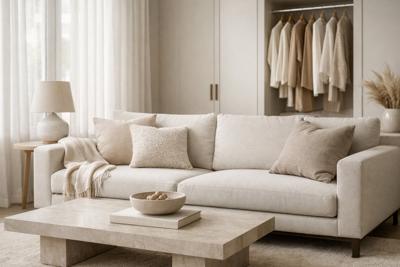

Quiet luxury is not about being plain. It is about being precise. A beautifully cut coat, a linen sofa with the right proportions, a walnut table that looks better after years of use, or a stone lamp that feels carefully chosen all carry the same message: someone paid attention.
That is the real appeal of quiet luxury. It is less about logos, status, or chasing the latest thing, and more about materials, restraint, fit, proportion, and longevity. It works in a living room. It works in a wardrobe. It even works in the small daily rituals that make life feel a little more considered and a lot less cluttered.
The best part is that quiet luxury does not require turning the house beige or dressing without personality. It is about choosing fewer, better pieces and letting quality do the talking. A home and wardrobe built this way feel polished without looking staged, expensive without looking obvious, and timeless without becoming dull.
Quiet Luxury Begins With Materials That Age Well
The first principle of quiet luxury is choosing materials that improve with time. In interiors, that often means solid wood, stone, linen, wool, leather, plaster, ceramic, marble, brass, and other materials that develop character rather than simply wearing out. In fashion, the same logic applies to wool coats, cotton shirting, silk blouses, leather shoes, cashmere knits, and well-made denim.
There is a reason natural materials have staying power. Linen softens. Wood develops patina. Leather becomes richer when cared for properly. Wool can hold structure and warmth for years. These materials do not rely on novelty. They earn their place by performing well and looking better once life has touched them a little.
For homeowners thinking about long-term design choices, FINE’s guide to simple home upgrades that add everyday value pairs naturally with this idea because the most useful upgrades are often the ones that make a home feel better every day, not just better in a listing photo.
Craftsmanship Is the Detail That Lasts
Quiet luxury depends on construction. A sofa can look lovely in a showroom, but the frame, cushions, seams, joinery, and upholstery determine whether it still looks good after real people sit on it. A coat can look refined on a hanger, but the lining, shoulder, stitching, buttonholes, and fabric weight determine whether it still looks sharp after winter has had its say.
Good craftsmanship is not always loud. It is often hidden in the details: properly matched patterns, sturdy seams, quality hardware, balanced proportions, well-finished wood, and fabric that hangs correctly. These are the things people may not consciously notice, but they feel the difference.
The Smithsonian connects craft to skill, materials, process, and the hand of the maker. That idea is central to quiet luxury. The value is not in announcing that something is expensive. The value is in seeing, touching, and using something that was made with care.
Proportion Is the Invisible Upgrade
Proportion is one of the most overlooked luxury principles. In a room, it is the difference between a sofa that anchors the space and one that looks like it wandered in from another house. In clothing, it is the difference between a blazer that looks tailored and one that looks like it is borrowing you.
The rule is simple: scale matters. A coffee table should relate to the sofa. Curtains should have enough fullness and length to feel intentional. A rug should be large enough to connect the furniture. A coat should hit at a flattering length. Trousers should break properly. Sleeves should not look like an unresolved negotiation.
When proportion is right, everything looks more expensive. Not louder. Not trendier. Just better. This is why a simple room with excellent scale can feel more luxurious than one filled with costly pieces fighting for attention.
Neutral Palettes Work Best With Depth
Quiet luxury often leans on neutral palettes, but that does not mean everything has to be beige, flat, and afraid of personality. The most successful neutral rooms and wardrobes use depth. Ivory, cream, taupe, camel, chocolate, charcoal, navy, olive, warm gray, and soft black can all work beautifully when layered with intention.
The secret is contrast. A cream sofa against warm wood. A charcoal coat over an ivory sweater. A pale stone table paired with dark metal. A camel blazer with denim and a white shirt. These combinations feel calm but not sleepy.
Color still has a place. It simply enters with restraint. Deep burgundy, forest green, dusty blue, terracotta, tobacco, ink, and soft blush can all add richness without turning the entire room or outfit into an announcement.
Texture Does What Logos Cannot
Texture is the quiet luxury statement piece. It gives a room or outfit interest without relying on obvious branding, loud prints, or novelty. A linen sofa, wool rug, plaster wall, leather chair, ceramic lamp, and wood table can create a room that feels layered before a single bold color appears.
A wardrobe works the same way. Cashmere with denim, silk with wool, cotton poplin with leather, suede with a crisp white shirt. These combinations create richness through feel and finish rather than decoration.
In interiors, texture also helps avoid the dreaded “expensive but cold” problem. FINE’s article on what rugs contribute to style and texture in modern interiors explores this beautifully because rugs often do the quiet work of softening, grounding, and finishing a space.
Buy Less, But Choose Better
Quiet luxury is not about buying constantly. It is about editing. A room does not need three side tables when one beautiful, useful table would do. A wardrobe does not need twelve almost-right sweaters when two excellent ones are the pieces you reach for every week.
This is where cost per use becomes useful. A well-made coat worn for years may be more practical than several cheaper coats that lose shape quickly. A quality sofa that lasts may be less wasteful than replacing a trendy one every few seasons. Buying better only works, of course, if the piece is something you will genuinely use. The most luxurious thing in the world is not very useful if it sits untouched because it does not fit your actual life.
Maintenance Is Part of the Luxury
Quiet luxury falls apart quickly when things are neglected. A beautiful coat covered in lint, a scuffed leather bag, a stained linen sofa, or a scratched wood table that was never cared for will not read as effortless. It will read as overlooked.
Maintenance is not glamorous, but it is essential. Brush wool coats. Polish shoes. Fold knits instead of stretching them on hangers. Rotate sofa cushions. Clean spills quickly. Condition leather. Use proper hangers. Protect stone surfaces. Repair small issues before they become expensive ones.
The Smithsonian Museum Conservation Institute offers care guidance for preserving objects and materials, and the broader lesson applies at home: what lasts usually lasts because someone cared for it. Elegance is not only what you buy. It is how you keep it.
Quiet Luxury Still Needs Personality
The biggest mistake people make with quiet luxury is confusing it with blandness. A room with no personality is not timeless. It is just cautious. A wardrobe with no point of view is not refined. It is simply waiting for someone to make a decision.
Personality can come through art, books, travel pieces, family heirlooms, vintage furniture, an interesting lamp, a sculptural chair, a beloved watch, a signature scarf, or a color that appears in small, thoughtful ways. The difference is editing. Quiet luxury allows personality, but it does not allow every personality to speak at once.
FINE’s article on the art of luxury floral curation is a good example of how one thoughtful detail can elevate a space without overwhelming it.
Lighting and Collected Pieces Make It Feel Personal
Quiet luxury is not created by furniture alone. Lighting, art, books, flowers, vintage pieces, and objects collected over time are what keep the look from becoming sterile. A room can have beautiful materials and perfect proportions, but without a little history, it may still feel more like a showroom than a home.
Layered lighting matters. Table lamps, floor lamps, sconces, picture lights, and warm bulbs can soften a room in a way overhead lighting rarely can. A vintage chair, an antique mirror, a sculptural vase, or a piece brought home from travel can add the kind of character that cannot be ordered in a matching set.
How Quiet Luxury Works in the Living Room
In a living room, quiet luxury begins with comfort and proportion. Choose seating that fits the room, textiles that feel good, lighting that flatters, and surfaces that can handle daily use. A room should not feel so precious that guests are afraid to sit down. That is not luxury. That is a design problem wearing expensive fabric.
Layer materials slowly. A linen or wool sofa, a large rug, a wood or stone table, tailored window treatments, a few substantial lamps, and one or two personal pieces can create a room that feels considered without looking overly decorated. The goal is not to fill the space. The goal is to let the right pieces breathe.
How Quiet Luxury Works in the Wardrobe
In a wardrobe, quiet luxury begins with fit. A perfectly tailored pair of trousers, a crisp shirt, a soft knit, a structured coat, and good shoes will always outlast louder trend pieces. The pieces do not have to be severe. They simply need to fit well, feel good, and work together.
A quiet luxury wardrobe is often built around repeatable pieces: clean denim, wool trousers, silk or cotton shirts, cashmere or merino sweaters, leather shoes, a tailored blazer, a strong coat, and accessories that improve rather than interrupt the outfit. It is not about dressing plainly. It is about removing the unnecessary.
What to Avoid
Avoid anything that relies too heavily on obvious trend value. If a piece only works because it is currently everywhere, it may not have much life once the trend passes. That does not mean never buying something fashionable. It means knowing the difference between a playful accent and a major investment.
Also avoid fake restraint. A beige room filled with poor materials is not quiet luxury. A logo-free outfit in cheap fabric is not timeless. The point is not to remove visual noise while ignoring quality. The point is to make quality visible in quieter ways.
Quiet Luxury Checklist
- Choose natural materials when they make sense for the use.
- Prioritize fit, scale, and proportion.
- Use neutrals with contrast and depth.
- Add texture instead of relying on loud patterns.
- Buy fewer pieces and choose them more carefully.
- Look for visible craftsmanship and strong construction.
- Maintain what you already own.
- Use art, books, flowers, and personal pieces for character.
- Avoid trend-driven investment purchases.
- Let rooms and outfits evolve slowly.
The Bottom Line on Quiet Luxury
Quiet luxury is not a trend so much as a return to good judgment. It asks better questions. Is this well made? Will it still look good in five years? Does it fit the room, the body, the lifestyle? Is it beautiful because of quality, or only because it is new?
From the living room to the wardrobe, the principles are the same: thoughtful materials, good proportion, texture, craftsmanship, restraint, and care. When those elements are in place, style does not need to shout. It has already made its point.

(0) comments
We welcome your comments
Log In
Post a comment as Guest
Keep it Clean. Please avoid obscene, vulgar, lewd, racist or sexually-oriented language.
PLEASE TURN OFF YOUR CAPS LOCK.
Don't Threaten. Threats of harming another person will not be tolerated.
Be Truthful. Don't knowingly lie about anyone or anything.
Be Nice. No racism, sexism or any sort of -ism that is degrading to another person.
Be Proactive. Use the 'Report' link on each comment to let us know of abusive posts.
Share with Us. We'd love to hear eyewitness accounts, the history behind an article.