
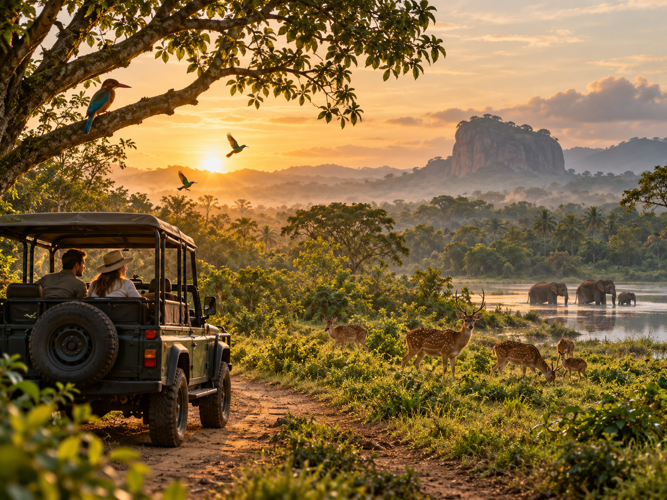
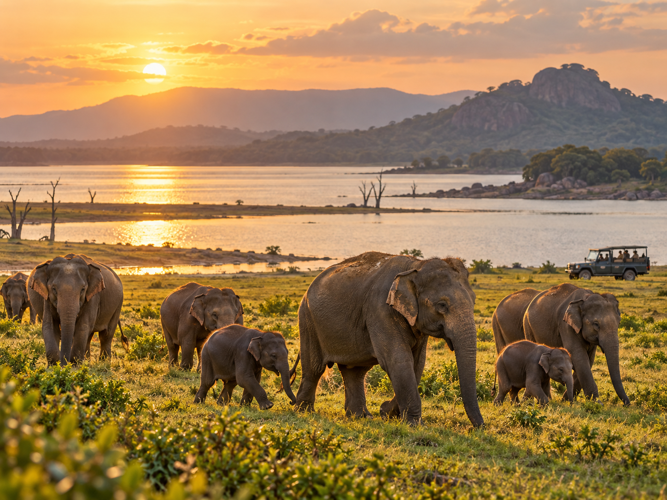
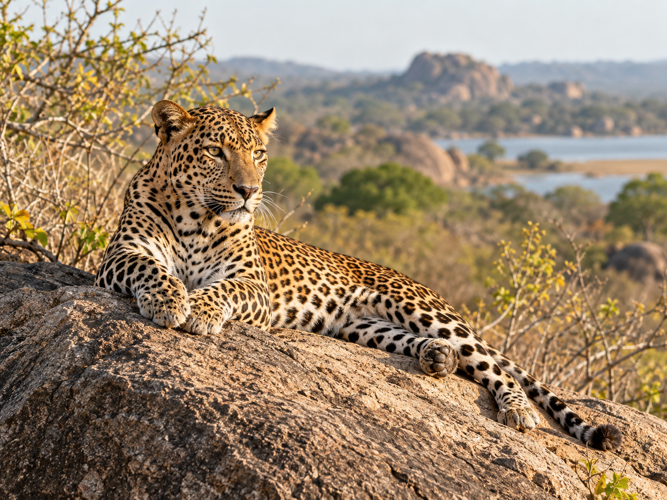

When people picture a safari, they usually think of Africa. Yet Sri Lanka, an island you can cross in a day, has some of the finest wildlife viewing in Asia. Leopards patrol the dry forests of the south, elephants gather in their hundreds on the grasslands of the north, and in the east they swim between islands on a vast reservoir. Add sloth bears, crocodiles, endemic birds and whales offshore, and the variety is remarkable for somewhere so compact.
It also fits easily into a wider journey. A few days on safari can sit alongside ancient cities, tea country and a week on the beach, and the right choice of park, luxury lodge and private guide makes all the difference.
Yala: Sri Lanka’s most famous park
Yala, in the island’s southeast, is famous above all for its leopards, with one of the highest densities in the world, and the Sri Lankan leopard is found nowhere else. Yet its scrub forest, plains, waterholes and lagoons also support elephants, sloth bears, crocodiles, spotted deer and a wealth of birdlife, and some of its best moments have nothing to do with big cats.
Where you enter the park matters as much as when. Yala is divided into five blocks. Block 1, reached through the main Palatupana gate, has the highest leopard density but also by far the most jeeps. The Katagamuwa gate to the north leads into the same rich core of Block 1 with much less traffic. The Galge gate opens onto Blocks 3 and 5, and Block 5 in particular is far quieter, at times almost exclusive, excellent for elephants, sloth bears and birdlife, though leopards are harder to find.
Choosing a lodge close to the right gate, and a private jeep with a tracker who knows the quieter routes, makes a real difference. Wild Coast Tented Lodge sets its luxury canvas suites between the jungle and the ocean on the edge of Block 1, right in the heart of the action, though drives here are busier. Leopard Trails sits closer to one of the park’s quieter gates, and Leopard Safaris, founded by naturalist Noel Rodrigo, runs an all-inclusive tented camp near the Katagamuwa gate, with Blocks 3 and 5 within easy reach.
Wilpattu: The quieter alternative
In the northwest, Wilpattu is Sri Lanka’s largest national park and feels nothing like Yala on a busy morning. Its forests are dotted with more than a hundred villus, shallow natural lakes that draw in leopards, sloth bears, elephants and deer, along with over 230 species of birds. Leopards can take more patience to find, but with far fewer jeeps, a sighting feels like a real discovery. It combines well with the ancient city of Anuradhapura nearby.
Minneriya and the Gathering
As the dry season takes hold, usually from around July to September, elephants converge on the grasslands around the ancient Minneriya reservoir in the Cultural Triangle. Known as the Gathering, it can bring hundreds of elephants together at once.
Its fame has a downside, though. At its peak, Minneriya can get very busy, with long lines of jeeps converging on the same herds. A good guide will choose between Minneriya and neighbouring Kaudulla depending on where the elephants are and where the crowds are not, and Hurulu Eco Park nearby is often quieter still. All three are easy to combine with Sigiriya, Dambulla and Polonnaruwa.
Udawalawe: Elephants year round

If your dates don’t fall during the Gathering, Udawalawe is the answer. Its open grasslands and wide reservoir make wildlife easy to spot, and elephant sightings are reliable throughout the year. It’s also excellent for birds of prey, and it sits conveniently between the hill country and the south coast. For families with younger children, it’s often the most rewarding park of all, because the sightings come quickly and the drives don’t need to be long.
Wasgamuwa: The bear forest
Tucked between the Mahaweli and Amban rivers, Wasgamuwa is one of Sri Lanka’s most overlooked parks. Its name comes from the Sinhala word for bear, and it’s one of the best places on the island to look for the shy, shaggy sloth bear. Elephants roam here too, in the greatest numbers from around November to May, and with only a handful of jeeps on the tracks, sightings feel wonderfully unhurried. It’s within easy reach of the Cultural Triangle and Kandy.
Gal Oya: Elephants that swim
For something completely different, head east to Gal Oya, one of Sri Lanka’s least visited parks. Boat safaris on the vast Senanayake Samudraya reservoir offer the chance to see wild elephants swimming between its islands, something you won’t see anywhere else on the island. You can also walk with the chief of the local Vedda community through the forests his ancestors have lived in for generations, and Gal Oya Lodge makes a beautiful base for all of it.
Kumana and Bundala: A paradise for birdwatchers
Sri Lanka has over 30 endemic bird species and huge numbers of migrants arriving each winter. Kumana, just east of Yala, becomes one of the island’s great bird sanctuaries during the migration season, with pelicans, painted storks and the rare black-necked stork, and elephants and even leopards live here too, with a fraction of Yala’s visitors. Leopard Trails Kumana offers a comfortable tented base close to the park. On the south coast, Bundala’s lagoons, salt pans and dunes attract flamingos and waders, particularly from November to March.
Beyond the parks
Between December and April, blue and sperm whales feed off the south coast, where deep water runs remarkably close to shore. The most responsible way to see them from the water is aboard a Sail Lanka catamaran, a far calmer and more considered experience than the crowded standard boats, or you can take a short flight along the coast and watch them from above without disturbing the ocean at all.
Sinharaja: Into the rainforest

Sinharaja, in the southwest, is the island’s last significant stretch of primary lowland rainforest and a UNESCO World Heritage Site, where more than half of the species are endemic. This is not a place for jeeps. You explore on foot with a naturalist, looking for endemic birds such as the Sri Lanka blue magpie, along with purple-faced langurs, giant squirrels and an extraordinary variety of butterflies and frogs. It’s wet all year, so leech socks are essential, but a morning here is one of the most rewarding wildlife experiences Sri Lanka has to offer.
When to go
Sri Lanka offers wildlife year round, but each park has its moment:
Yala: around February to July is generally best. The park usually closes for part of the year, typically around September and October.
Wilpattu: at its best from around February to October.
Minneriya and Kaudulla: the Gathering usually peaks between July and September.
Udawalawe: good elephant sightings throughout the year.
Wasgamuwa: elephant herds are usually largest from around November to May.
Kumana and Bundala: best for migratory birds from around November to March.
Whales: December to April off the south coast.
Getting the most from a safari
Two nights near each park allows for both a morning and an afternoon drive, and a private jeep lets you linger with an animal rather than moving on with the crowd. Choose parks for the experience you want: Yala for the best odds of leopards, Minneriya for the greatest numbers of elephants, and Wilpattu, Wasgamuwa, Kumana and Gal Oya for the sense of having the wilderness largely to yourself. If you only have time for one, Yala entered through a quieter gate is still the best all-rounder. If you’ve been before, Wilpattu or Gal Oya will show you a very different Sri Lanka.
Travelling responsibly
The best wildlife encounters are always in the wild, and they’re far more rewarding than any captive attraction. Choose discreet guides who keep a respectful distance and lodges that support conservation and employ local people, and spread your time across the quieter parks to ease the pressure on places like Yala and Minneriya.
Final thoughts
Few destinations offer leopards, elephants, whales and rainforest birds within such easy reach of each other, or combine them so naturally with culture, tea country, beaches and luxurious lodges. Red Dot’s guide to Sri Lanka’s wildlife and wilderness shows how the parks fit together. With more than 20 years’ experience across the island and teams in both the UK and Colombo, Red Dot knows which gate, which lodge and which tracker will make the difference, and its exceptional chauffeur-guides are handpicked as much for their knowledge as for their company on the road. It designs private safaris in Sri Lanka around your interests and dates, as part of a bespoke, tailor-made journey, with every jeep, tracker and lodge arranged in advance.


(0) comments
We welcome your comments
Log In
Post a comment as Guest
Keep it Clean. Please avoid obscene, vulgar, lewd, racist or sexually-oriented language.
PLEASE TURN OFF YOUR CAPS LOCK.
Don't Threaten. Threats of harming another person will not be tolerated.
Be Truthful. Don't knowingly lie about anyone or anything.
Be Nice. No racism, sexism or any sort of -ism that is degrading to another person.
Be Proactive. Use the 'Report' link on each comment to let us know of abusive posts.
Share with Us. We'd love to hear eyewitness accounts, the history behind an article.