
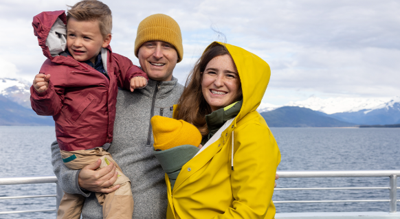

Most families who book Alaska arrive prepared for hardship. They pack thermals they’ll never need, brace for cold meals and colder showers, and quietly assume the trip will be measured in how much discomfort everyone tolerated for the sake of the view.
That version of Alaska still exists. You can sleep in a tent on a glacier if you want to. But the rest of us — the parents who want their kids wide-eyed in front of a mountain without anyone crying about a frozen toilet seat — have a different state to work with now. Heated vehicles. Lodges with hot tubs. Guides who carry the gear so you don’t have to. The trick is knowing where the soft-adventure version of Alaska actually lives, and how to build a trip around it.
Skip the Cruise, or Bookend It
If your starting point is a seven-day cruise out of Seattle, congratulations on the scenery and condolences on the experience. Cruise Alaska is beautiful at a distance. The actual texture of the place — the silence at the end of a dirt road, the smell of wet spruce after rain, a moose that doesn’t care you’re there — happens on land.
The families who get the most out of Alaska treat the cruise, if they take one, as the panoramic prelude or the soft landing. The real days are the ones bookending it: three or four nights anchored somewhere with mountains out the window, with a calendar of small-group adventures in between. If you’re skipping the cruise entirely, even better. You’ll spend less and remember more.
Base Yourself an Hour North of Anchorage
Downtown Anchorage is convenient. It is also not the Alaska anyone came to see. Most of the photographs your kids will eventually frame happen between forty-five minutes and two hours north of the city, in the corridor that runs through Wasilla, Palmer, and Talkeetna and threads into the Talkeetna Mountains.
Basing yourself up there — rather than driving in and out from Anchorage every morning — buys you back two hours a day, puts the trailheads and tour meeting points in your backyard, and trades the parking-garage hotel for somewhere your kids will actually remember. Anchorage is fine for an arrival night and a departure-day dinner. Don’t ask it to do more.
Pick Activities Built for Comfort, Not Endurance
This is where most family Alaska trips quietly succeed or fail. The activity menu used to read like a dare: paddle this, hike that, sleep on this rock. The new menu is gentler, and a great deal more interesting.
The clearest example is what’s happened with guided backcountry vehicles. The newest fleets in the Talkeetna Mountains are heated, fully enclosed Polaris Xpeditions — closer in feel to a small SUV than a four-wheeler — which means a four-year-old can ride through alpine creek crossings in February without anyone losing a fingertip. Operators like Hatcher Pass ATV Tours run small-group trips through the Hatcher Pass area year-round, with all gear, helmets, and training included; in summer the machines run on wheels, in winter they switch to snow tracks. “No experience required” is more than a tagline — it’s an architectural choice. Kids forty-two inches and up can ride. Grandparents who haven’t driven anything more aggressive than a Volvo can drive these.
Dog sledding fits the same template. Done right, it’s a forty-minute experience with kennel-raised huskies who are visibly thrilled to work. A short, guided glacier walk on the Matanuska Glacier — crampons rented, route picked by someone who’s done it a thousand times — gives kids the ice-cave photograph without the climbing-gear conversation. Add a half-hour of gold panning and a salmon-bake dinner, and you’ve delivered four childhood-defining hours without burning a single calorie of misery.
Sleep Somewhere Memorable, Not Roadside
The lodging part of the trip is where parents tend to flinch and book a chain. Don’t. A cabin off a dirt road with a wood stove, a hot tub on the porch, and a window full of mountains is what your kids will draw later. There are dozens of these in the Talkeetna and Hatcher Pass area, ranging from straightforward two-bedroom cabins to off-grid lodges that lean into the castle-in-the-woods aesthetic.
The signal you’re looking for is straightforward: heated, plumbed, photogenic. “Off-grid” should describe the views, not your shower situation. Filter listings by what’s open year-round if you’re going in shoulder seasons, and read recent reviews specifically for mentions of families.
Time It Right — and Don’t Assume Summer
The assumption is June or July. The reality is more interesting.
Mid-summer is gorgeous but crowded, and cruise-port towns can feel like timeshare presentations. September trades a few degrees of warmth for fall colors, half the tourists, and the first nights of aurora season. February, the dark-horse pick, delivers Northern Lights — never guaranteed, but the season for it — alongside snowmobile country that the right operators make genuinely accessible to non-extreme travelers.
If you have flexibility, late August through mid-September is the sweet spot for families: still light enough for full days, cool enough for aurora to be on the table after dinner, and far enough past peak that you’ll actually have the trailheads to yourself.
The Alaska Worth Showing Your Kids
The version of Alaska worth bringing your family to isn’t the one that requires endurance. It’s the one where the friction has been engineered out — better vehicles, smaller guided groups, lodges that work, an itinerary built around moments rather than mileage. You can still hike. You can still get cold if you want to. But you don’t have to anymore, and that changes which families come.
Plan that version of the trip, and the only thing your kids will remember about the discomfort is that there wasn’t any.

(0) comments
We welcome your comments
Log In
Post a comment as Guest
Keep it Clean. Please avoid obscene, vulgar, lewd, racist or sexually-oriented language.
PLEASE TURN OFF YOUR CAPS LOCK.
Don't Threaten. Threats of harming another person will not be tolerated.
Be Truthful. Don't knowingly lie about anyone or anything.
Be Nice. No racism, sexism or any sort of -ism that is degrading to another person.
Be Proactive. Use the 'Report' link on each comment to let us know of abusive posts.
Share with Us. We'd love to hear eyewitness accounts, the history behind an article.