
Most people board a Danube cruise in Budapest, find the first free seat near a window and figure the views will sort themselves out. And they're not entirely wrong - the central stretch of the Danube between Liberty Bridge and Margaret Bridge is genuinely spectacular from any angle. But there is a real difference between what you see from the Pest side versus the Buda side, and if you've got a specific landmark you're hoping to photograph or just want the most dramatic possible angle on the city, it's worth knowing before you sit down.
The short answer is this: the Pest side gives you the Parliament, the Margaret Bridge approach and a long, flat skyline of grand 19th-century architecture. The Buda side gives you the Castle, Fisherman's Bastion, the Gellért Hill Liberty Statue and a much more vertical, dramatic silhouette. Both sides are worth seeing - that's not a cop-out, it's just true. But if you had to pick one and couldn't walk around mid-tour, Buda's the more photogenic of the two, especially at night. If you want to start planning seats and timing before you arrive, https://alle.travel/en/budapest/category/danube-cruise lists the available Danube boat tours in Budapest with departure times, durations and the key route details - so you can work out which slot actually suits you.
Budapest's famous cityscape along the river - the Banks of the Danube, the Buda Castle Quarter and Andrássy Avenue - was added to the UNESCO World Heritage List in 1987. That designation covers the exact stretch most short tours operate on, roughly the 3-kilometer central corridor between Petőfi Bridge to the south and Margaret Bridge to the north. A standard one-to-two-hour tour will cover all of it, which means both sides of the boat get their moment - it's really just a question of which moment comes first and which landmarks you're facing directly versus at an angle.
The Pest Side: What You're Actually Looking At
The Pest bank is the flat one - it stretches east in a long, mostly level facade, and it's where most of Budapest's grandest public buildings were constructed during the late 19th century. The single biggest landmark you see from the Pest side is the Hungarian Parliament Building, which sits right on the riverbank on the Kossuth Lajos tér embankment. Completed in 1904, it's 268 meters long and 96 meters tall, with 691 rooms and a roofline dense enough with spires that it looks genuinely different from every angle you approach it.
From the water, you get a straight-on view of the full facade - which is something you basically can't get from land, because the embankment road in front of it is too close and too low. On an evening tour, with the Parliament floodlit against a dark sky and its reflection running across the Danube, it's probably the single most photographed image in Budapest. And honestly, the reflection alone justifies picking a Pest-side seat for that stretch of the route.
A bit further north, still from the Pest bank, you'll catch Margaret Island - a 2.5-kilometer-long island sitting in the middle of the river - as the boat approaches or departs Margaret Bridge (Margit híd, opened 1876). The island itself isn't heavily developed, which gives this northern section of the tour a much quieter, greener quality than the central stretch. So if you've got a window seat on the Pest side, the northern end of the route is actually pretty nice too, even if it's not the postcard view.
The Buda Side: More Vertical, More Dramatic
Buda's the hilly one. The western bank rises steeply from the water, and because so much of what's worth seeing here sits on elevated ground, the Buda side gives you views that are genuinely harder to replicate from street level. You're looking up at things, which changes the perspective considerably - and that's part of what makes it feel different.
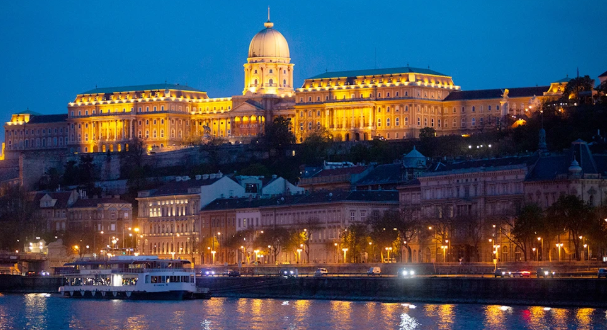
Buda Castle (the Royal Palace) is the dominant feature - a massive complex sitting 60 meters above the river on Castle Hill, with a facade stretching roughly 300 meters along the ridge. The current building is mostly 18th and 19th century in its form, though the site has been fortified since the 13th century. From the water it reads as one long pale composition, anchored by the large central dome and flanked by wings that drop away toward the riverbank. It's probably the most photographed thing in Budapest after the Parliament, and the view you get from a boat on the Danube is a better one than you'd get from most spots in the city.
Just north of the Castle, if conditions are right and the light's decent, you can make out Fisherman's Bastion (Halászbástya) - a neo-Romanesque terrace built between 1895 and 1902 by architect Frigyes Schulek. It's technically behind the Castle from most river angles, but the white turrets and towers are often visible above the treeline in winter when the foliage is down. And a bit further south, Gellért Hill rises to 235 meters above sea level - the highest point visible from the central river corridor - with the Liberty Statue (Szabadság-szobor, erected 1947, 14 meters tall) visible from a surprising distance. On clear evenings it's lit up and catches the eye even before you process what you're looking at.
The Bridges: Both Sides Have a Moment Here
Budapest's central river bridges are worth thinking about separately, because they're actually best appreciated from the middle of the river - not from either bank specifically. But the approach angle matters, and which side you're on affects what you see first.
The Chain Bridge (Széchenyi lánchíd, opened 1849) is the oldest bridge in the city and probably the most iconic. It was designed by the English engineer William Tierney Clark and is a pretty close match to his Hammersmith Bridge in London - though most people who know both find Budapest's version more impressive. From a boat passing underneath it, the lion sculptures at the base of each tower are visible from both sides, but the upstream (southern) approach gives you the fuller frontal view of the whole span. So wherever you're sitting, try to have a clear sightline when the boat passes through or under it.
Liberty Bridge (Szabadság híd), further south, was built in 1896 for Hungary's Millennium celebrations and has a more decorative, art nouveau-ish character than the Chain Bridge - lots of metalwork detail, turuls (mythological birds) on the towers and a green paint job that makes it stand out from the water. And Elizabeth Bridge (Erzsébet híd), the white cable-stayed span that replaced the original destroyed in World War II, opened in its current form in 1964 - it's the youngest of the central bridges and the most minimal-looking, but it photographs well precisely because of the contrast with everything around it.
Daytime vs Evening: Which Actually Wins?
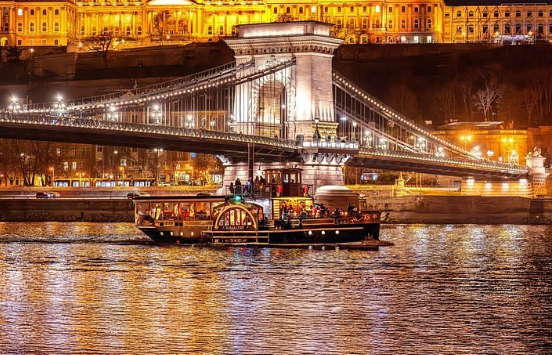
This probably matters more than which side of the boat you're on, to be straight about it. The daytime view is clearer and better for detail - you can actually read the architecture, pick out individual windows on the Parliament facade and see the stone textures on the Castle walls. But the evening view, especially after dark in the 45-to-60-minute window after sunset, is just on a different level.
The Parliament is floodlit in a warm amber. The Castle complex is lit from below, which makes the dome glow. The bridges have their own lighting rigs and the reflection of all of it in the Danube adds a whole second version of the city below the actual one. Short evening tours of 60 to 90 minutes cover the same central stretch as daytime tours, just looking considerably more cinematic. Most of the tour operators on the Danube run both day and evening slots between April and October, with evening departures typically starting between 7pm and 9pm depending on sunset time.
If you're visiting in summer, the golden hour - roughly 8pm to 9pm in June and July - is probably the best possible light for river photos from either side. The sun drops behind Buda Hill at that point and the warm side-light catches the Parliament facade from the west, which is genuinely not something you can plan for from the bank.
So, Which Side Should You Actually Pick?
Here's a pretty straightforward breakdown based on what matters most to you.
Pick the Buda side if you want the Castle, Gellért Hill, Fisherman's Bastion and a more dramatic vertical skyline. It's the side that photographs better in most lighting conditions and it's probably the right call if you're visiting for the first time and want the "wow" shot.
Pick the Pest side if the Parliament is your priority - because the full-facade view of it from the Pest-side seat is genuinely one of the better things you can see in Budapest, especially in the evening. Also good if you're more interested in the bridges and want to face upstream for the southern approach.
Actually the simplest move is to choose a seat near the middle of the boat and stay mobile - most short tours allow you to move around or stand at the railings, so you're not locked into one view for the whole hour. The central corridor on most riverboats gives you access to both sides fairly easily.
But if you're on a smaller vessel or the boat's crowded, go Buda. It's the more consistently rewarding side for first-timers and the one that's harder to appreciate from land. The Pest side - and especially the Parliament - you can spend a long time staring at from the embankment for free. The Castle from the river at night is a bit harder to replicate any other way.


(0) comments
We welcome your comments
Log In
Post a comment as Guest
Keep it Clean. Please avoid obscene, vulgar, lewd, racist or sexually-oriented language.
PLEASE TURN OFF YOUR CAPS LOCK.
Don't Threaten. Threats of harming another person will not be tolerated.
Be Truthful. Don't knowingly lie about anyone or anything.
Be Nice. No racism, sexism or any sort of -ism that is degrading to another person.
Be Proactive. Use the 'Report' link on each comment to let us know of abusive posts.
Share with Us. We'd love to hear eyewitness accounts, the history behind an article.