
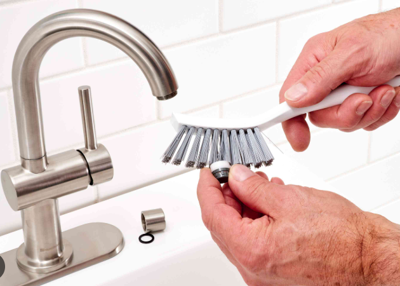
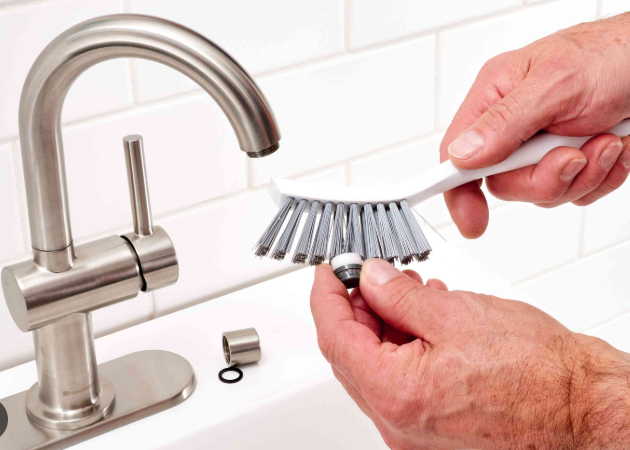
One of the most important components of your kitchen and bathroom isn’t much bigger than the common dime. But if it isn’t working properly, it can create major problems when it comes to cooking and washing. It’s called a faucet aerator and it’s the device that not only gives you optimum water pressure, but that also conserves your water consumption—something that’s good for the environment and that will also save you money.
But because the faucet aerator also acts like a water filter, it can become clogged over time with dirt and calcium deposits. When this happens, you need to remove the aerator to thoroughly clean it.
According to the pros at Aerator.com, you will achieve the highest return on investment only if you make an effort to clean and/or replace your faucet aerator in a timely manner. You can do this by using a special faucet aerator key. If you don’t use a key, you run the risk of damaging both your aerator and your faucet.
That said, when exactly should you repair and/or replace your faucet aerator? A recent report by Engineer Fix states that from a technical point of view, the faucet aerator is a small, round device that’s located on the tip of your kitchen and bathroom faucets. It mixes air into the water as it comes out of the tap, thereby increasing pressure while conserving the water volume you use. Aerators are a standard component on all kitchen and bathroom faucets. If they are operating properly, they will give you terrific water pressure while saving you money.
When To Replace Your Faucet Aerator
The precise time to replace your faucet aerator can depend on a few factors, including the hardness of the water supply. Water that contains a high mineral content can cause limescale build-up relatively quickly which means you might find yourself replacing your aerator, or aerators, once every six months.
High-frequency use faucets such as the kitchen sink might require more frequent aerator replacement. You might ask yourself, why bother with the expense of replacing your faucet aerator when you can clean it?
Cleaning only addresses mineral buildup and dirt accumulation, while the internal components, such as the plastic flow protectors and mesh screen, are said to degrade with time from constant exposure to hard water. That’s why in some cases, you’re better off swapping out your aerator for a new one, rather than attempting to clean it.
When Aerators Fail
When a faucet aerator fails, it is said to require immediate attention. This can happen even to relatively new aerators. The most common sign that a faucet aerator is failing? The reduction of water pressure whereby the water flow weakens, and it takes far longer than normal to fill the basin or even remove the soap from your hands. The cause of this is almost always an aerator that’s clogged with minerals, sediment, and dirt.
Another indicator that your aerator is failing is when tap water exits the faucet erratically. It can sputter or shoot out in all directions. When tap water is forced out of partially blocked screen, it leads to splashing. Another visible sign of aerator failure is a greenish or white crusty buildup around the aerator’s tip. If fluid leaks out of the faucet after it’s turned off, it means the aerator seal is compromised.
Making the Decision to Clean or Replace Your Aerator
According to Engineering Fix, when your aerator is clearly exhibiting signs of failure, no matter how old it is, your first decision is whether cleaning it will suffice or if you need to replace it. Cleaning is the most logical and less expensive first step for repairing performance issues. The process is relatively simple. It involves unscrewing the aerator, soaking it in white vinegar for 24 hours until the mineral scale dissolves.
If there are any deposits left over after soaking, you can use a toothbrush to gently scrub them away. But, if after cleaning, the water flow is still erratic, or the internal components of the aerator show visible signs of damage, it will need to be replaced.
Keep in mind that despite their diminutive size, a malfunctioning faucet aerator can cause big problems in both your kitchen and bathrooms. It pays to clean or replace them on a regular basis, especially if you live in an area where hard water is prevalent. If you feel as though you aren’t capable of replacing your own aerator, then it’s wise to call a licensed plumber.
(0) comments
We welcome your comments
Log In
Post a comment as Guest
Keep it Clean. Please avoid obscene, vulgar, lewd, racist or sexually-oriented language.
PLEASE TURN OFF YOUR CAPS LOCK.
Don't Threaten. Threats of harming another person will not be tolerated.
Be Truthful. Don't knowingly lie about anyone or anything.
Be Nice. No racism, sexism or any sort of -ism that is degrading to another person.
Be Proactive. Use the 'Report' link on each comment to let us know of abusive posts.
Share with Us. We'd love to hear eyewitness accounts, the history behind an article.