
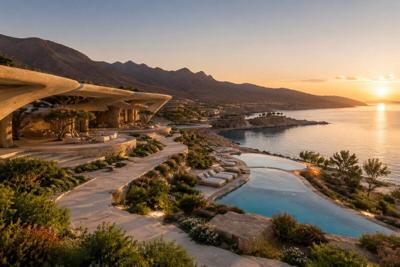

For decades, the conversation about high-end Hawaiian travel has centered on Maui and Oahu — manicured resorts, polished golf courses, and the well-trodden circuit of beachfront spas. The Big Island has always been the quieter sibling, known more for volcanoes and stargazing than for chaise lounges. That is changing. Slowly, and largely by design, Hawaii Island has become a destination for travelers looking for something the other islands struggle to offer: stillness, scale, and a relationship with the land that feels less curated than lived.
A Different Kind of Hawaii
Hawaii Island is larger than all the other Hawaiian islands combined, with the population density of a rural county. Drive an hour in any direction from Kailua-Kona and you can pass through coastal lava fields, high-altitude ranchland, rainforest, and coffee country — eight distinct climate zones depending on who is counting. The Kohala Coast holds the island's resort enclave. Kailua-Kona has the slower, lived-in feel of a working town. Hilo, on the eastern side, sits under the wettest skies in the state. The result is an island that resists being summarized, and that is much of the appeal.
Why the Geography Lends Itself to Wellness
The conditions on the Big Island read like a checklist for a wellness designer. The Kona side delivers reliable sun and warm dry air most of the year. The ocean is calm enough most mornings for swimming or paddling before breakfast. The agricultural base — Kona coffee, cacao orchards, macadamia farms, tropical fruit — feeds a culinary scene that has been quietly building its own gravitational pull. And the elevation range makes it possible to be at sea level in the morning and near the summit of Mauna Kea by afternoon, under a sky that holds some of the clearest stargazing on earth.
The more important variable, though, is harder to put on a brochure. The island is uncrowded. The pace of life is unhurried in a way visitors notice within a day. Quiet, on an island this size, is abundant — and quiet is increasingly what travelers are paying for.
The Spectrum of Wellness Stays Now Available
What has emerged here in the last decade is a full continuum of wellness travel rather than a single archetype. At one end, the Kohala Coast resorts offer week-long spa programs built around marine-mineral treatments, lomi lomi, and seasonal Hawaiian therapies. A growing roster of yoga and meditation retreats — some on agricultural land in the Kona uplands, others perched along the coast — cater to travelers who want a defined practice for a defined window of time.
A newer category sits between leisure and clinical care: longevity-leaning retreats, biohacking-inflected stays, and immersion programs that blend traditional Hawaiian healing with contemporary diagnostics. These appeal to guests who want measurable structure without giving up the destination experience.
At the most clinical end of the spectrum are residential mental and behavioral health programs that have set up in Kailua-Kona to take advantage of exactly what makes the island distinct. A representative example is The Ohana Hawaii Rehab, a three-acre residential program that pairs licensed clinical care for substance use and co-occurring mental health concerns with adventure therapy, gourmet dining, and Hawaiian cultural programming. The model is uncommon — small group sizes, an evidence-based clinical core, and a setting that is part of the therapeutic premise rather than a backdrop to it. Programs like this are what most clearly distinguish the Big Island's wellness offering from the rest of the state.
The Cultural Through-Line
What the strongest operators on the island share is not a design language or a price point, but a willingness to engage with Hawaiian wellness traditions on their own terms. ʻOhana — family, in its broadest sense — runs through hospitality here in a way that is hard to fake. Aloha ʻāina, the love and stewardship of land, shapes how serious programs handle their properties: gardens that feed the kitchen, native plantings, sourcing from neighboring farms. Pono, the concept of balance and rightness, surfaces in how schedules are built — work and rest, activity and stillness, individual and group.
These are not decorative references. The operators who do this well work with cultural practitioners, support local communities, and avoid borrowing language they have not earned. It is the part of a Hawaiian wellness stay that visitors most often describe as the thing they did not expect to take home with them.
How to Choose the Right Stay
The best advice for travelers considering the Big Island for a wellness trip is to match the program to the actual goal. A weekend spa stay is not the same as a two-week reset, and a yoga retreat is not the same as a residential program with clinical staff. Anything involving health care — anything offering treatment for mental health, substance use, or significant medical concerns — should be vetted for state licensing, accreditation, and clinician credentials before booking.
Allow more time than feels reasonable. The island's pace works against any itinerary that tries to compress it. Consider where on the island the program sits — Kohala for resort polish, Kailua-Kona for a quieter community feel, the windward side for rain and rainforest. And remember that the point of the trip is restoration, not consumption.
The Big Island's rise as a wellness destination has not been loud, and it probably will not get loud. The space, the quiet, and the working relationship with traditional practices that make it distinct do not scale the way resort wings do. That is precisely why travelers are finding their way there.





(0) comments
We welcome your comments
Log In
Post a comment as Guest
Keep it Clean. Please avoid obscene, vulgar, lewd, racist or sexually-oriented language.
PLEASE TURN OFF YOUR CAPS LOCK.
Don't Threaten. Threats of harming another person will not be tolerated.
Be Truthful. Don't knowingly lie about anyone or anything.
Be Nice. No racism, sexism or any sort of -ism that is degrading to another person.
Be Proactive. Use the 'Report' link on each comment to let us know of abusive posts.
Share with Us. We'd love to hear eyewitness accounts, the history behind an article.