
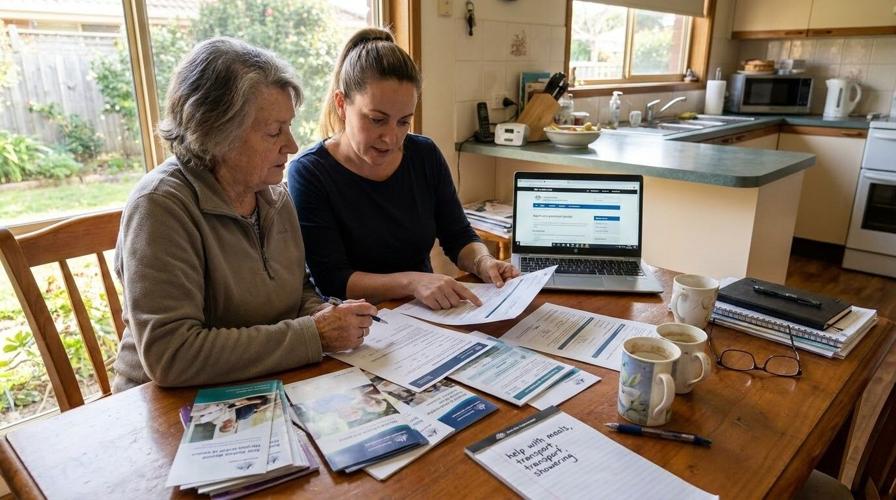


Most families don’t have a subsidy problem. They have a timing problem. They wait too long, panic, then sign whatever lands in front of them.
I’ve watched adult kids spend months arguing about “the best option” while Mum quietly struggles to shower safely. That’s not a strategy. That’s avoidance.
Start with the right program
In Australia, the front door for government-funded aged care support is My Aged Care, and the two main at-home pathways are the Commonwealth Home Support Programme for entry-level help and Support at Home for people with ongoing or more complex needs. Support at Home replaced the old Home Care Packages program on 1 November 2025, while CHSP continues as a separate entry-level program.
That distinction matters because people waste time chasing the wrong thing. If someone needs a bit of domestic help, transport, meals, or occasional personal care, CHSP often makes more sense than aiming straight for a bigger funded arrangement. If their needs keep stacking up, medication prompts, showering support, mobility help, allied health, regular coordination, then you look harder at Support at Home.
My blunt advice? Don’t start by ringing random providers. Start by getting clear on the actual level of need. I’ve seen families compare service brochures for three weeks, then find out the person wasn’t even assessed for that stream yet.
Get assessed before the wheels fall off
Aged care assessment drives access to funded services, and assessors use that process to work out what support a person can receive. For CHSP, the program focuses on helping older people stay independent at home and in the community, not turning the house into a mini nursing home.
So prepare like an adult. Have the medication list ready. Have recent hospital letters ready. Write down what the person can still do, what now takes too long, and what creates real risk. Don’t sugar-coat it out of pride. Assessors can’t fund a problem nobody admits exists.
The last time I helped a family through this, the daughter kept saying, “Dad’s fine, he just gets a bit puffed.” Translation? He couldn’t shower without sitting down, skipped meals, and hadn’t driven in months. Once we laid out the reality properly, the conversation changed fast.
You also need to think in tasks, not emotions. “Mum wants to stay at home” is understandable, but it’s useless on its own. “Mum needs help with showering twice a week, shopping, meal prep, and transport to appointments” gets traction. Specifics win. Vague fear doesn’t.
Know what the subsidy won’t cover

Government assistance helps, but it doesn’t magically erase every cost. Services Australia still uses income and assets information to work out contributions for aged care fees, and that means your home, savings, super income, and other assets can affect what you pay.
This is where families get sloppy. They hear the word “subsidy” and assume “free”. Not the same thing. Even with funded support, you still need to understand fees, service charges, and what comes out of the budget before you start celebrating.
A very practical example: in one government residential aged care fee scenario published in late 2025, a person with a home valued at $960,000 had the assessable value of that home capped at $210,555.20 for the means assessment. That single figure tells you something important. The rules can get technical fast, and guessing usually costs money.
This is the point where a decent personal finance advisor earns their keep. Not because they wave a magic wand. Because they can model what happens if you sell the house, keep the house, rent it out, give it to children, or draw income differently. I’ve had to clean up some truly heroic financial mistakes made by well-meaning relatives who thought they were being clever. They weren’t. They were just fast.
Also, stop making asset decisions before you understand the care pathway. Don’t rush to offload property because someone at a barbecue said “Centrelink will take the lot”. That sort of pub advice has done more damage than bad weather.
Choose providers with your eyes open
Under CHSP, providers must put a service agreement in place before services start and review support at least every 12 months. That sounds basic, and it is, but plenty of families still don’t read the agreement properly.
Here’s what I look for first. What does the hourly rate actually include? Are there travel charges? Is there a minimum visit length? How often do they swap support workers? Who answers the phone when something goes wrong on a Friday afternoon? Pretty brochures mean bugger all if nobody turns up.
If you’re comparing home care providers Sunshine coast it's understandable that many clients feel overwhelmed by the sheer number of options. The trick is to compare the service model, not just the headline rate. A cheaper provider who burns half your funded hours on admin, poor rostering, and constant staff changes can cost you more in real terms.
I also tell families to test responsiveness early. Ring with a normal question and see how they handle it. If they dodge clear answers before you sign, they are good once you’re locked in.
Avoid the common stuff-up list
People don’t usually lose out because the system is impossible. They lose out because they make the same avoidable mistakes over and over.
- Waiting for a crisis. You’ll make better decisions before the hospital social worker starts using the “urgent discharge” voice.
- Confusing eligibility with affordability. Approval for support does not tell you the full cost picture.
- Understating care needs in the assessment. Pride is expensive.
- Choosing a provider based on charm alone. Nice manners help. Reliable service helps more.
- Ignoring the paperwork. Service agreements, statements, and care plans exist for a reason.
One more thing. Keep a simple care file. One folder, paper or digital, I don’t care. Put assessment notes, medication lists, invoices, provider contacts, and fee letters in it. When things change, and they will, that file saves hours of nonsense.
Government funding can make senior living support far more manageable, but only if you treat the process like a practical project instead of an emotional fog. Get assessed early, understand the money, question every provider properly, and don’t hand major financial decisions to the loudest relative in the room.


(0) comments
We welcome your comments
Log In
Post a comment as Guest
Keep it Clean. Please avoid obscene, vulgar, lewd, racist or sexually-oriented language.
PLEASE TURN OFF YOUR CAPS LOCK.
Don't Threaten. Threats of harming another person will not be tolerated.
Be Truthful. Don't knowingly lie about anyone or anything.
Be Nice. No racism, sexism or any sort of -ism that is degrading to another person.
Be Proactive. Use the 'Report' link on each comment to let us know of abusive posts.
Share with Us. We'd love to hear eyewitness accounts, the history behind an article.