
If my first air fryer had been a bad one, I am not sure I would still be singing the praises of air frying today.
That is the truth no one tells you when they start waving around frozen fries and talking about how an air fryer will change your life. Yes, air fryers may all work from the same basic idea—fast-moving hot air in a compact chamber—but they do not perform the same, they do not feel the same, and they absolutely do not deliver the same level of crisp. That part matters. A lot.
I happened to get lucky on my first go-round. My old Ninja, a model that has since aged out of the spotlight, set the bar so high that it ruined me for a lot of the newer ones I have tested since. It preheats properly. It cooks evenly. It gives breaded foods that deeply satisfying crisp crunch that makes you feel like you pulled off something a little more impressive than weeknight frozen chicken. And, maybe most important of all, it does not make me work too hard to get there.
That is why I stand by this opinion with zero hesitation: not all air fryers are alike.
The Design Changes the Entire Experience
People tend to talk about air fryers as if they are interchangeable. They are not. The design alone can completely change how you feel about using one.
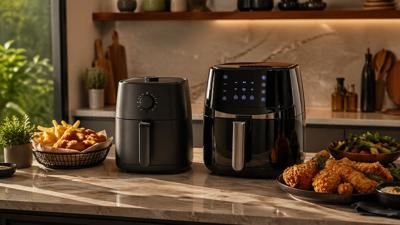
Some open from the top. Some pull out like a drawer. Some are essentially miniature countertop ovens with air-fry capability added in. Some have dual baskets. Some have windows. Some have touchscreens that look like they are preparing for a Mars launch instead of reheating leftover fries.
And that design is not just cosmetic. It affects how easily you can load food, how often you check on it, how much heat escapes when you open it, how easy it is to clean, and whether you will actually want to use it on a busy day.
I personally still love the older top-opening style I started with. It feels sturdier. It feels simpler. It feels easier. I know the drawer-style basket is now the more common setup, and I am open to being won over eventually, but I have yet to meet one that makes me forget my old Ninja.
If you love a kitchen gadget that actually earns its counter space, you can also explore our home and kitchen coverage.
Basket Quality Is a Bigger Deal Than People Realize
This is one of the most underrated differences between models.
Some baskets feel solid and substantial. Others feel light, flimsy, and oddly delicate for something meant to handle high heat, grease, crumbs, and constant scrubbing. That matters more than it sounds like it should. A basket is not just a container. It is part of the cooking performance, part of the cleanup experience, and part of whether the machine feels well made or annoyingly temporary.
I tend to prefer the heavier, sturdier baskets, even if they are a little less convenient to clean. The lighter ones may wash up faster, but I would trade easy cleanup for stronger performance and a more durable feel every single time. When I am air frying, I want something that feels dependable, not something that makes me nervous every time I wipe it down.
Basket size matters too. Some units look generous until you realize the actual usable cooking area is underwhelming. Others technically have a large capacity, but the shape works against you, forcing food to stack or crowd. And once you crowd an air fryer, you start losing the airflow that creates that coveted crisp finish in the first place.
Wattage and Heating Power Are Not Boring Details
They are the reason one batch of food turns out golden and crisp while another comes out pale, soft, and suspiciously disappointing.
Air fryers are essentially compact convection cookers, so power and airflow are not side notes. They are the whole game. In general, stronger heating systems and smart airflow design help food brown faster and more evenly, while basket shape and chamber size affect how efficiently hot air moves around the food.
That explains something I learned the hard way. I used to follow a time and temperature and get perfect results in my old Ninja. Then I tried other models and suddenly the exact same instructions did not deliver the same crispness. I was adjusting times, bumping temperatures, and still not getting the same crunch. It was not my imagination. Different machines simply cook differently.
That is one of the biggest mistakes people make when comparing air fryers. They assume that if two machines both say “air fry,” they should perform the same. Not even close.
More Buttons Do Not Always Mean a Better Appliance
In theory, extra presets sound helpful.
In reality, they can turn dinner into a minor administrative task.
I thought I was ready to retire my old, couple-button air fryer for a shiny new multifunction model with dual baskets and separate cooking zones. On paper, it sounded like an upgrade. In real life, it felt like homework. And if you are anything like me, you want dinner to go your way without needing a user manual and a small emotional support team. This one did not.
One of the easiest ways to make an air fryer feel less useful is to overcomplicate the controls. A touchscreen can look modern. A long list of functions can sound impressive. But if the interface is confusing, the appliance stops feeling helpful and starts feeling annoying.
That is why control logic matters so much. The best air fryer is not necessarily the one with the most features. It is the one that makes good food without making you feel like you need a tutorial every time you heat something up.
Preheat Behavior Matters More Than Brands Like to Admit
This may sound nitpicky, but it is not.
Some air fryers handle preheating beautifully. They warm up, prompt you to add the food, and keep the process moving without fuss. Others make preheating feel like a trap. You start the cycle, it heats up, it shuts off, and then if you do not get the food in fast enough, you are suddenly back at square one.
That kind of design breaks the rhythm of cooking. It sounds small, but it changes how natural the machine feels to use. And when a kitchen appliance becomes fussy, people stop reaching for it.
That is one reason I still adore my old Ninja. Its preheat cycle feels intuitive. It does what it should do, then tells me when to add the food, and from there the results are reliably crisp and satisfying. For everyday use, that kind of friction-free experience matters just as much as the final texture.
What Actually Makes a Good Air Fryer
After trying several of them, I do not care nearly as much about flashy features as I do about how the thing actually cooks.
Does it heat evenly? Does it get the food crispy? Is the basket sturdy? Is the capacity actually useful? Are the controls simple enough that I do not feel annoyed before dinner even starts? And does the preheat process help me instead of slowing me down?
That is really what separates a great air fryer from one that just looks impressive sitting on the counter.
My old Ninja is still the benchmark in my kitchen. Maybe that is nostalgia. Maybe it really was just built better. Whatever the reason, it taught me something valuable: if your first air fryer had been mediocre, you might assume air fryers are overrated. If your first one was excellent, you understand exactly why people get attached to them.
And because a great air fryer still has to cook food safely, it is worth bookmarking the USDA’s guidance on air fryers and food safety.
The Bottom Line
So I will say it one more time for the people in the back of the kitchen aisle: not all air fryers are created equal.
Some are clever. Some are complicated. Some are all promise and not enough crunch. And some, if you are lucky, earn permanent counter space.
I got lucky on my first one. It spoiled me. And after trying enough others to know better, I can say this with confidence: design, basket quality, power, and ease of use matter just as much as the name on the box.
And once dinner is over, safe storage still matters too. The USDA’s page on leftovers and food safety is a good one to keep handy.


(0) comments
We welcome your comments
Log In
Post a comment as Guest
Keep it Clean. Please avoid obscene, vulgar, lewd, racist or sexually-oriented language.
PLEASE TURN OFF YOUR CAPS LOCK.
Don't Threaten. Threats of harming another person will not be tolerated.
Be Truthful. Don't knowingly lie about anyone or anything.
Be Nice. No racism, sexism or any sort of -ism that is degrading to another person.
Be Proactive. Use the 'Report' link on each comment to let us know of abusive posts.
Share with Us. We'd love to hear eyewitness accounts, the history behind an article.