
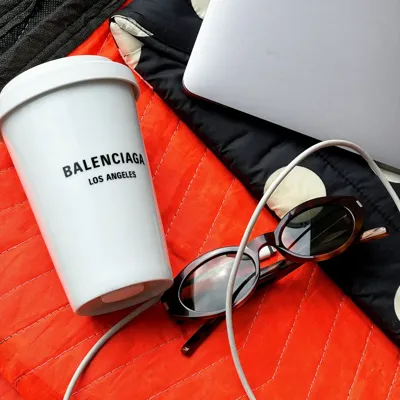

There is an uncomfortable truth about branded travel mugs that the industry tends to skip over. A travel mug only works as marketing if someone actually carries it. Not owns it, not received it at an event, not has it somewhere in a kitchen: carries it, daily, out into the world where other people can see the logo. And an enormous number of branded mugs never make that leap from the cupboard to the commute. They were the wrong size, or they leaked, or they were uncomfortable to hold, or they simply were not nice enough to reach for over the other mug already on the shelf. The branding was fine. The habit never formed.
This matters because the entire promotional value of a travel mug rests on repeated use. The logic that makes drinkware such a strong promotional category, that it gets kept and seen far more than a leaflet or a pen, only holds if the item is genuinely in daily circulation. A mug carried every morning is seen by the owner, by everyone on their train or in their office, by the queue in the coffee shop, over and over for months or years. That repetition is where the value is. But it is entirely conditional on the mug being good enough that someone chooses to use it, unprompted, again and again. A logoed object that people are given uses the merchandise budget; a logoed object that people actually carry earns it.
So the real design brief for a promotional travel mug is not “how do we get our logo on it” but “how do we make something people will want to reach for”. Those are different questions, and the second is the harder and more important one. This UK drinkware specialist thinks about the second, because the answer determines whether the whole exercise pays off, and it comes down to a handful of unglamorous practical qualities that decide whether a mug becomes a habit or a cupboard ornament.
Comfort in the hand is the first. A mug that is awkward to hold, too wide, too slippery, badly balanced when full, is a mug people quietly stop using. It never announces the problem; it just gets left behind on busy mornings until it is left behind every morning. The way it feels to carry and drink from is not a luxury consideration, it is the thing that gets tested every single day, and it fails silently.
Reliability is the second, and leaking is its enemy. A travel mug that has once tipped its contents into a bag, over a laptop, across a car seat, has usually earned itself a permanent place at the back of the shelf. Trust, once broken by a leak, is very hard to rebuild, and people do not give a mug many second chances. A lid that seals properly and a mug that can be trusted upside down in a bag is not a premium feature; it is the baseline that keeps the mug in use at all.
Then there is the simple question of whether the mug is nice enough to prefer. Most people who would use a travel mug already own one. A new branded mug is competing with the incumbent, and it only wins if it is genuinely better or nicer in some way: keeps the drink hotter, feels better to hold, looks good enough that they are happy to be seen with it. A cheap, flimsy, forgettable mug loses that competition instantly and goes unused, whatever is printed on it. Quality here is not vanity; it is what earns the mug its place in someone’s routine over the mug they already have.
There is a comfortable-feeling assumption behind a lot of merchandise spending that giving something away is the same as getting it used. It is not. The handover is the easy part. What happens in the weeks after, whether the item survives the honest test of daily life or quietly drops out of it, is what decides whether the money did anything. For a travel mug, that test is unusually demanding, because it is used, washed, carried and judged every day, and any weakness shows up fast.
The practical lesson is to spend where it counts and choose for the habit, not the handover. It is better to give fewer, better mugs that get carried than a great many cheap ones that get abandoned, because a hundred mugs in cupboards advertise less than twenty on commutes. Pick something comfortable to hold, genuinely leak-resistant, and good enough that the recipient would have been happy to buy it themselves. Get that right and the mug does what it was bought to do, day after day, in front of exactly the people you wanted to reach. Get it wrong and you have paid to fill the nation’s cupboards, which is a poor return on a marketing budget.


(0) comments
We welcome your comments
Log In
Post a comment as Guest
Keep it Clean. Please avoid obscene, vulgar, lewd, racist or sexually-oriented language.
PLEASE TURN OFF YOUR CAPS LOCK.
Don't Threaten. Threats of harming another person will not be tolerated.
Be Truthful. Don't knowingly lie about anyone or anything.
Be Nice. No racism, sexism or any sort of -ism that is degrading to another person.
Be Proactive. Use the 'Report' link on each comment to let us know of abusive posts.
Share with Us. We'd love to hear eyewitness accounts, the history behind an article.