
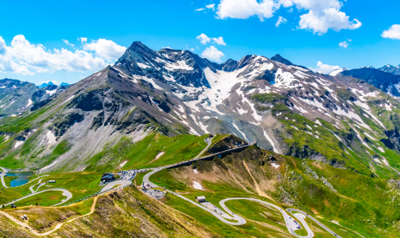

A modern grand tour is an extended journey through several European regions, with enough time for each destination to feel like more than a stopover. Travelling across Europe need not mean a succession of airport terminals and hurried transfers. Railways, coastal crossings, and river routes allow the scenery to change gradually, from snow-covered Alpine peaks to Mediterranean harbours and the long summer light of northern waters.
An extended itinerary draws its character from these contrasts. A historic rail journey may lead to a private cultural evening, then onwards to a maritime crossing, a terraced river valley, and quieter northern waters. The route connects these experiences into one continuous journey, allowing every destination to become an occasion in its own right.
Riding Private Alpine Railways Through Jungfrau, Switzerland
The journey to Jungfraujoch begins in the valleys of the Bernese Oberland, following either the route through Grindelwald Terminal or the railway through Lauterbrunnen, Wengen, and Kleine Scheidegg. Rail connections require careful coordination when planning a 3-day luxury Switzerland package, since reaching Jungfraujoch involves several stages. Private road transfers, luggage handling, and a guide can make those changes easier, but the mountain ascent takes place on scheduled public services. From Grindelwald Terminal, the Eiger Express climbs to Eigergletscher, where passengers join the Jungfrau Railway for the final ascent.
Much of this final stage runs through tunnels inside the Eiger and Mönch before arriving at Jungfraujoch, Europe’s highest railway station, at 3,454 metres. From the station, an elevator carries visitors to the Sphinx viewing terrace, where the Aletsch Glacier stretches below the surrounding Alpine peaks. Depending on the chosen route, the descent returns through Grindelwald or Wengen, with snowfields gradually giving way to green pastures, timber chalets, and village rooftops. That transition keeps the return journey from feeling like a simple transfer back to the valley.
Attending Private Concerts Inside Imperial Palaces in Vienna, Austria
After the high-altitude landscapes of Switzerland, Vienna shifts the grand tour toward architecture, music, and imperial history. The Hofburg served as the Habsburgs’ principal residence for centuries, and its ceremonial rooms preserve the scale and ornament of court life. A private chamber performance places the music within that architectural context, with gilded details, chandeliers, and high ceilings surrounding a smaller audience.
The repertoire may draw from composers closely associated with Vienna, including Mozart, Haydn, Schubert, and Strauss, although the program and ensemble depend on the event. A string quartet or solo recital also creates a different relationship with the room than a large public concert, allowing the audience to notice both the performance and its setting. In a longer European journey, the evening provides a cultural counterpoint to the Alpine railway leg and gives the Austrian stage an occasion of its own.
Watching the Grand Prix from a Harbour Side Terrace in Monaco
Leaving Vienna's chamber music behind, the grand tour heads south toward a dramatically different spectacle. The Monaco Grand Prix transforms the Port Hercule waterfront into a street circuit bordered by team facilities, grandstands, temporary barriers, and harbour-side yachts. High-speed cars surge out of the tunnel and brake hard for the Nouvelle Chicane, which can be viewed from select elevated terraces.
Those chasing coveted F1 tickets should distinguish between grandstand admission and hospitality access to a private terrace. Sightlines vary by building: some overlook the harbour or swimming-pool complex, while others face La Rascasse or sections nearer the start-finish straight. Dining, balcony access, and views of the circuit also depend on the specific arrangement and should be confirmed in advance. Across practice, qualifying, and race day, Monaco provides a sharp change of pace after Vienna, with the performance now unfolding through the streets at racing speed.
Tasting Port Wine on Terraced Hillsides in Douro Valley, Portugal
From the glitz and high-octane energy of Monaco, the journey transitions west to the Iberian Peninsula. Leaving Porto behind, the railway follows the Douro River east into the wine-growing valley. Generations of labour shaped the steep slopes into terraces supported by schist walls, creating geometric lines that change with the river’s bends. The train remains close to the water for much of the journey, making the transition from the coastal city to the vineyard landscape part of the experience.
At some quintas, grapes are still crushed by foot in granite lagares during the autumn harvest before the wine is fortified and aged. Tastings may take place on terraces overlooking the river, with vintage and tawny ports revealing how aging methods influence the finished wine. Historic agricultural buildings now sit alongside contemporary tasting rooms constructed from glass, stone, and timber. Spending an afternoon at a quinta connects the Portuguese stage of the grand tour to the cultivation, craftsmanship, and time required to produce port on this demanding terrain.
Sailing Through Fjords Beneath the Midnight Sun in Norway
Northern Norway provides a fitting conclusion to the grand tour as private yachts enter the fjords around Tromsø and the Lyngen Alps. Steep mountains rise directly from the water, with lingering snowfields and narrow waterfalls visible along the slopes. North of the Arctic Circle, the summer sun remains above the horizon for weeks, casting low light across the landscape even around midnight.
Long daylight hours allow dinner to continue on deck without the usual transition into darkness. Menus may feature local cod, halibut, or Arctic char, followed by berries gathered in the north during their brief summer season. The route can pass fishing communities, small harbours, and cliffs where seabirds gather, with conditions determining how far the yacht enters the narrower channels. After Alpine railways, palace concerts, a Mediterranean race weekend, and the terraced vineyards of the Douro, sailing through northern Norway concludes the journey in long summer daylight and relative stillness.
Where does your grand European route begin?
A grand tour takes shape through the relationship between its destinations. Alpine railways lead to Vienna’s concert halls, Monaco changes the tempo with a race weekend, and the Douro Valley introduces a slower passage through vineyards and riverside estates. Northern Norway then brings the journey to a close beneath the extended daylight of the Arctic summer.
The route does not need to follow this exact order, but every stage should contribute something different to the journey. Begin with the experience that matters most, then plan the remaining stops around logical connections and enough time in each place. The result should feel like one continuous passage through Europe, with the travel between destinations carrying as much purpose as the time spent in them.


(0) comments
We welcome your comments
Log In
Post a comment as Guest
Keep it Clean. Please avoid obscene, vulgar, lewd, racist or sexually-oriented language.
PLEASE TURN OFF YOUR CAPS LOCK.
Don't Threaten. Threats of harming another person will not be tolerated.
Be Truthful. Don't knowingly lie about anyone or anything.
Be Nice. No racism, sexism or any sort of -ism that is degrading to another person.
Be Proactive. Use the 'Report' link on each comment to let us know of abusive posts.
Share with Us. We'd love to hear eyewitness accounts, the history behind an article.