
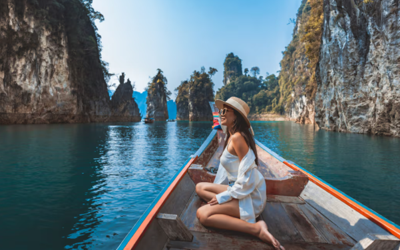

For decades, the defining characteristic of luxury travel was seamless convenience. The goal was immediate access: private air transfers landing at major hubs, guaranteed five-star white-glove amenities in high-density cultural capitals, and effortless proximity to iconic global monuments. If reaching a resort required a complex multi-leg transfer, it was often seen as an inconvenience, not part of the experience.
Today, that idea has shifted. For seasoned high-net-worth travellers, mainstream luxury has become too familiar to feel exclusive. Easy access no longer carries the same sense of exclusivity. The modern marker of elite status isn’t how quickly or easily a destination can be reached. It’s the privilege of experiencing places where visitor numbers are intentionally limited, and exclusivity is preserved through geography, conservation, and carefully managed access. As truly remote destinations become increasingly rare, affluent, well-travelled individuals are seeking environments where that sense of exclusivity still exists.
Mainstream luxury has become too familiar to feel exclusive. Easy access no longer carries the same sense of exclusivity. The modern marker of elite status isn’t how quickly or easily a destination can be reached. It’s the privilege of accessing places where visitor numbers are intentionally limited, and exclusivity is preserved through geography, conservation, and carefully managed access. As physical isolation becomes increasingly rare, well-travelled individuals are choosing remote environments where geography, climate, and conservation policies naturally limit access.
Marine Park Permits Are Capping Visitor Numbers by Design
In some of the world’s most fragile marine ecosystems, conservation authorities deliberately limit visitor numbers to protect biodiversity. Entry permits, conservation fees, vessel restrictions, and allocated mooring sites help prevent over-tourism while preserving the natural environment. These measures also make access significantly more exclusive.
In Indonesia’s Coral Triangle, for example, the Raja Ampat Marine Park authority strictly limits the number of liveaboards and charter vessels operating within designated sanctuary zones. Operators must secure non-transferable permits, pay conservation fees, and follow seasonal access schedules before entering these protected waters. For travellers arranging a Raja Ampat yacht charter, these access restrictions turn the journey into a rare privilege. Cruising through remote karst archipelagos aboard a traditional phinisi yacht opens access to untouched reefs far from commercial maritime routes. Limited visitor numbers help keep these reefs remarkably uncrowded.
Similar conservation policies shape other protected marine destinations. Visitor permits in the Galápagos Marine Reserve and strict maritime quotas around the Seychelles’ Aldabra Atoll help preserve fragile ecosystems while limiting human impact. Increasingly, luxury travel is defined not by unrestricted access but by carefully managed access that protects the places travellers come to experience.
Remote Work Now Justifies Multi-Day Journeys to Arrive
Reliable satellite internet, particularly low-earth orbit networks such as Starlink, has changed how affluent travellers approach remote destinations. Executives, business owners, and investors are no longer limited to short trips built around direct flights and quick transfers. Staying connected throughout the journey makes longer, more complex itineraries far more practical.
With high-speed broadband available on private sailing catamarans in the South Pacific, mobile tented camps in the Sahara, and high-altitude lodges in the Himalayas, travellers can remain productive while in transit. Multi-day journeys involving commercial flights, charter aircraft, helicopter transfers, and overland 4x4 travel become easier to justify when work can continue along the way.
Rather than viewing transit as lost time, many travellers now use it to lead video calls, oversee business operations, or simply ease into a slower pace before reaching their destination. As a result, remote regions such as the Kazakh Steppe, Fiji’s outer islands, and the high-altitude deserts of South America have become more accessible to travellers who previously couldn’t spend days away from reliable connectivity.
Sparse Populations Are Meeting a New Demand for Space
High population density and urban congestion are increasingly perceived as liabilities by affluent travellers. In an era when iconic European capitals, Mediterranean coastal towns, and traditional island resorts face severe peak-season crowding, destinations defined by vast landscapes and minimal human presence offer an antidote: absolute spatial privacy.
If you’re planning luxury Namibia safari holidays, you’ll find that the defining luxury is space. Southern Africa’s Namib Desert is one of the oldest and most sparsely populated regions on Earth, with an average population density of roughly four people per square kilometre across the country. Private concessions in regions such as Sossusvlei, the Skeleton Coast, and Kaokoland span hundreds of thousands of acres while accommodating only a handful of guests at any given time.
Here, fly-in wilderness camps built on stilted platforms sit amid 300-meter-high rust-red sand dunes and ancient dry riverbeds. Guests can explore dark-sky reserves with almost no light pollution, watch desert-adapted elephants and black rhinos cross barren landscapes, and experience silence uninterrupted by commercial air traffic. The status marker isn’t the opulence of the suite. It’s the luxury of having an entire horizon without another person in sight.
Social Media Sameness Is Driving Travellers to the Unphotographed
The saturation and homogenisation of travel content across digital platforms have drastically diminished the prestige of traditional bucket-list destinations. When iconic vistas, such as the overcrowded viewpoints of Santorini and Positano and the manicured infinity pools of Bali, are algorithmically amplified and reproduced millions of times, they lose their distinctiveness. For seasoned luxury travellers, visiting a location that has been thoroughly documented and commercialised offers little sense of personal discovery.
This visual exhaustion is driving a distinct shift toward the "unphotographed". These are destinations that lack geotagged landmarks, commercial photo infrastructure, or standardised tourist circuits. Whether it involves private helicopter drops onto untouched powder basins in the Caucasus Mountains, overland expeditions across the sandstone canyons of Chad’s Ennedi Plateau, or guided treks through the primary rainforests of the Congo Basin, the goal is simple: to experience landscapes that remain raw, challenging, and largely absent from mainstream digital culture.
Vanishing Reefs and Ice Are Adding Urgency to Remote Trips
Climate change is adding a new sense of urgency to remote luxury travel. Polar regions such as Greenland, Svalbard, the Canadian Arctic, and Antarctica, along with fragile coral reef ecosystems, are already experiencing visible environmental change.
As a result, discerning travellers are increasingly prioritising expedition voyages to experience these remote environments while they can still be seen in their current state. This demand has encouraged the development of luxury ice-strengthened expedition vessels with PC6 ice-class hulls, dynamic positioning systems that eliminate the need for anchoring on sensitive seabeds, and hybrid-electric propulsion designed to reduce noise and emissions.
These expeditions allow guests to witness calving glaciers, observe polar bears on sea ice, and kayak through remote fjords alongside marine biologists and polar experts. Beyond the experience itself, they offer a chance to understand some of the world’s most fragile environments before further environmental change reshapes them.
Why Is Remoteness the New Luxury?
Remoteness has become one of the defining markers of modern luxury travel because it can’t be replicated through comfort or convenience alone. Reaching these destinations often requires time, careful planning, permits, and a willingness to travel beyond established tourist routes. In return, travellers gain something increasingly difficult to find: pristine natural environments, genuine solitude, and experiences shaped by conservation rather than mass tourism.


(0) comments
We welcome your comments
Log In
Post a comment as Guest
Keep it Clean. Please avoid obscene, vulgar, lewd, racist or sexually-oriented language.
PLEASE TURN OFF YOUR CAPS LOCK.
Don't Threaten. Threats of harming another person will not be tolerated.
Be Truthful. Don't knowingly lie about anyone or anything.
Be Nice. No racism, sexism or any sort of -ism that is degrading to another person.
Be Proactive. Use the 'Report' link on each comment to let us know of abusive posts.
Share with Us. We'd love to hear eyewitness accounts, the history behind an article.