
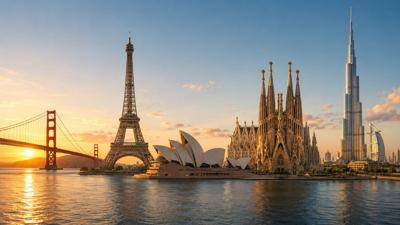
The world has never stopped building wonders. We simply stopped agreeing on which ones deserve the title.
The World Travel & Tourism Council is attempting to change that with a new global campaign inviting the public to help choose the 7 Contemporary Wonders of the World. The search is open to human-made landmarks, buildings, institutions and resorts created from 1801 to the present day.
Unlike a list chosen quietly inside a conference room, this one begins with public nominations. Anyone can suggest a destination that has changed the way people experience a city, strengthened its community or inspired travelers to cross an ocean just to see it in person.
The campaign will unfold over the next year. Seventy nominees will be revealed in January 2027, followed by a public vote, a shortlist of 30 finalists in April and the announcement of the seven winners on July 7, 2027.
That gives travelers plenty of time to argue over the possibilities—and there will undoubtedly be arguments. One person’s architectural masterpiece is another person’s overcrowded photo stop. Still, certain places have become so closely tied to their destinations that imagining one without the other feels nearly impossible.
These are the contemporary wonders we believe deserve a serious place in the conversation.
The Eiffel Tower in Paris
It is difficult to discuss modern landmarks without beginning with the Eiffel Tower. Completed in 1889 for the Exposition Universelle, the iron structure was originally intended to remain standing for only 20 years. Paris would look rather different today had that plan been followed.
Once criticized by prominent French artists and writers, the tower has become one of the most recognizable structures on Earth. Its influence extends well beyond architecture. It appears on postcards, perfume bottles, movie posters and probably more questionable souvenir T-shirts than anyone could count.
Most importantly, the Eiffel Tower changed the identity of Paris. It proved that a structure built for a temporary event could become the enduring symbol of an entire nation.
The Golden Gate Bridge in San Francisco
Some landmarks are admired from a distance. The Golden Gate Bridge is experienced in motion, whether travelers are driving across its span, sailing beneath it or watching the fog drift through its towers from the Marin Headlands.
Opened in 1937, the bridge connected San Francisco with Marin County while solving what many engineers had considered an impossible construction challenge. Its International Orange exterior was selected in part to improve visibility through the region’s famous fog, but it also gave the bridge a visual identity unlike any other.
The Golden Gate Bridge is both essential infrastructure and public artwork. Few engineering projects have managed to perform a practical job while looking quite so photogenic doing it.
The Sydney Opera House in Australia
The Sydney Opera House does not merely sit beside the harbor. It appears to rise from it.
Its sculptural roofline has been compared to sails, shells and ocean waves, although Danish architect Jørn Utzon resisted reducing the design to any single interpretation. Completed in 1973, the building challenged conventional ideas about what a performance venue could look like and helped reshape Sydney’s global image.
Today, the opera house is recognized almost instantly even by people who have never attended a performance there. That ability to become a destination in its own right is exactly what a contemporary wonder should possess.
La Sagrada Família in Barcelona
Barcelona’s most famous basilica has been under construction since 1882, which makes complaining about a delayed kitchen renovation feel slightly dramatic.
Designed by Antoni Gaudí, La Sagrada Família combines Gothic traditions with forms inspired by plants, trees and natural geometry. Its towers rise above Barcelona like something imagined rather than engineered, while the interior’s branching columns create the feeling of standing beneath a stone forest.
The fact that the basilica remains unfinished has become part of its fascination. Visitors do not simply see a completed monument; they witness a landmark continuing to evolve across generations.
The Burj Khalifa in Dubai
Dubai has never been especially interested in thinking small, and the Burj Khalifa may be the clearest expression of that ambition.
Opened in 2010, the skyscraper rises more than half a mile above the city and remains the tallest building in the world. Its height is impressive, but its greater significance lies in how dramatically it changed perceptions of Dubai.
The tower became the centerpiece of a destination built around record-setting architecture, luxury hospitality, shopping and entertainment. It did not merely join the skyline. It created the skyline most travelers now associate with the city.
The Guggenheim Museum Bilbao
Before the Guggenheim Museum opened in 1997, Bilbao was better known as an industrial city than an international cultural destination. Frank Gehry’s titanium-clad museum helped rewrite that story.
The building’s curved exterior appears different from every angle, reflecting the river, sky and changing light. Inside, monumental galleries accommodate contemporary works that would overwhelm a more traditional museum.
The museum’s influence became so significant that the term “Bilbao effect” entered discussions about how major cultural projects can help revive cities. Architecture does not always transform a local economy, but Bilbao demonstrated what can happen when an extraordinary building, strong cultural programming and destination investment work together.
The Statue of Liberty in New York
Since its dedication in 1886, the Statue of Liberty has greeted millions of people arriving in New York Harbor. For generations of immigrants, it represented the first visible sign that a difficult journey was nearing its end.
The monument was a gift from France to the United States, but its meaning has grown far beyond the circumstances of its creation. It has become an international symbol of liberty, migration, possibility and the complicated promise of a new beginning.
Many landmarks are visually recognizable. Far fewer carry such immediate emotional weight.
Marina Bay Sands in Singapore
Three towers connected by what appears to be an enormous ship in the sky could easily have become an architectural gimmick. Instead, Marina Bay Sands helped establish a new visual identity for Singapore’s waterfront.
Opened in 2010, the development combines a luxury hotel, restaurants, shops, entertainment spaces and one of the world’s most photographed rooftop pools. The property also demonstrates how a contemporary wonder might differ from the monuments of earlier centuries.
Modern landmarks are not always statues, bridges or ceremonial buildings. Some are complex destinations that combine architecture, hospitality and public experience on a scale that changes how visitors move through a city.
The Palm Jumeirah in Dubai
The Palm Jumeirah is remarkable before a traveler ever sets foot on it. Viewed from above, the artificial archipelago forms the shape of a palm tree extending into the Arabian Gulf.
Its construction expanded Dubai’s coastline and created space for resorts, residences, restaurants and beaches where open water once stood. The engineering required to shape and protect the islands was enormous, as was the ambition behind transforming reclaimed land into an internationally known destination.
Environmental questions surrounding large-scale coastal development deserve consideration, particularly when assessing what responsible tourism should look like. Even so, the Palm’s influence on resort development and destination branding cannot be ignored.
The Grand Egyptian Museum in Giza
Standing near the pyramids, the Grand Egyptian Museum creates a bridge between one of the world’s oldest civilizations and one of its newest major cultural institutions.
The enormous museum was designed to house and interpret Egypt’s archaeological treasures on a scale that earlier facilities could not accommodate. Its location provides visitors with a rare dialogue between ancient objects, contemporary architecture and the landscape in which much of that history unfolded.
The museum also raises an intriguing question for the WTTC campaign: Can a contemporary building become a wonder partly because of how well it presents the wonders that came before it? In this case, the answer may be yes.
The Channel Tunnel Between England and France
Not every wonder needs a dramatic silhouette. Some disappear beneath the landscape entirely.
Opened in 1994, the Channel Tunnel created a direct rail connection beneath the English Channel between Britain and continental Europe. The project required extraordinary engineering, international cooperation and the stubborn belief that trains should be able to travel through ground previously occupied by a great deal of seawater.
Its tourism impact is easy to underestimate because the tunnel has become part of ordinary European travel. That normality is arguably the achievement. A journey that once required a flight or ferry became a direct rail trip between major cities.
The Sphere in Las Vegas
Las Vegas has never lacked buildings designed to attract attention, but the Sphere still managed to make the rest of the Strip pause and look up.
Opened in 2023, the enormous venue is wrapped in a programmable exterior display capable of transforming the building into an eye, a planet, a basketball or nearly anything else its creators can animate. Inside, immersive screens and advanced sound technology attempt to rethink the traditional concert and entertainment experience.
It may be too new to know whether the Sphere will remain culturally important for decades. However, the WTTC campaign is partly about identifying landmarks shaping the future of travel, not merely honoring structures that have already survived a century. On those terms, the Sphere deserves consideration.
What Actually Makes a Contemporary Wonder
The most obvious choice is not necessarily the right one.
According to the WTTC campaign criteria, a contemporary wonder should be made by human hands, created since 1801, open to discovery and capable of creating meaningful opportunities for its destination. Architectural beauty matters, but so do community value, tourism impact and the ability to change how a place is understood.
That broader definition leaves room for famous icons as well as emerging landmarks that have not yet appeared on every traveler’s bucket list. It also prevents the final selection from becoming nothing more than a popularity contest among the world’s most photographed buildings.
A true contemporary wonder should make people curious about the place surrounding it. It should support a destination rather than simply consume it. And ideally, it should remain impressive after the visitor has put down the phone and stopped searching for the perfect selfie angle.
How to Nominate a Landmark
Public nominations for the 7 Contemporary Wonders of the World opened on July 7, 2026. Travelers can submit their choices through the official WTTC Contemporary Wonders website.
The official list of 70 nominees is scheduled to be announced on January 7, 2027, when public voting will begin. Thirty finalists will be revealed on April 7, followed by the seven selected wonders on July 7, 2027.
Until then, the debate is wide open. Perhaps the winners will be familiar landmarks already printed on millions of postcards. Perhaps a less celebrated structure will finally receive the attention it deserves.
Either way, choosing only seven will be the easy part—provided nobody expects the rest of the world to agree.
(0) comments
We welcome your comments
Log In
Post a comment as Guest
Keep it Clean. Please avoid obscene, vulgar, lewd, racist or sexually-oriented language.
PLEASE TURN OFF YOUR CAPS LOCK.
Don't Threaten. Threats of harming another person will not be tolerated.
Be Truthful. Don't knowingly lie about anyone or anything.
Be Nice. No racism, sexism or any sort of -ism that is degrading to another person.
Be Proactive. Use the 'Report' link on each comment to let us know of abusive posts.
Share with Us. We'd love to hear eyewitness accounts, the history behind an article.