


For many Florida property owners, especially those with high-value homes, one of the most misunderstood roofing questions has always been simple:
“How old is the roof?”
For years, roof age alone often influenced insurance decisions, real estate conversations, HOA concerns, and contractor recommendations. But throughout Florida, that conversation is changing.
Florida Statute 627.7011, often referred to as Florida’s Roof Age Law, has helped move the discussion away from age alone and toward a more accurate standard: documented roof condition.
That distinction matters.
An older roof is not automatically a failed roof. At the same time, the law does not suggest that every older roofing system should be preserved. Some roofs truly reach the end of their useful life and require replacement.
The key is determining which roof is which.
That requires proper inspection, documentation, certification, and remaining useful life evaluation.
As a Florida Certified Roofing Contractor specializing in roof certifications, remaining useful life evaluations, and tile roof preservation, I have seen firsthand how often roofing systems are misunderstood.
One of the most common misconceptions is that roofs fail evenly.
They do not.
Most roof systems begin to fail in specific areas long before the entire roof reaches the end of its service life. High-water-flow valleys, roof-to-wall transitions, flashing areas, penetrations, skylights, tie-ins, and prior repair locations often deteriorate faster than the surrounding field sections.
These areas handle more water, more movement, and more stress. They are also frequently the source of leaks, interior damage, and premature replacement recommendations.
For luxury homeowners, this distinction is especially important. A full tile roof replacement can be a major capital project, often involving high cost, disruption, permitting, material matching, and aesthetic considerations.
But in many cases, the tile itself has not failed.

Instead, the underlying issue may be deteriorated underlayment, flashing deficiencies, mortar failure, broken tiles, roof-to-wall water intrusion, or localized construction defects.
When the overall roof remains structurally sound, full replacement may not always be the only responsible option.
Tile roof preservation is becoming an increasingly important part of Florida’s roofing future.
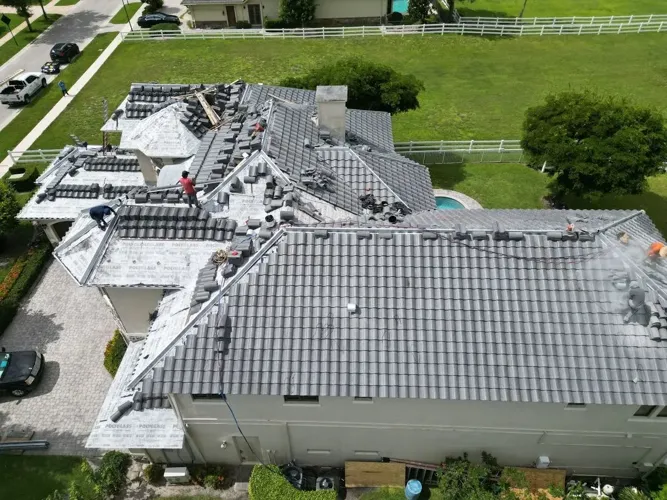
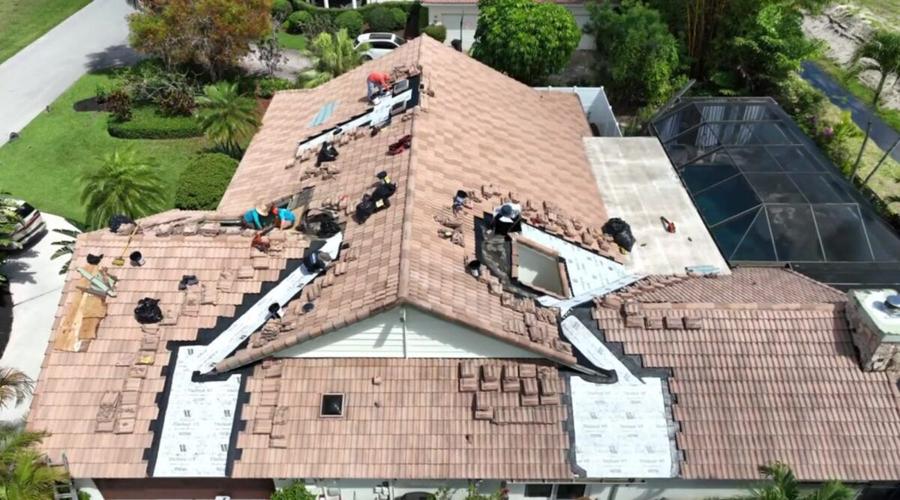
A proper preservation approach may include removing tile in affected sections, inspecting sheathing and plywood, replacing compromised decking where necessary, installing new tile underlayment, correcting flashing details, sealing vulnerable transitions, replacing broken tiles, improving water flow areas, and documenting the work with photographs and inspection records.
The goal is not simply to stop a leak.
The goal is to preserve the roofing asset, extend service life, support insurance and real estate documentation, and give the property owner a clear understanding of the roof’s actual condition.
This is where roof certifications and Remaining Useful Life evaluations become valuable.
A roof certification provides professional documentation regarding the present condition of the roofing system. A Remaining Useful Life evaluation helps determine whether the roof can reasonably be expected to continue performing for a defined period of time.
For homeowners, this provides clarity.
For real estate professionals, it can reduce uncertainty during transactions.
For HOA boards and property managers, it can support reserve planning and maintenance decisions.
For insurance review, it may provide condition-based documentation instead of relying only on the original installation date.
For contractors, it raises the standard of inspection and reporting.
In Florida, documentation has become almost as important as construction.
Property owners increasingly need inspection reports, roof certifications, remaining useful life evaluations, repair histories, maintenance records, warranty information, and before-and-after photographs.
A contractor who can provide that level of documentation creates more long-term value than one who simply performs a repair and issues an invoice.
Florida’s Roof Age Law accelerated a shift that was already taking place.
The roofing conversation is no longer simply repair versus replacement.
It is now about condition, useful life, preservation, documentation, and making the correct roofing decision based on evidence.
That is a positive development for Florida property owners.
Roofs should not be judged by age alone. They should be evaluated by actual condition, documented construction findings, and remaining useful life.
As insurance challenges, construction costs, and aging roofing systems continue to affect Florida homeowners, the contractors who understand this shift will be best positioned to serve the market.
Florida’s Roof Age Law is not simply changing how roofs are discussed.
It is changing how roofs are inspected, certified, preserved, documented, and understood.
Author Attribution
Mike McGilvary
Florida’s Roof Age Law Advocate & Tile Roof Preservation Advocate
Florida Certified Roofing Contractor CCC1331721
Author Bio

Mike McGilvary is a Florida Certified Roofing Contractor (CCC1331721), founder of Mike McGilvary Roofing, Inc., and a leading advocate for condition-based roofing decisions, roof preservation, and professional roof documentation throughout Florida. Based in Palm Beach County, he specializes in roof certifications, Remaining Useful Life evaluations, tile roof preservation, forensic roof inspections, and repair-first strategies that help property owners understand when a roof can be responsibly preserved—and when replacement is truly warranted.

(0) comments
We welcome your comments
Log In
Post a comment as Guest
Keep it Clean. Please avoid obscene, vulgar, lewd, racist or sexually-oriented language.
PLEASE TURN OFF YOUR CAPS LOCK.
Don't Threaten. Threats of harming another person will not be tolerated.
Be Truthful. Don't knowingly lie about anyone or anything.
Be Nice. No racism, sexism or any sort of -ism that is degrading to another person.
Be Proactive. Use the 'Report' link on each comment to let us know of abusive posts.
Share with Us. We'd love to hear eyewitness accounts, the history behind an article.