
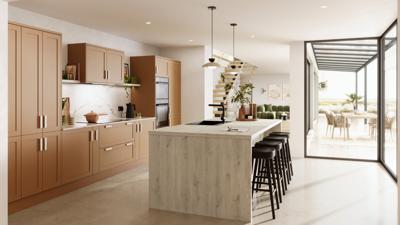

A beautiful kitchen worktop has an unusually difficult job. It needs to look good enough to anchor the entire room while surviving hot pans, hurried breakfasts, spilled coffee, dinner preparation and whatever else daily life puts on it.
That makes choosing one less about finding the prettiest slab in the showroom and more about finding the material you will still be happy living with years from now.
For homeowners renovating in Edinburgh, there is another consideration. Kitchens here can sit inside everything from traditional tenements and Georgian properties to contemporary extensions filled with glass and natural light. The right worktop should feel appropriate to the architecture without forcing the rest of the kitchen into a particular style.
The good news is that today's choices extend far beyond deciding between granite and laminate. Natural stone, engineered quartz, porcelain and ultra-compact surfaces each offer a very different balance of appearance, maintenance and durability.
Start With How You Actually Use Your Kitchen
It is easy to fall for a dramatic worktop in a showroom. Before choosing it, imagine an ordinary Tuesday morning instead.
Someone sets down a coffee cup. A lemon gets sliced for dinner. A hot pan comes off the hob. Groceries land on the island. If you entertain regularly, that same surface may become a buffet, cocktail station and gathering place before the evening is over.
Those habits matter more than trends.
A serious home cook may prioritize stain resistance, easy cleaning and enough durability for constant use. Someone designing a relatively formal kitchen may be more willing to accept the maintenance of marble in exchange for its distinctive appearance. Families may place greater value on forgiving surfaces and softer edge profiles.
This is also why looking at a worktop sample alone can be misleading. Cabinetry, flooring, backsplash material and natural light all change how that surface appears once it is installed.
Natural Stone Has Character You Cannot Manufacture
There is a reason marble, granite and quartzite continue to appear in high-end kitchens. Natural stone has variation, depth and movement that comes from the material itself rather than a printed pattern.
Granite remains one of the more practical natural-stone choices. Available in an enormous range of colors and patterns, it works equally well with traditional cabinetry and more streamlined contemporary kitchens.
Marble has a softer, unmistakably luxurious appearance, particularly when used across a large island or paired with painted cabinetry. The tradeoff is greater sensitivity to acids and staining. Lemon juice, vinegar and certain household cleaners can etch calcareous stones such as marble, according to the Natural Stone Institute.
Quartzite can provide another option for homeowners attracted to dramatic natural veining. Because individual stones vary, however, it is worth discussing the characteristics and care requirements of the specific slab with the fabricator rather than relying on the material name alone.
With any natural stone, see the actual slab whenever possible. A small sample cannot show where a prominent vein will fall across an island or how several pieces will look once joined.
Quartz Makes Everyday Living Easier
For homeowners who love the look of stone but do not want quite as much maintenance, engineered quartz remains an appealing middle ground.
Quartz worktops are nonporous, generally require no sealing and are available in everything from subtle solid tones to increasingly convincing interpretations of marble and other natural materials. That combination helps explain why quartz worktops have become such a significant kitchen trend.
Consistency can also be an advantage. On a long run of cabinetry or a large island, an engineered pattern may be easier to plan around than a highly directional natural slab.
Low maintenance does not mean indestructible, however. Manufacturers generally recommend chopping boards for cutting and trivets or heat pads beneath very hot cookware. That is a much more sensible standard for any expensive worktop than testing just how much abuse it can withstand.
Ultra-Compact Surfaces Suit Hardworking Kitchens
Materials such as Dekton occupy another part of the market. Rather than trying simply to reproduce natural stone, these ultra-compact surfaces are engineered for demanding applications.
Cosentino, which manufactures Dekton, lists resistance to UV exposure, stains, abrasion and high temperatures among the material's characteristics. That can make this category particularly interesting in kitchens that extend into bright garden rooms or indoor-outdoor spaces.
The aesthetic has evolved considerably as well. Ultra-compact and porcelain-style surfaces are now available in finishes that range from restrained concrete effects to bold veining.
They are still not automatically the right answer for every kitchen. Fabrication, edge details, cutouts and installation all need to be considered early, particularly when the design includes a substantial island, waterfall edge or integrated sink area.
Let the Architecture Influence the Choice
An Edinburgh kitchen does not need to look traditional simply because the building is old.
In fact, some of the strongest renovations create deliberate contrast. A clean, lightly veined worktop can look striking against original architectural details, while a richly patterned stone can introduce warmth into an otherwise minimalist extension.
Light deserves particular attention. In a kitchen with limited daylight, a pale surface or softly reflective finish can make the room feel more open. In a bright space with large windows or roof glazing, a honed or matte worktop may create a calmer effect than a highly polished slab.
The worktop should also be considered alongside the cabinetry rather than after it. If you are using glossy cabinets, for example, balancing them with a quieter surface can keep the room from becoming overly reflective. FINE's guide to maintaining high-gloss kitchen cabinetry is useful if that finish is part of the design.
Do Not Ignore the Edge, Thickness and Seams
The material usually gets all the attention, but the way a worktop is finished can change the character of the room almost as much as the stone itself.
A slim profile with a simple eased edge tends to feel contemporary. Rounded edges soften the look and can be practical in busy family kitchens. More decorative profiles can suit traditional cabinetry, although restraint is usually worthwhile when the stone itself has prominent veining.
A mitred edge can create the appearance of a much thicker slab without requiring solid material at that full depth. It is particularly effective on islands where the worktop becomes a major visual feature.
Ask about seams before approving the final design as well. Where will they fall? How will the pattern meet? Will an important vein suddenly stop at a joint? These details are much easier to solve during templating than after installation.
Good Installation Matters as Much as Good Material
An expensive surface cannot compensate for poor fabrication or installation.
Measurements have to account for walls that may not be perfectly straight, appliance clearances, sinks, hobs, taps and any other penetrations through the surface. Large stone slabs also require properly supported cabinetry, particularly around cutouts where the material can be more vulnerable.
This is where working with an experienced kitchen designer or fabricator earns its value. Edinburgh-area specialist EKCO, for example, offers several worktop categories including quartz, Dekton, Corian and laminate alongside its kitchen design and installation services. The important point, regardless of supplier, is to discuss fabrication and installation at the same time you choose the material rather than treating them as separate decisions.
And if the cabinetry and layout are still sound, replacement may not always be necessary. In some kitchens, professional resurfacing or restoration can extend the life of an existing worktop. FINE has also looked at ways to refresh a kitchen without replacing everything.
Choose the Surface You Will Still Like in Ten Years
Kitchen worktops tend to reward long-term thinking.
Trends in veining, colors and edge profiles will continue to change, but the questions that matter are remarkably consistent. Does the material work with the architecture? Can it tolerate the way you cook and entertain? Are you comfortable with the maintenance? And will you still enjoy looking at it once the novelty of the renovation has worn off?
There is no single worktop that wins every category. Marble offers character but asks for more care. Quartz makes everyday maintenance easier. Granite brings natural variation and durability. Ultra-compact surfaces offer impressive technical performance and increasingly sophisticated design choices.
The best kitchen does not need the material with the longest list of specifications. It needs the one that allows you to use the room comfortably without constantly worrying about it.
Choose for that, and the worktop becomes more than the finishing touch. It becomes the surface that quietly makes the entire kitchen work.

(0) comments
We welcome your comments
Log In
Post a comment as Guest
Keep it Clean. Please avoid obscene, vulgar, lewd, racist or sexually-oriented language.
PLEASE TURN OFF YOUR CAPS LOCK.
Don't Threaten. Threats of harming another person will not be tolerated.
Be Truthful. Don't knowingly lie about anyone or anything.
Be Nice. No racism, sexism or any sort of -ism that is degrading to another person.
Be Proactive. Use the 'Report' link on each comment to let us know of abusive posts.
Share with Us. We'd love to hear eyewitness accounts, the history behind an article.