

Los Angeles has always had a flair for making the future feel glamorous. It has done it through cinema, architecture, fashion, music and, now, artificial intelligence. With the opening of DATALAND in Downtown Los Angeles, the city has a new cultural destination that feels less like a traditional museum and more like stepping inside a living, breathing work of art.
FINE Magazine had the honor of attending a sneak peek before the museum opened to the public on June 20, and the experience was unlike anything currently sitting on the usual Los Angeles museum circuit. DATALAND is a ground-up, new-construction museum dedicated to AI-generated art forms. Its inaugural exhibition, Machine Dreams: Rainforest, is ambitious, sensory, highly polished and just strange enough to make you feel as if you have wandered into the elegant side of science fiction.
Think Minority Report meets contemporary art, with rainforest data, reflective floors, personalized technology, scent design and visuals that seem to move with a mind of their own.
The first surprise is that DATALAND does not feel like a museum built around static objects. It feels like a living system. The system identifies you and makes your experience unique and tailored to you.

The experience begins before you enter the galleries. Guests step into a sleek introductory space where the room appears to greet them. A futuristic podium, sliding doors and personalized devices immediately establish the mood. This is not a place where you simply stand in front of a framed artwork and whisper politely. DATALAND is designed to notice you.
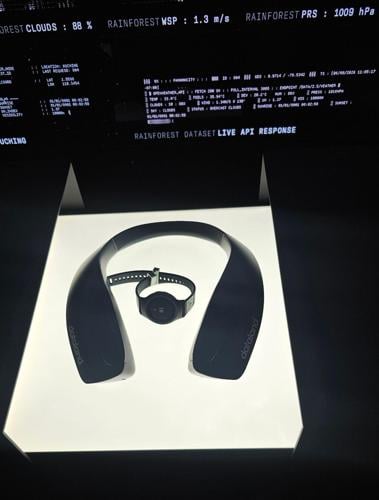
Visitors are given a personal sensor with a unique two-digit ID. The sensor allows the system to respond to subtle biological and behavioral cues, including movement, time spent near certain works and, in certain areas, the quiet language of the body. According to the museum’s introduction, every experience leaves a memory. Nothing resets to zero. The building listens, responds and remembers.
That idea gives the entire exhibition a thrilling sense of participation. You are not just viewing the art. You are helping shape it.
At the center of DATALAND is Refik Anadol and Efsun Erkılıç , both internationally recognized media artists known for transforming data into immersive visual environments. These works often feel like painting with information instead of pigment. At DATALAND, that concept reaches a new level.
Machine Dreams: Rainforest is powered by the Large Nature Model, an AI system developed by Refik Anadol Studio and trained on vast ecological datasets. The museum team explained that the data comes from scientific and research partnerships, including institutions such as the Smithsonian and Cornell Lab of Ornithology. Rather than relying on generic internet scraping, the exhibition emphasizes ethically sourced nature data.
The scale is remarkable. The dataset includes hundreds of millions of images and ecological information connected to rainforests, species, humidity, soil, electricity and environmental conditions. In the preview, the guide explained that each day the exhibition can be shaped by a different rainforest. On the day of the visit, the real-time data was tied to Leticia, Colombia, with humidity and environmental signals helping influence the generative artwork.
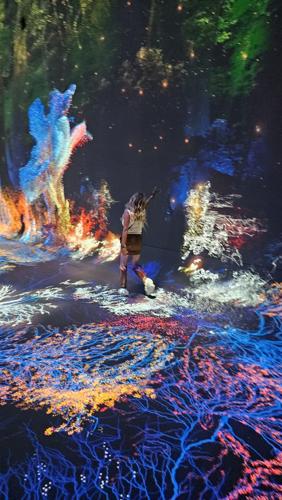
This is where “data painting” becomes more than a phrase. The rainforest is not merely represented. It is translated. Environmental signals become color, motion, form and atmosphere. The result is not a literal documentary of nature. It is a machine dream of nature.
Machine Dreams: Rainforest unfolds in five chapters: the Discovery Portal, the Data Pavilion, the Latent Gallery, the Infinity Room and the Sanctuary. Each space has its own rhythm, but the exhibition feels connected by a single larger idea: nature is intelligent, and artificial intelligence can become a new way to listen to it.

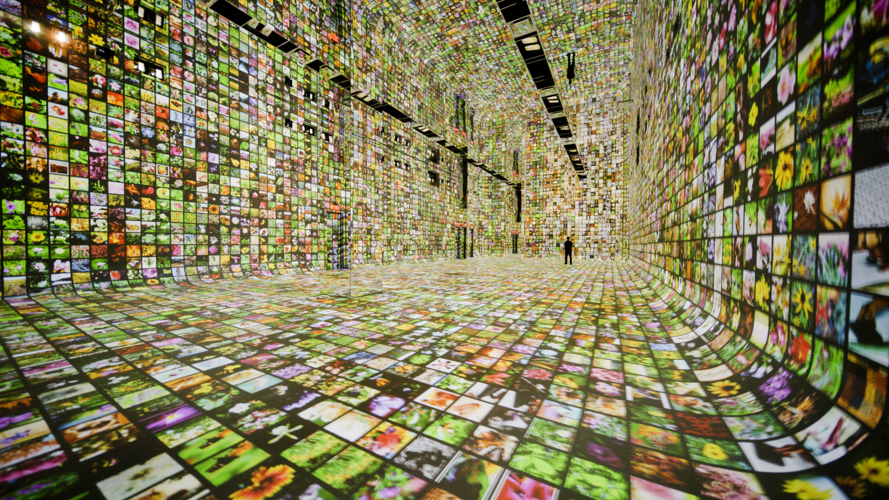
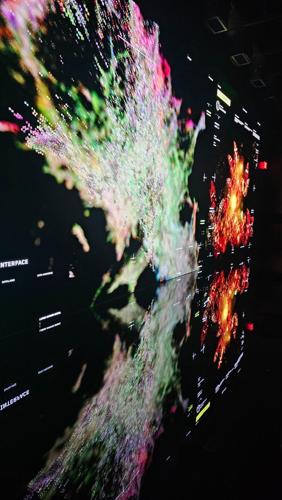
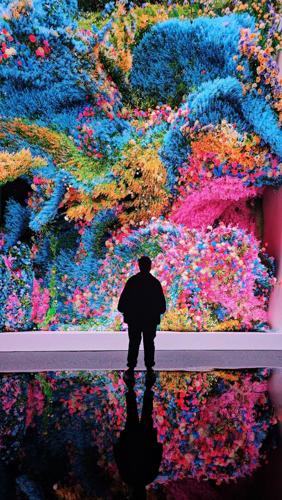
In the Data Pavilion, invisible planetary data takes visual and spatial form. Movements shape what guests see. The rainforest becomes a fluid, responsive environment. The visuals are stunning in scale and texture, with images, colors and forms moving across the space in ways that feel both highly technological and strangely organic.
The reflective floors are especially effective. They are not just pristine design details; they become part of the exhibition. The light bounces below and around you, expanding the art until it feels as though the room has no firm edge. For a museum dedicated to AI art, the architecture and finishes are doing a remarkable amount of sensory work.
The Latent Gallery allows visitors to explore and interact with the archive more directly. During the tour, the team described a real-time application called Thinking Brush, where AI can draw biomes based on the nature data it has learned. It gives guests a clearer understanding of what is inside the model. Instead of treating AI as a mysterious black box, the museum tries to show the ingredients behind the dream.

That transparency matters. Many people remain skeptical of AI art, and rightfully so. The questions around authorship, ethics and sourcing are not small. DATALAND is strongest when it shows that the data has origins, structure and meaning. When the guide zoomed into the archive, individual species, regions and biomes could be traced, reinforcing the idea that this is not random digital spectacle. It is built from a dense, researched natural archive.
The most unexpected element is scent.
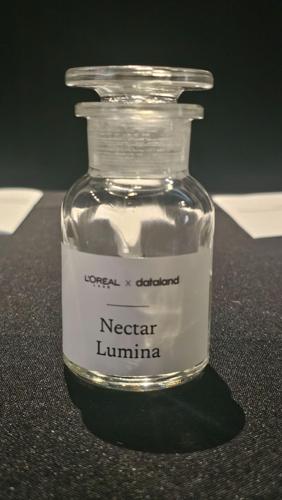
L’Oréal Luxe partnered with DATALAND as the founding olfactory partner, and the collaboration is far more thoughtful than a branding exercise. The exhibition uses fragrance as part of the art experience, creating what the L’Oréal representative described as a “living scent” connected to living art.

During the preview, the L’Oréal team explained how their work in extraction and fragrance technology made the partnership possible. Some scent work begins by collecting molecules from nature, such as flowers, woods or earth, then reconstructing an olfactory impression. Other techniques use air extraction, capturing volatile molecules from flowers without water, high heat, distillation or solvents.
For DATALAND, scent is not meant to sell a perfume at the end of the visit. It is designed to help guests understand what they are experiencing during the exhibition. The fragrance becomes part of the rainforest data, part of the memory and part of the emotional response.
This is one of the most successful aspects of the museum. Smell bypasses the logical mind and goes directly to memory. A rainforest is not only something you see. It is something you feel in the air. By adding scent, DATALAND opens another sense and makes the artwork feel more alive.
DATALAND was co-founded by Refik Anadol and Efsun Erkılıç, whose role is important to the emotional and cultural framing of the museum. A project this technologically ambitious could easily feel cold. It does not.

Instead, Machine Dreams: Rainforest feels poetic, carefully composed and deeply interested in the relationship between human presence and natural memory. The exhibition is not simply asking whether machines can create images. It is asking whether technology can help us feel the natural world differently.
That is what makes DATALAND compelling for a sophisticated audience. The museum does not require visitors to be technology experts. It invites them into a sensory conversation. You can appreciate it as contemporary art, as design, as science, as environmental storytelling or simply as a spectacular Los Angeles day out.
For FINE Magazine readers, DATALAND is a strong choice for a high-end cultural date with your spouse or partner in Los Angeles. It is polished, visually impressive, intellectually current and easy to pair with a beautiful lunch, cocktails or a dinner Downtown.
This is the kind of outing that gives you something to talk about long after you leave. It is ideal for couples, art lovers, tech-curious travelers and anyone who wants to experience something genuinely new rather than simply another pretty room with projections.
The location at The Grand LA puts the museum in one of the city’s most recognizable cultural corridors, near Walt Disney Concert Hall, The Broad and MOCA. The parking is also refreshingly easy, with parking directly below the museum. In Los Angeles, that detail should not be underestimated.
AI art is still a debated frontier. Some will see it as the next evolution of creative tools. Others will question whether machines should have this much space in the art world. DATALAND does not answer every concern, but it makes a compelling argument that, in the right hands, AI can become a medium.
DATALAND is avant-garde in the truest sense. It is bold, polished, slightly surreal and unmistakably Los Angeles. It turns data into atmosphere, rainforests into dreams and museum-going into something more interactive, more intimate and more cinematic.
For a city built on imagination, DATALAND feels like the next scene.
(0) comments
We welcome your comments
Log In
Post a comment as Guest
Keep it Clean. Please avoid obscene, vulgar, lewd, racist or sexually-oriented language.
PLEASE TURN OFF YOUR CAPS LOCK.
Don't Threaten. Threats of harming another person will not be tolerated.
Be Truthful. Don't knowingly lie about anyone or anything.
Be Nice. No racism, sexism or any sort of -ism that is degrading to another person.
Be Proactive. Use the 'Report' link on each comment to let us know of abusive posts.
Share with Us. We'd love to hear eyewitness accounts, the history behind an article.