
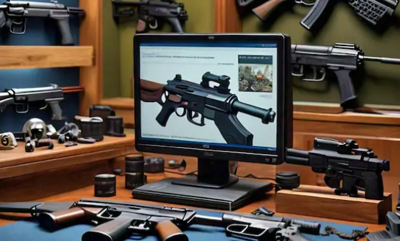

The online firearms market in 2024 looks nothing like it did a decade ago. Search traffic for terms like alpha guns, AWM for sale, and Bren for sale has climbed steadily since 2019, according to Google Trends, and the buyer behind those searches is often not the buyer the industry expects. Younger collectors, lapsed shooters returning after the pandemic surge, curious first-timers who watched a YouTube review at 2am. They are reshaping what a marketplace listing has to do to earn a click.
What follows is a working tour of how that marketplace functions now and where buyers tend to get burned.
What buyers actually search for
The most revealing dataset in firearms retail is not sales numbers. It is search queries. NSSF reported roughly 16.4 million NICS-adjusted background checks in 2023, down from the 2020 peak but still well above the pre-2019 baseline. Underneath that headline figure sits a long tail of weirdly specific search behavior.
A buyer rarely types "rifle." The buyer types a model. Sometimes a model that is not commercially available in the configuration shown in the search, which is its own kind of problem. The phrase "AS Val for sale," for example, generates consistent monthly volume in the United States despite the actual Russian-made AS Val being unavailable to civilian buyers under current import restrictions. What buyers usually find, and sometimes buy, is a semi-automatic clone or a stylistic tribute build chambered in 9x39mm or .300 Blackout. That gap between the search and the available product is where a lot of the marketplace friction lives, and most retailers handle it badly.
"AWM for sale" tells a similar story, except the inflation comes from somewhere stranger. The Accuracy International AWM is a real precision rifle. Most of the search volume comes from players of a certain battle royale video game looking up the gun they used last night. Retailers who understand that split, and write listings that gently educate without condescending convert better than retailers who assume every shopper is a competition shooter with a $7,000 budget.
Why do niche and historical categories keep gaining ground
There is a quiet appetite for guns with stories attached. Bren for sale searches spike whenever a World War II documentary lands on a major streaming service, which is a fact that surprises almost nobody who has worked in the category for more than a year. Searches for the Abercrombie gun and Abercrombie and Fitch guns, referring to the high-grade sporting arms the retailer sold from roughly 1900 through the 1970s, climb every fall when auction houses publish their winter catalogs. Rock Island Auction Company has noted in several post-sale reports that engraved Abercrombie and Fitch shotguns by makers like Boss and Purdey continue to outperform pre-sale estimates.
This matters for marketplace design in ways that are easy to miss. A buyer hunting for an ALE Firearms part or an AB Prototype LLC component is not browsing. That buyer arrived with a part number, a forum thread bookmarked, and forty minutes of patience. Sites that surface SKU-level inventory, real photos of the actual unit in stock, and a clean shipping policy win those buyers in a way that flashy hero images never will.
The American Eagle gun line, produced under Federal Premium's branding, is doing something else entirely. It rides on ammunition recognition. A shooter who has run American Eagle 5.56 through a training rifle for years carries that brand trust over to any firearm wearing the same name, even if the product manager three states away has never thought of it that way.
How a marketplace earns trust in a regulated category
Firearms retail sits under a regulatory load that most ecommerce categories never have to think about. Every transfer goes through a federally licensed dealer. Every shipment leaves a paper trail. The buyer is paying for a product but also for a process, and the process is where most online sellers fumble.
A strong marketplace makes three things obvious before checkout: which FFLs the seller will ship to, what the buyer's home-state restrictions are on the specific item, and how returns work when a firearm has already been transferred. Sites that bury this information under a help-center link lose sales. Sites that put it on the product page, in plain language, keep them. For buyers who want to compare inventory and policies in one place, it helps to explore firearms listings from established dealers who publish their transfer terms upfront rather than leaving them to a post-purchase email.
Used and consignment inventory raises the stakes further. A 1960s Browning Superposed in 80 percent condition is worth real money, and the photos in the listing have to do the work that a hands-on inspection would normally do. The best listings show the bore, the action open, the receiver markings, and at least one shot of any wear the seller can document. Vague photography signals one of two things to an experienced buyer: the seller is hiding something, or the seller does not know what they have.
The pricing problem nobody fixes
Firearms pricing is volatile in ways that confuse new buyers and irritate old ones. A Glock 19 Gen 5 might sit at $549 at one retailer, $629 at another, and $479 at a third running a holiday promotion. The first instinct of a shopper is to assume the cheapest seller is suspect. Often the cheapest seller is just sitting on inventory bought at a better wholesale tier six months earlier, and saying so out loud in a listing would probably help, though nobody does.
Ammunition pricing is worse. The 2020 to 2022 ammo shortage compressed margins for retailers and trained an entire generation of buyers to hoard. 9mm Luger that sold for 19 cents a round in 2019 hit 55 cents in mid-2021, then settled around 28 cents by late 2023 according to Ammoseek's historical tracker. A shopper who remembers the peak still treats every price tag with suspicion, and honestly, fair enough.
Sellers could fix part of this by showing price history, or at least explaining what a fair current price looks like in the category. Almost none of them do. Buyers, meanwhile, should know that a posted price below MAP is not always a scam. It is always worth a phone call to the dealer before sending payment.
Where the next wave of buyers comes from
First-time gun owners made up roughly 30 percent of purchasers in 2020 and 2021 per NSSF retailer surveys. That number cooled but did not collapse. Women accounted for an estimated 3.5 million first-time buyers across that window, a demographic shift retailers are still adjusting their merchandising to reflect, often clumsily. Product photography that only shows hands belonging to one type of shooter quietly tells everyone else they are in the wrong store.
Video games and films drive the other engine. The AS Val, the AWM, the Bren, and yes, the search term alpha guns itself all owe part of their volume to media exposure. The instinct to dismiss those searchers as not-serious is exactly the wrong one. Someone who arrived because of a video game might leave with a .22 trainer, a range membership, and a habit that lasts thirty years.
The marketplace will keep fragmenting in messy ways. Large generalist retailers will hold the everyday Glock and AR-15 traffic, specialist dealers will own the Abercrombie shotgun crowd and the AB Prototype LLC parts buyer, auction houses will keep eating the collector segment. What happens in the middle is the interesting question. The retailers who survive there will be the ones who treat the listing page as a conversation rather than a catalog entry, and who remember that even a search query as strange as alpha guns is somebody at a keyboard trying to figure something out.
(0) comments
We welcome your comments
Log In
Post a comment as Guest
Keep it Clean. Please avoid obscene, vulgar, lewd, racist or sexually-oriented language.
PLEASE TURN OFF YOUR CAPS LOCK.
Don't Threaten. Threats of harming another person will not be tolerated.
Be Truthful. Don't knowingly lie about anyone or anything.
Be Nice. No racism, sexism or any sort of -ism that is degrading to another person.
Be Proactive. Use the 'Report' link on each comment to let us know of abusive posts.
Share with Us. We'd love to hear eyewitness accounts, the history behind an article.