

As we get older our skin becomes less tight which causes fine lines and wrinkles and sagging and before surgery was the main option but now there are simple non surgery treatments that give good results without risk or long healing time.
Two common treatments are Sofwave and Ultherapy and both use sound energy to help the skin make more natural and become tight but they work in different ways and are used for different needs.
If you are deciding between the two this comparison will help you see the differences and choose the one that fits your needs best.
Understanding Sofwave: A Modern Way to Refresh the Skin
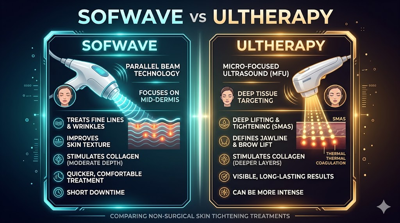
Sofwave skin tightening is a modern treatment that makes skin firmer and reduces signs of aging and it is special because it works on the middle layer of the skin where collagen is most active.
This treatment uses SUPERB™ technology which sends controlled sound energy to the skin in a safe and gentle way and it works at the right depth to increase new collagen while keeping the top layer of skin safe.
Unlike Ultherapy which delivers a single focused beam, Sofwave's SUPERB™ technology fires 7 simultaneous ultrasound beams at a precise 1.5mm depth, producing a more even, consistent energy distribution across the treatment area. Its effectiveness has been validated in a peer-reviewed clinical study, giving it a level of scientific credibility that sets it apart. It also works equally well on all skin types and tones.
As a result sofwave offers a good balance of effectiveness and safety making it a strong option for people who want visible improvement without discomfort or downtime.
This makes Sofwave a good choice for people who want good results without pain or recovery time.
Key Benefits of Sofwave
Helps reduce fine lines and wrinkles
Improves skin texture, firmness, and overall appearance
Addresses mild to moderate skin laxity with clinically proven results
No downtime - patients return to normal life immediately
Significantly more comfortable than Ultherapy, no numbing medication needed for most patients
Works on all skin types and tones
Results visible in weeks, not months
Many people choose Sofwave because it fits a busy life and you can go back to your normal routine right after the session.
What Is Ultherapy and How Does It Work?
Ultherapy is one of the most well-known non-invasive skin tightening treatments today and like Sofwave it also uses ultrasound energy but its method is a little different.
Instead of working in the middle layer Ultherapy goes deeper into the skin and reaches the SMAS layer which surgeons also target in facelift and this deeper work helps give more visible lifting in some areas.
It is commonly used to treat many skin problems
Droopy eyebrows
Loose skin under the chin
Neck lines
Upper chest.
The treatment can feel more intense and results may vary depending on technique and individual response.
Sofwave vs Ultherapy: Breaking Down the Differences
While both treatments aim to tighten and refresh the skin their differences can strongly affect your experience and results.
1. Depth of Treatment
The biggest distinction lies in how deeply each treatment works.
Sofwave targets the mid dermis with pinpoint precision, the exact depth where collagen production is most active. This focused approach produces consistent, predictable results without the risks that come with deeper energy delivery.
Ultherapy goes deeper into the skin which can create more noticeable lifting effects.
For the vast majority of patients, Sofwave delivers excellent, natural-looking results. Ultherapy's deeper energy reach may seem appealing in theory, but it comes at the cost of comfort, consistency and recovery time, which is why many patients and practitioners now prefer Sofwave as their first choice regardless of the degree of laxity.
2. Comfort During the Procedure
Comfort is very important for many people when choosing cosmetic treatments.
Sofwave is generally described as tolerable and often does not require numbing.
Ultherapy can feel more intense due to the depth of energy delivery and numbing cream or medication is sometimes used.
For people who are sensitive to pain or want a more comfortable experience Sofwave is the preferred option.
3. Downtime and Recovery
One main reason people choose non invasive treatments is to avoid recovery time.
Sofwave usually has no downtime and some patients may notice slight redness that goes away quickly.
Ultherapy may cause temporary swelling and tenderness or redness that can last a bit longer.
If you are looking for a “lunchtime procedure” Sofwave is often the more convenient choice.
4. Results and Timeline
Both treatments rely on collagen regeneration which takes time.
Sofwave results can begin appearing within a few weeks and continue improving gradually.
Ultherapy results typically take 2 to 3 months to fully develop.
Sofwave is often liked because it gives steady natural improvements in skin texture and firmness over time.
5. Ideal Candidate
Choosing the right treatment depends on your skin condition and goals.
Sofwave is best for:
Early signs of aging
Fine lines and mild sagging
Natural looking improvements
Busy individuals who want no downtime
Ultherapy may be considered for:
Patients with significant skin laxity who have been advised by a doctor that deeper structural treatment is specifically required
Those who have already tried Sofwave and want to explore additional options
Individuals who are fully informed about and comfortable with the higher discomfort level and variable outcomes
Safety and Technology Considerations
Both Sofwave and Ultherapy are FDA approved and considered safe when performed by trained professionals however the method of energy delivery can impact overall experience and consistency.
Sofwave uses controlled and uniform ultrasound delivery which helps produce more predictable results while minimizing unnecessary tissue impact.
This precision is one of the reasons many patients prefer it.
As with any treatment choosing a qualified provider is essential for achieving the best results.
Making the Right Choice for Your Skin
There is no one size fits all answer when it comes to skin tightening.
If your goal is to refresh your look and improve skin texture and keep a natural appearance without interrupting your routine, sofwave is a modern comfortable and reliable option.
For patients with more advanced laxity who are specifically seeking structural lifting, a surgical consultation may actually be more appropriate than either ultrasound treatment. In cases where a non-invasive approach is preferred, a qualified provider can assess whether Sofwave alone is sufficient or whether a combination approach makes sense.
In many cases Sofwave is increasingly chosen as a first line treatment for overall skin rejuvenation especially for those who value comfort and consistency.
Non invasive treatments have transformed how people approach aging and offer effective alternatives to surgery with far less commitment.
While both Sofwave and Ultherapy are good options they serve different purposes. Ultherapy targets deeper lifting while Sofwave offers more consistent natural looking results with better comfort and convenience.
For many people Sofwave stands out as a more balanced and practical option helping improve skin firmness and health without downtime or disruption to daily life.
(0) comments
We welcome your comments
Log In
Post a comment as Guest
Keep it Clean. Please avoid obscene, vulgar, lewd, racist or sexually-oriented language.
PLEASE TURN OFF YOUR CAPS LOCK.
Don't Threaten. Threats of harming another person will not be tolerated.
Be Truthful. Don't knowingly lie about anyone or anything.
Be Nice. No racism, sexism or any sort of -ism that is degrading to another person.
Be Proactive. Use the 'Report' link on each comment to let us know of abusive posts.
Share with Us. We'd love to hear eyewitness accounts, the history behind an article.