
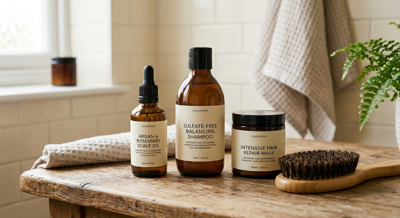

Most people don't realize they've been solving the wrong problem. They notice hair fall, grab a shampoo that promises thickness, use it for a month, and then wonder why nothing changed. The truth is, what you apply on your scalp is rarely the whole answer. Effective hair care runs deeper than that — sometimes much deeper.
Why Surface-Level Treatments Often Fall Short
Walk into any pharmacy and you'll find rows of products claiming to stop hair fall, boost growth, and restore volume. Many of them address the symptom without touching the cause. A moisturizing shampoo can improve texture. A scalp scrub can clear buildup. But if your hair is falling because of iron deficiency, a disrupted thyroid, or chronic stress — no shampoo will fix that.
This is the gap that most hair care solutions ignore. They're built around what's visible, not what's happening underneath.
The Root Causes That Most People Miss
Hair fall is rarely one thing. It usually involves a combination of internal and external factors working together over time. Some of the more common — and often overlooked — causes include:
- Nutritional deficiencies, especially iron, Vitamin D, zinc, and B12
- Hormonal imbalances like elevated DHT or thyroid irregularities
- Poor scalp circulation, which limits the nutrients reaching follicles
- Chronic stress, which pushes hair follicles into a resting phase prematurely
- Gut health issues that affect how nutrients are absorbed in the first place
The tricky part is that hair responds to internal changes with a delay of two to three months. So by the time you're seeing significant fall, the trigger may have happened weeks ago. This lag makes it easy to misread what's actually causing the problem.
What the Scalp Actually Needs
The scalp is skin. It has pores, oil glands, a microbiome, and blood vessels. When people treat it like just a platform for growing hair, they miss a lot.
A healthy scalp environment needs:
Balanced sebum production — too much clogs follicles, too little leaves the scalp dry and inflamed
- Good microcirculation to deliver oxygen and nutrients to the root
- A stable pH to protect against fungal overgrowth and inflammation
- Regular but gentle cleansing to prevent product and pollution buildup
When the scalp is inflamed or congested, even a strong, healthy follicle can struggle to sustain growth. This is why people who eat well and manage stress still sometimes deal with persistent hair fall — they're not caring for the scalp itself.
The Role of Internal Health in Hair Growth
Hair is not a vital organ. When your body is under pressure — nutritionally, hormonally, or emotionally — it redirects resources away from hair growth to protect more critical functions. This is a completely normal physiological response, but it does mean that hair is one of the first things to suffer when something is off internally.
This is also why looking at bloodwork matters. A complete hair fall evaluation should include hemoglobin levels, ferritin, thyroid function (TSH, T3, T4), Vitamin D, and sometimes hormone panels depending on the individual. Many people go years without getting these checked, treating hair fall externally while an internal imbalance continues unchecked.
If you want to understand what proper root-cause evaluation looks like in practice, reading through something like this hair treatment guide can give you a clearer picture of what a thorough approach actually covers.
What Separates Effective Approaches from Everything Else
Effective hair care solutions share a few qualities. They don't promise results in two weeks. They account for the individual — because hair fall in a 28-year-old woman with PCOS is a different problem than hair fall in a 40-year-old man with high stress and poor sleep. And they combine internal support with external care rather than treating these as separate concerns.
Some treatment frameworks, like Is Traya Good For Hair, are built specifically around this idea — understanding what's driving hair fall for a specific person before recommending anything. That approach tends to yield more consistent outcomes because the solution is actually matched to the problem.
Hair care works when it's honest about what hair fall really is — a signal, not just a problem on the surface. If your current routine isn't producing results, the question worth asking isn't which product to switch to. It's whether you've actually identified what's causing the fall in the first place. That shift in thinking is usually where real progress begins.
(0) comments
We welcome your comments
Log In
Post a comment as Guest
Keep it Clean. Please avoid obscene, vulgar, lewd, racist or sexually-oriented language.
PLEASE TURN OFF YOUR CAPS LOCK.
Don't Threaten. Threats of harming another person will not be tolerated.
Be Truthful. Don't knowingly lie about anyone or anything.
Be Nice. No racism, sexism or any sort of -ism that is degrading to another person.
Be Proactive. Use the 'Report' link on each comment to let us know of abusive posts.
Share with Us. We'd love to hear eyewitness accounts, the history behind an article.