

For cyberattackers, healthcare data has always been a valuable target because of the data it contains. Over the years, data breaches have grown significantly, and according to a report in the HIPAA journal last year, 508 breaches were reported.
In August alone, 58 incidents were reported and health information related to more than 3.7 million individuals. And this is why it has become important to protect the patient's health information (PHI) in the EHR.
The impact of these data breaches goes far beyond penalties and compliance violations. Because a single breach disrupts care delivery, damages patient trust, and affects a clinic's reputation. However, many traditional EHRs are not equipped or secure enough to protect the sensitive PHI.
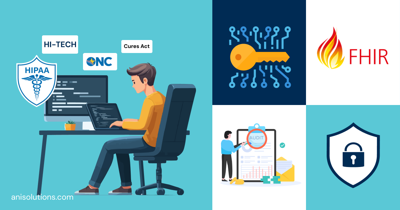
This is where EHR software development needs to be shifted to a security-driven approach. Meaning, you need to embed HIPAA, HITECH, ONC, and the 21st Century Cures Act from day one. Without following these EHR security standards, healthcare data security can’t be ensured.
In this guest post, we will break down the EHR compliance requirements and how it strengthens healthcare data security and ensures patients trust clinics completely.
Let’s dive in!
Core US Regulatory Security Frameworks
When it comes to EHR security in the US, there are many regulations that make protecting sensitive patient data mandatory. However, if you don’t understand these regulations clearly, it can become difficult to effectively embed them in custom EHR development security.
The first regulation is HIPAA, which is the foundation that defines how ePHI is secured through administrative, physical, and technical safeguards. This means implementing access controls, auditability, end-to-end encryption, and role-based access that decides who can access which data.
Another mandate is the HITECH Act, which expands HIPAA’s regulatory mandates, introducing strict breach notification alerting requirements. The EHRs must support rapid incident detection, forensic logging, and defensible reporting workflow, not just prevention.
Then comes the ONC Health IT Certification (2015 Edition Cures Update), which is governed by the Office of the National Coordinator for Health Information Technology. These standards directly tie security with interoperability. So, if you are using APIs and FHIR-based data exchange, they need to be built on these ONC standards.
Finally, the 21st Century Cures Act brings accountability in the patient data exchange while giving free data access to patients and providers. With this act’s regulations, the custom EHRs must enable secure access without opening gaps in security or misuse.
In short, all these EHR security standards ensure security, compliance, and interoperability in modern EHR software development.
Essential Technical Security Safeguards
Once regulatory requirements are clear, the next question is simple: what does secure EHR software actually look like in practice? This is where technical security comes in, and there is no room for shortcuts.
In EHR security, end-to-end encryption is non-negotiable. The data stored inside the EHR must be protected using strong encryption standards like AES-256, while all data moving between systems, users, or APIs should be encrypted with TLS 1.2 or higher. If PHI is readable when intercepted or stolen, compliance is already broken.
Next is access control, which keeps the data access limited to only the roles that require it to view the data. Moreover, layering in multi-factor authentication (MFA) adds a critical safeguard, especially for remote access, admin accounts, and integrations.
Audit logging is another requirement that often gets underestimated. The EHR must log every access, update, export, and system action in a way that is immutable and traceable. These logs aren’t just for internal monitoring; they are essential during breach investigations, audits, and regulatory reviews.
One more standard that helps protect data is using session controls, enabling automatic logouts, session expiration, and idle timeouts on all devices used by clinical staff. With this, unauthorized access can be prevented without relying on perfect user behavior.
Interoperability & API Security
Interoperability is essential in modern healthcare, but it’s also where many security gaps appear. Every API connection, data exchange, or third-party integration expands the EHR’s attack surface. If it’s not secured properly, interoperability can quickly become a liability.
Most custom EHR systems rely on standards defined by Health Level Seven International, including HL7 and FHIR, to support data exchange with labs, pharmacies, payers, and patient-facing apps. These standards make sharing data easier, but they don’t secure it by default. That responsibility sits squarely with the EHR’s architecture.
The APIs must be protected using OAuth 2.0, secure token handling, and strict scope-based permissions. This ensures third-party applications only access the specific data they are authorized to see, and nothing more. Features like token expiration, refresh controls, and secure storage are just as important as authentication itself.
Rate limiting and monitoring play a critical role in interoperability security. Without them, APIs become easy targets for abuse, scraping, or denial-of-service attacks. A secure EHR actively watches how APIs are used, flags unusual behavior, and shuts down risky access before damage spreads.
The goal is not to restrict data flow; it’s to enable safe, controlled exchange. A well-secured interoperability layer supports connected care models while preventing accidental overexposure of sensitive patient information.
Security-First Development Lifecycle
In custom EHR development, security can’t be something you add later. By the time an application reaches testing or deployment, architectural decisions are already locked in. A security-first development lifecycle ensures that privacy, compliance, and resilience are built into the system from day one.
Development Stage | Security Focus | Why It Matters in EHR Systems |
Architecture & Design | Privacy by Design, threat modeling | Prevents structural security gaps before development begins |
Development | Secure coding standards, access control enforcement | Reduces vulnerabilities introduced during feature builds |
Testing & Validation | Vulnerability scanning, penetration testing | Identifies exploitable risks before production use |
Deployment | Environment hardening, secure configurations | Limits exposure during go-live and scaling |
Post-Launch Operations | Continuous monitoring, patching, and log reviews | Maintains long-term compliance and breach readiness |
Resilience Planning | Backups, disaster recovery, redundancy | Ensures system availability during outages or incidents |
When security is treated as a continuous process rather than a one-time milestone, EHR platforms are better equipped to withstand evolving cyberthreats, regulations, and real-world clinical demands. This lifecycle approach not only protects patient data but also reduces costly rework, audit failures, and operational disruption over time, improving custom EHR development security.
The Human and Operational Layer
Even the most secure EHR architecture can fail if the human and operational layers are overlooked. In real healthcare settings, clinicians move fast, share workstations, and juggle multiple systems at once. Security controls must work with clinical workflows, not against them, or they’ll be bypassed under pressure.
Ongoing security awareness training is essential for both clinical and non-clinical staff. Phishing, weak passwords, and accidental data exposure remain some of the most common causes of healthcare breaches. Regular, role-specific training helps teams recognize risks without slowing down care delivery.
Equally important is having a clear incident response plan. When a security event occurs, teams shouldn’t be figuring out next steps in real time. Defined escalation paths, response timelines, and reporting procedures allow organizations to contain incidents quickly and meet regulatory notification requirements with confidence.
Finally, operational security must align with how care is actually delivered. Access controls, session timeouts, and permissions should reflect real job responsibilities and clinical contexts. When security policies match day-to-day workflows, compliance becomes natural instead of burdensome.
Operational Area | Security Practice | Practical Impact |
Staff Training | Ongoing security awareness programs | Reduces human error and phishing-related incidents |
Incident Response | Documented response and escalation plans | Faster containment and compliant breach reporting |
Clinical Workflows | Role-aligned access and session controls | Prevents unnecessary data exposure |
Governance & Oversight | Regular reviews and policy updates | Keeps security aligned with evolving risks |
Long story short, healthcare is one of the most vulnerable sectors to cyberattacks because of the sensitive patient data it stores. And with the digitization and EHR software, it has opened new gateways for the attackers.
However, traditional EHRs are not sufficient to keep cybersecurity robust, and this is where a security-first approach is essential in EHR software development. The developers must embed the EHR security compliances such as HIPAA, ONC, and HITECH from day one of the development.
If these EHR compliance requirements are treated as add-ons, then patient data safety can’t be threatened. Click here to connect with our team and book your free consultation for developing a HIPAA-compliant EHR software.
Frequently Asked Questions
What are the minimum security requirements for a custom EHR to be HIPAA compliant?
A HIPAA-compliant EHR must include access controls, encryption, audit logging, secure authentication, automatic session timeouts, and breach detection capabilities. These safeguards protect ePHI across administrative, physical, and technical layers.
How does ONC certification impact the security architecture of an EHR?
Office of the National Coordinator for Health Information Technology certification requires EHRs to embed security into interoperability features, including API protection, access transparency, auditability, and secure data exchange, especially for FHIR-based workflows tied to federal programs.
What is the difference between encryption “at rest” and “in transit” for healthcare data?
Encryption at rest protects stored PHI in databases and backups, while encryption in transit secures data as it moves between systems, users, or APIs, preventing interception during network communication.
How can healthcare providers balance system usability with strict multi-factor authentication?
Usability is maintained by applying risk-based MFA—enforcing stronger authentication for remote access, administrators, and sensitive actions, while minimizing friction for routine clinical workflows through smart session handling and device trust.
What are the common security risks when integrating a custom EHR with third-party lab systems?
Common risks include unsecured APIs, excessive data sharing, weak authentication, poor vendor security controls, and a lack of monitoring. Without proper safeguards, integrations can expose PHI beyond intended clinical use.
Why is an immutable audit trail considered a “technical safeguard” under HITECH?
The HITECH Act requires verifiable tracking of ePHI access. Immutable audit logs prevent tampering, support breach investigations, and provide defensible evidence during audits and regulatory enforcement actions.
How does the 21st Century Cures Act affect how we design EHR security permissions?
The 21st Century Cures Act pushes EHRs to allow broader data access while preventing overexposure, requiring granular permissions, scope-based API access, and safeguards that support information sharing without violating patient privacy.
(0) comments
We welcome your comments
Log In
Post a comment as Guest
Keep it Clean. Please avoid obscene, vulgar, lewd, racist or sexually-oriented language.
PLEASE TURN OFF YOUR CAPS LOCK.
Don't Threaten. Threats of harming another person will not be tolerated.
Be Truthful. Don't knowingly lie about anyone or anything.
Be Nice. No racism, sexism or any sort of -ism that is degrading to another person.
Be Proactive. Use the 'Report' link on each comment to let us know of abusive posts.
Share with Us. We'd love to hear eyewitness accounts, the history behind an article.