
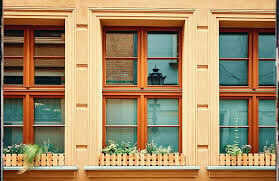
Walk through any design-forward neighbourhood — Brooklyn brownstones, West London terraces, lakeside retreats in New England — and you’ll notice something the catalogues haven’t caught up with yet. The windows are changing. Not in size or shape, necessarily, but in what they’re made of. After decades dominated by vinyl, aluminium, and composite frames, timber is making a decisive return to high-end residential architecture. And the architects driving this shift aren’t motivated by nostalgia. They’re choosing wood because, for the homes they’re designing, nothing else performs quite the same way.
Material honesty and the rejection of the synthetic
The broader design world has been moving in this direction for several years. Mass timber construction, reclaimed wood interiors, rammed earth walls, natural stone — the 2025–2026 architectural conversation is dominated by what designers call “material honesty.” The idea is straightforward: use materials that are what they appear to be. No laminate pretending to be oak. No foil-wrapped plastic pretending to be bronze. The backlash against faux finishes has been gathering momentum, and windows — one of the most visible elements of any facade — sit right at the centre of it.
Timber frames carry a visual warmth and tactile depth that synthetic materials struggle to replicate. Grain patterns shift with the light. The surface ages gracefully, developing character rather than degradation. Architects working on high-end projects increasingly specify wooden windows not as a concession to tradition, but as an intentional design statement — a way to bring organic texture into buildings that might otherwise feel too clean, too uniform, too manufactured.
As London architect Mike McMahon noted in a recent Dwell piece on 2026 trends, there’s a renewed appetite for “tactile, expressive surfaces” in residential architecture. Ornamentation is returning. Detail matters again. And few details shape the character of a home more than the frames around its openings.
Performance that matches the aesthetics
The knock against timber windows has always been practical: they need maintenance, they warp, they cost more. Two decades ago, much of that was fair. Modern engineered timber has changed the equation. Laminated profiles built from kiln-dried hardwoods like meranti or European oak are dimensionally stable — they resist the warping and swelling that plagued solid softwood frames. Factory-applied microporous coatings protect the wood from moisture while allowing it to breathe, extending finish life to 8–12 years between recoats.
On the thermal side, wood is a natural insulator. A timber frame conducts heat far more slowly than aluminium and outperforms standard vinyl profiles of equivalent thickness. Paired with argon-filled double or triple glazing and warm-edge spacer technology, contemporary timber windows deliver U-values that satisfy even the most demanding energy codes — all while keeping frames slimmer than the bulky profiles that high-performance vinyl units often require.
For architects, this combination of beauty and performance is the point. A window that looks right, insulates properly, and lasts decades is not a compromise. It’s the only specification that makes sense for a home designed to stand the test of time.
Bespoke by nature: why custom matters
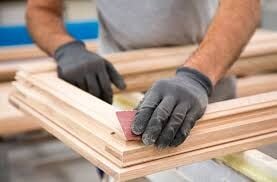
One of the qualities that sets timber apart is how naturally it lends itself to customisation. Unlike vinyl or aluminium — which are extruded in fixed profiles and limited to standard configurations — wood can be machined to virtually any shape. Period mouldings, slim contemporary sightlines, arched heads, curved frames: the material follows the architect’s intent rather than constraining it.
This matters enormously in renovation work, where new windows must respect existing proportions and architectural language. A flush casement window in engineered pine, built to match the exact muntin bars and glazing proportions of a 1920s original, preserves the visual integrity of the building in a way that no off-the-shelf alternative can. For homes in historic districts or conservation zones, this kind of fidelity isn’t optional — it’s a planning requirement.
Specialist manufacturers now offer bespoke timber window designs in engineered pine, meranti, and oak — each unit made to measure rather than pulled from a catalogue. It’s an approach that reflects the broader shift in high-end design: away from mass production and toward materials and components that are crafted to suit the specific building they’re destined for.
Sustainability as a design principle, not a marketing claim
The environmental case for timber is harder to argue against than ever. Wood is a renewable resource. Responsibly sourced timber — certified under FSC or PEFC schemes — sequesters carbon throughout its lifespan, meaning a wooden window frame is actively storing CO₂ rather than adding to it. The embodied energy of manufacturing a timber window is a fraction of what’s required for aluminium, and significantly less than vinyl, which is derived from petroleum.
Vectorworks’ 2025 AEC Trend Report found that nearly half of architecture, engineering, and construction professionals plan to adopt sustainable design analysis tools within the next five years, with natural materials like timber and rammed earth leading a “revival of interest.” The report highlights what practitioners on the ground already know: clients increasingly expect sustainability to be baked into the design, not bolted on as an afterthought.
Choosing timber windows is one of the quieter ways to deliver on that expectation. There’s no solar panel on the roof to photograph, no heat pump humming in the garden. Just a beautiful, high-performing natural material doing exactly what it was grown to do — for decades.
The return of timber in residential architecture isn’t a trend in the fleeting, Instagram sense of the word. It’s a correction — a recognition that the rush to synthetic materials over the last thirty years solved some problems while creating others. Homes that aspire to craft, authenticity, and longevity need materials that deliver on those same terms. For architects designing the next generation of fine homes, timber windows are no longer an alternative. They’re the standard.


(0) comments
We welcome your comments
Log In
Post a comment as Guest
Keep it Clean. Please avoid obscene, vulgar, lewd, racist or sexually-oriented language.
PLEASE TURN OFF YOUR CAPS LOCK.
Don't Threaten. Threats of harming another person will not be tolerated.
Be Truthful. Don't knowingly lie about anyone or anything.
Be Nice. No racism, sexism or any sort of -ism that is degrading to another person.
Be Proactive. Use the 'Report' link on each comment to let us know of abusive posts.
Share with Us. We'd love to hear eyewitness accounts, the history behind an article.