
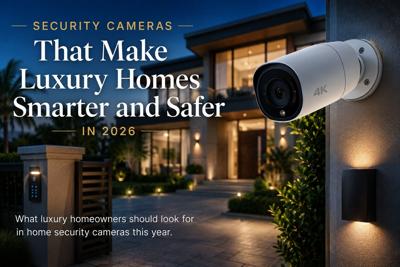
Home security cameras have changed a lot since the days when a grainy front-door clip was considered impressive. In 2026, the best systems are clearer, smarter, more discreet, and better connected to the way people actually live. For luxury homeowners, that matters because security should feel protective, not intrusive.
The right home security cameras can help monitor entry points, driveways, deliveries, pool areas, guest houses, side gates, and outdoor living spaces. They can also work with lighting, smart locks, motion sensors, and alarms to create a more complete security plan. The goal is not to cover every inch of the property like a reality show nobody asked to join. The goal is to know what matters, when it matters.
Whether you are protecting a primary residence, a vacation home, or a property that sits empty between visits, home security cameras should do more than record video. They should help you see clearly, respond quickly, and feel more confident about what is happening around your home.
Why Home Security Cameras Still Matter
Cameras remain one of the most practical parts of a modern security setup because they provide visual information. An alert is useful, but a clear image tells you what is actually happening. Is it a delivery? A guest? A contractor? A raccoon with suspicious confidence? A camera helps remove the guesswork.
For larger homes and luxury properties, cameras are especially helpful because there are often more entry points to manage. A home may have a front gate, driveway, garage, side yard, pool entrance, guest casita, back patio, and service entrance. It is not realistic to watch every area manually, and frankly, nobody bought a beautiful home just to spend the evening patrolling it like a tired security guard.
That is why home security cameras should be placed with purpose. The strongest systems focus on the most vulnerable and useful areas, including front doors, garage doors, driveways, side gates, package drop-off areas, and outdoor spaces where people regularly gather.
Start With the Entry Points
The front door is the most obvious place to begin, but it should not be the only place. A smart camera or video doorbell can help monitor visitors, deliveries, and unexpected activity, but many homes have secondary access points that are just as important.
Side doors, garage entries, sliding doors, and guest house entrances deserve attention because they may be less visible from the street. In some homes, the garage-to-house door is used more often than the front door. In others, the side gate is the easiest way to reach a backyard or pool area.
Home security cameras work best when they are part of a larger entry strategy. FINE’s guide to modern home security systems explains how cameras, smart locks, lighting, sensors, and monitoring work together to create a stronger layer of protection.
Clear Resolution Is Not Optional Anymore
Camera quality matters. A security camera should capture enough detail to be useful, especially around faces, license plates, packages, and movement near entry points. Higher resolution can make a major difference, but it should be paired with the right placement, lighting, and storage setup.
It is easy to get distracted by specs, but homeowners should think practically. A camera pointed too high may show the top of someone’s head beautifully, which is not exactly helpful unless the intruder is famous for their hairstyle. A camera pointed into direct sun may struggle with glare. A camera placed too far from the action may record motion without useful detail.
Before choosing a camera, consider what each location needs to show. A front-door camera may need a wide enough view for packages and visitors. A driveway camera may need stronger night vision and a wider field of view. A pool-area camera may need weather resistance and careful placement for privacy.
Night Vision and Low Light Performance Matter
Many security events happen after dark, so nighttime performance is essential. Cameras should be able to capture useful footage in low light, whether through infrared night vision, color night vision, built-in lights, or support from nearby exterior lighting.
Smart exterior lighting can make cameras much more effective. A camera may be technically strong, but poor lighting can still limit what it captures. Pathway lights, entry sconces, garage lighting, and landscape lighting can improve visibility while also helping the home look polished.
For luxury homes, the key is balance. You want enough light to support security without making the property feel like a stadium. Nobody wants to walk up to a front door and feel like they are about to perform the halftime show.
Motion Alerts Should Be Smart, Not Annoying
Motion alerts are useful only if homeowners trust them. A camera that sends alerts for every shadow, leaf, and passing moth will train you to ignore it. That defeats the point.
Look for home security cameras with adjustable motion zones, sensitivity controls, person detection, package detection, vehicle detection, or other smart filtering features. These tools can help reduce false alerts and focus attention on the activity that actually matters.
Motion zones are especially helpful in neighborhoods with sidewalks, busy streets, or shared driveways. You may want to monitor your front porch without receiving a notification every time someone walks a dog across the street. The dog is probably innocent. Probably.
Two Way Audio Can Be Useful at the Door
Two-way audio allows homeowners to speak through the camera or video doorbell from a phone. This can be useful for deliveries, visitors, service providers, and unexpected activity near the front entry.
It is especially helpful for people who travel often or manage a second home. If someone arrives at the wrong time, you can respond without opening the door or being physically present. For package deliveries, two-way audio can help direct a driver to leave an item in a safer location.
As with any smart feature, use it thoughtfully. A calm response is more useful than trying to sound like a movie villain through a doorbell speaker. Security works better when it is clear, practical, and not accidentally theatrical.
Storage and Privacy Should Be Decided Early
Before installing home security cameras, decide how footage will be stored. Some systems use cloud storage, some use local storage, and some offer both. Each option has advantages.
Cloud storage can make footage easier to access from anywhere, but it may require a subscription. Local storage may appeal to homeowners who prefer more control, but it may require additional hardware or management. Event-based recording can save storage space, while continuous recording may be useful for driveways, gates, and high-traffic areas.
Privacy should also be part of the plan. Cameras should focus on your property, not your neighbor’s windows, private outdoor spaces, or areas where guests reasonably expect privacy. For homes with staff, renters, or frequent guests, camera placement should be transparent and respectful.
Secure the Cameras Themselves
A camera is a security device, but it is also an internet-connected device. That means it needs digital protection. The Federal Trade Commission advises homeowners not to use a camera’s default username and password, not to reuse passwords from other accounts, and to choose a strong password that would be difficult for a stranger to guess.
Homeowners should also turn on two-factor authentication when available, keep camera apps and firmware updated, and remove access for anyone who no longer needs it. If a camera system is connected to a larger smart-home platform, the account controlling that platform should be protected just as carefully.
This is the part of security that is not glamorous, but it matters. A beautiful camera system with a weak password is like buying a designer front door and leaving the key taped to it with a friendly note.
Compatibility Is Becoming More Important
Home security cameras are increasingly part of connected-home ecosystems. They may work with smart locks, lighting, alarms, door sensors, voice assistants, and apps that control multiple devices. That makes compatibility a major consideration.
The Connectivity Standards Alliance announced that Matter 1.5 introduced support for cameras, including live video and audio streaming, two-way communication, detection and privacy zones, and storage options. For homeowners, this matters because the smart home is moving toward better interoperability across devices and platforms.
That does not mean every camera will work perfectly with every system overnight. Homeowners should still check compatibility with Apple Home, Google Home, Amazon Alexa, Samsung SmartThings, or whichever ecosystem they already use. The point is to plan for a system that can grow without turning the home into an app-filled maze.
FINE’s guide to smart home upgrades to consider as we head into 2026 looks at how connected-home features are becoming more refined, practical, and easier to integrate into daily life.
Cameras Work Best With Smart Locks and Lighting
A camera is useful by itself, but it becomes stronger when it works with other parts of the home. For example, a camera at the front door can pair well with a smart lock. If a trusted guest, housekeeper, or contractor arrives, homeowners may be able to verify who is there and manage access more safely.
FINE’s article on smart locks explains how keyless entry, guest codes, and remote access can make modern home life easier. When paired with cameras, those features can add another layer of awareness at the front door, guest house, or garage entry.
Lighting also matters. A camera that triggers exterior lighting when motion is detected can improve visibility and help deter unwanted activity. This is especially useful around side yards, driveways, garages, and outdoor living areas.
Choose Placement Before Choosing Products
Before buying home security cameras, walk the property and identify the areas that actually need visibility. Start with the front door, garage, driveway, side gates, backyard access points, and any detached structures. Then think about delivery areas, dark corners, pool gates, and places where people naturally enter or exit.
This helps avoid overbuying. A thoughtful camera plan is better than placing cameras everywhere and hoping the footage makes sense later. More equipment can create more alerts, more maintenance, more subscriptions, and more opportunities to forget which device is named “Front Door 2,” which somehow turns out to be the side yard.
For larger homes, it may be worth working with a professional installer who can evaluate sightlines, Wi-Fi strength, power access, privacy concerns, and camera angles. A polished system should feel intentional, not patched together one weekend after someone watched too many home-security videos.
The Bottom Line
Home security cameras are no longer just about recording what happened. In 2026, they are part of a smarter, more connected approach to protecting the home. The right cameras can improve visibility, support safer deliveries, monitor key entry points, and work with lighting, smart locks, sensors, and alarms.
For luxury homeowners, the best camera system is not necessarily the most obvious one. It is the one that fits the property, respects privacy, reduces blind spots, and supports the way the household actually lives. Security should feel calm, capable, and quietly integrated into the home.
Choose cameras with clear resolution, strong night performance, useful alerts, secure account settings, thoughtful storage, and compatibility with the rest of the home. Done well, home security cameras can make a property feel safer without making it feel watched every second. That is the balance modern homeowners should be looking for.
(0) comments
We welcome your comments
Log In
Post a comment as Guest
Keep it Clean. Please avoid obscene, vulgar, lewd, racist or sexually-oriented language.
PLEASE TURN OFF YOUR CAPS LOCK.
Don't Threaten. Threats of harming another person will not be tolerated.
Be Truthful. Don't knowingly lie about anyone or anything.
Be Nice. No racism, sexism or any sort of -ism that is degrading to another person.
Be Proactive. Use the 'Report' link on each comment to let us know of abusive posts.
Share with Us. We'd love to hear eyewitness accounts, the history behind an article.