


For most homeowners, the arrival of monthly electricity bills is something to be anxious about. There are seasons when utilization of home appliances rises, with the electric bill increasing proportionally with it. This unpredictability can affect how you do your budget. If you want to stabilize your expenses, then a solar-powered system is for you.
Nowadays, solar power is the buzzword of most neighborhoods. An increasing number of homeowners realize that the benefits outweigh the cost of resident solar power system. If you want to catch up with the rest of your community, this article got you covered. Read on to find out how solar power works, what the benefits are, and how to start your journey.
How Solar Energy Powers Your Home
The sun is a massive nuclear reactor that produces unlimited energy potential. By capturing this energy, your homes can be powered with electricity. How does this work?
The sun releases particles of light called photons. The solar panels capture these particles of light. Because solar panels have silicon semiconductors in them, the photons energize the electrons, causing them to flow and create a direct current (DC). This DC is transformed into alternating current (AC) using the inverter.
Once the DC is converted to AC, electricity runs to your panels and is distributed in your homes. You can plug your devices into the socket. The system works similarly to the traditional grid so you need not worry. Plus, you can have the option to connect to the grid itself if you need additional electricity.

Benefits of Solar Energy
The problems of climate change and the oil crisis drive the usage of solar energy as an alternative solution. Going solar gives you both energy security and economic benefits.
Cost Reduction And Savings
If you can produce your electricity, you don’t have to pay the bills from electric companies; you can save on your energy bills instead.
Tax Incentives
Often, the government offers tax incentives to homeowners to encourage the switch to a renewable energy resource. Tax incentives allow you to recover a certain percentage of your investment.
Green Solution
Compared to fossil fuels, solar power emits only a negligible quantity of greenhouse gases. That’s why the solar source is considered pollution-free in contrast to fossil fuel which generates methane and carbon dioxide. If you switch to solar power, it will mean decreased dependence on fossil fuels. Moreover, solar systems do not require a large amount of water for maintenance, and they do not contribute to noise pollution.
Better Home Value
Property value increases when your home is solar-powered. Having a solar source in your homes is an attraction in itself to environmentally conscious clients. Thus, if you plan to sell your properties, you can recover your solar investments with this increase in value.
Going Solar: How To Begin?
Now that you know the benefits of going solar, the next step will be reaping these benefits. The steps outlined below will help you transition to a solar-powered home.
Determine If Your Home Is A Good Solar Candidate
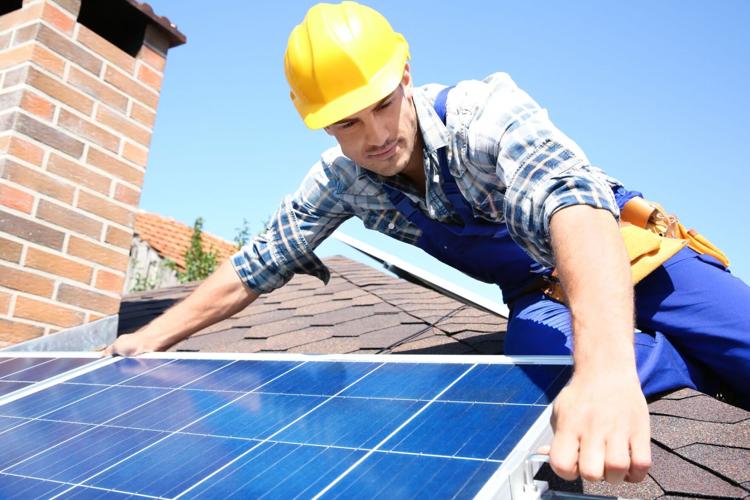
Before going solar, there are factors you would have to consider. One of these is your home’s roofing. Most solar panels are installed on rooftops because they are out of direct danger and more exposed to sunlight. That’s why your roof is a significant consideration in your journey to a solar-powered home.
The first thing you need to check is the orientation of your roof. You need to have a roof that can accommodate solar panels and maximize sunlight absorption. Ideally, a south-facing roof will be the best orientation for those who live in the Northern Hemisphere and a north-facing one for Southern Hemisphere.
Likewise, you have to assess the material of your roof. Make sure that your roof is not made of fragile materials. If your roof is not that strong and durable, you can always opt for customization, but don’t forget to include the cost in weighing your return on investment.
Assess Your Power Requirement
Before installing a power system, you need to know how much electricity you can consume. This will determine the type and size of a solar-powered system you would like to have.
To calculate your power requirement, look at your monthly bills and solve for the average. Most companies include your power consumption in kilowatt-hour in the receipt and the billing statements. To compute for the average, add up your monthly power consumption for the whole year and divide the sum by 12. The result is your average power requirement.
Decide Which Type Of System Best Fits You
Solar-powered systems come in different packages. You can opt to go fully off-grid, which means you are independent of utility power. You can also choose grid-tie, which means you can still connect to power companies and shift between on-grid and off-grid. Additionally, you can consider backup battery storage for your solar power.
Choose The Method Of Implementation
There are two ways to implement a solar-powered system at home: you can do it yourself or hire a solar installation company.
If you would prefer to do it yourself, you have to research the components of the solar-powered systems. These components include solar panels for capturing the sunlight, a solar inverter for converting DC to AC, a rack to hold your components, and a consumption monitor for measuring the electricity produced.
However, if you want a third-party service provider to do it, you can review various companies in terms of cost of service, reputation, and expertise.
Compare Quotes And Prices
After selecting your materials and methods, you can start comparing prices and quotations from different solar providers. You have to focus on how many panels you need, the panel efficiency, and the power rating based on your energy consumption. The number of solar panels often affects the price you need to pay. Then, you can compare different quotes and select the best one that suits your needs and budget.
Conclusion
Solar-powered systems are increasingly popular among homeowners for the benefits they offer. To maximize their benefits, use this guide to understand how solar energy powers your home and what steps you should take.

(0) comments
We welcome your comments
Log In
Post a comment as Guest
Keep it Clean. Please avoid obscene, vulgar, lewd, racist or sexually-oriented language.
PLEASE TURN OFF YOUR CAPS LOCK.
Don't Threaten. Threats of harming another person will not be tolerated.
Be Truthful. Don't knowingly lie about anyone or anything.
Be Nice. No racism, sexism or any sort of -ism that is degrading to another person.
Be Proactive. Use the 'Report' link on each comment to let us know of abusive posts.
Share with Us. We'd love to hear eyewitness accounts, the history behind an article.