
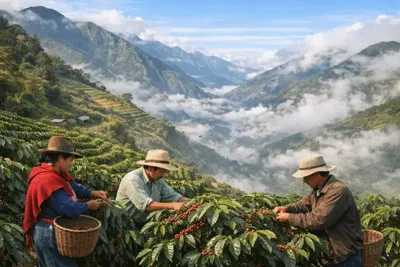

A coffee cherry doesn't just grow. It responds to everything around it: the mineral makeup of the soil, the thickness of the shade canopy, the temperature swing between day and night. Two farms a few miles apart, at different elevations, can produce beans that taste nothing alike.
Nowhere is this clearer than across the volcanic highlands stretching from southern Mexico down through Central America. This is the same terrain and tradition behind premium mexican coffee, where elevation and soil do as much work as the farmer does.
This guide looks at what actually happens in the ground and in the air around these high-altitude farms, and why it matters so much for what ends up in the cup.
Why Elevation Changes Everything About a Bean
Altitude is the single biggest lever on flavor in this region.
Arabica plants thrive between roughly 1,000 and 2,000 meters above sea level, and the higher they grow within that range, the cooler and thinner the air becomes. Cooler temperatures slow down how fast the coffee cherry ripens on the branch.
That slower ripening matters more than it sounds. A cherry that takes its time accumulates more sugars and acids before it's picked. The result is a denser bean with a more complex, layered flavor. Cherries grown at lower elevations ripen faster in warmer air, which tends to produce a milder, less vibrant cup.
This is why the same variety of Arabica can taste completely different depending on whether it was grown at 900 meters or 1,800 meters. Elevation alone reshapes the bean before a single roasting decision is even made.
The Role of Volcanic Soil
Much of this region sits along a chain of active and dormant volcanoes, and that geology shapes the coffee as much as the altitude does.
Volcanic soil is naturally rich in potassium, magnesium, and phosphorus, minerals that support strong fruit development in the coffee plant. It also drains well, which keeps roots from sitting in excess water during heavy rainy seasons while still holding onto enough moisture to sustain the trees.
The mineral density in volcanic soil tends to show up in the cup as brighter acidity and a fuller, more rounded body. It's part of why coffees grown near volcanoes in Guatemala, El Salvador, and southern Mexico are often described as having a more complex, layered profile compared to beans grown in flatter, non-volcanic terrain.
Microclimates: Why Neighboring Farms Taste Different
Even within the same country, no two coffee-growing regions behave the same way.
A microclimate is the specific combination of temperature, humidity, rainfall, and shade cover in one particular growing area, and in this part of the world, those conditions can shift dramatically over a short distance. A valley tucked between two mountains might stay cooler and mistier than a slope facing more direct sun just a few kilometers away.
These small climate pockets are why farms in different valleys, even within the same region, can produce beans with noticeably different acidity, sweetness, or body. It's also why terms like "high-grown" or "strictly hard bean" carry real meaning in this part of the world. They point to a specific combination of elevation and microclimate, not just a general growing region.
Shade-Grown Coffee and Slower Maturation
Walk through a traditional coffee farm in this region and you'll likely see the trees growing under a canopy of taller native trees, not out in open sun.
Shade-grown cultivation keeps direct sunlight off the coffee plants, which slows cherry maturation even further and helps preserve soil quality season after season. It also supports biodiversity, since the shade trees create habitat for birds and other wildlife alongside the coffee itself.
This approach is especially common across southern Mexico's coffee regions, where farms are typically small, family-run operations planting coffee alongside native trees and other crops. The combination of shade and elevation is part of what gives coffee from these misty highland areas, sometimes called cloud forests, their signature clarity and brightness.
Traditional Harvesting Practices
Harvesting in this region is still, in most cases, done by hand.
Pickers move through the rows selecting only the ripest, reddest cherries, often returning to the same trees multiple times over the course of a season as different cherries ripen at different rates. This selective approach takes far more labor than machine harvesting, but it keeps unripe or overripe cherries out of the batch, which directly protects flavor quality.
Harvest season generally runs from late fall into early spring, depending on the specific region and elevation. In many communities, this work is carried out by smallholder families working plots that have been passed down for generations, with techniques shaped by decades of local knowledge about when a cherry is truly ready.
Processing Techniques That Shape the Final Cup
What happens to the cherry after it's picked matters almost as much as how it was grown.
Washed processing is the dominant method here. The outer skin and fruit pulp are removed, and the beans ferment briefly in water before drying. This produces a clean, bright cup that lets the bean's natural acidity and origin character come through clearly.
Natural, or dry, processing leaves the cherry intact while it dries in the sun, letting the fruit's sugars soak into the bean for a heavier body and more fruit-forward sweetness. It's used less often here than washed processing.
Honey processing sits between the two, leaving some fruit pulp on the bean during drying for added sweetness without full fruit intensity.
Most farms in this region rely on washed processing for the bulk of their harvest, reserving natural and honey methods for smaller, experimental lots.
None of these elements act alone. Elevation sets the pace of ripening. Volcanic soil supplies the minerals that shape acidity and body. Microclimate determines exactly how much sun, rain, and temperature swing a given plot receives. Shade cover slows things down even further, and harvesting and processing decisions decide how much of that potential actually makes it into the final bean.
That's the real story behind a genuinely exceptional high-altitude coffee. The terrain does the heavy lifting, but only when every step along the way respects what that terrain is capable of producing.


(0) comments
We welcome your comments
Log In
Post a comment as Guest
Keep it Clean. Please avoid obscene, vulgar, lewd, racist or sexually-oriented language.
PLEASE TURN OFF YOUR CAPS LOCK.
Don't Threaten. Threats of harming another person will not be tolerated.
Be Truthful. Don't knowingly lie about anyone or anything.
Be Nice. No racism, sexism or any sort of -ism that is degrading to another person.
Be Proactive. Use the 'Report' link on each comment to let us know of abusive posts.
Share with Us. We'd love to hear eyewitness accounts, the history behind an article.