
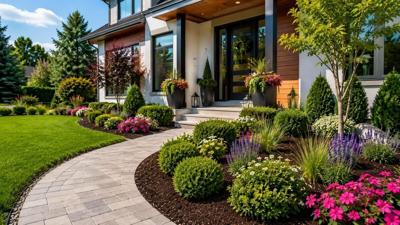

A beautiful lawn does more than fill the space between a home and the street. It frames the property, softens hardscaping, and creates a clean backdrop for everything from planting beds to walkways.
What makes a lawn look expensive is rarely one dramatic feature. More often, it is the cumulative effect of small details: even growth, crisp lines, healthy color, and a sense that the entire landscape has been cared for thoughtfully.
Here are seven details that make the biggest difference.
1. Thick, Even Turf
One of the clearest signs of a well-cared-for lawn is consistency.
Dense grass creates a smooth visual surface, while thin areas and bare patches immediately draw the eye. Natural variation is inevitable, but a lawn looks more refined when weak spots do not interrupt the overall appearance.
Thin turf can develop for many reasons, including soil compaction, shade, heavy foot traffic, drainage problems, or seasonal stress. Finding the cause is usually more effective than repeatedly adding seed to an area that continues to struggle.
2. Crisp, Defined Edges
Clean edges can transform even a simple lawn.
Where grass meets a driveway, walkway, patio, or planting bed, a defined border creates structure and makes the landscape feel intentional. Grass that creeps into surrounding areas can make an otherwise attractive yard appear unfinished.
The same principle applies around trees and garden beds. Clear transitions allow each part of the landscape to stand out while still feeling connected to the whole property.
3. Healthy, Consistent Color
A beautiful lawn should look healthy rather than artificially perfect.
Consistent color across the yard matters more than achieving the darkest possible shade of green. Yellowing, pale patches, or sharp differences from one area to another can signal underlying issues involving moisture, soil conditions, nutrients, or shade.
This is also why adding more fertilizer is not always the answer. Treatments are most useful when they respond to the actual needs of the grass and soil rather than being applied simply because the lawn looks less green than expected.
4. Minimal Visible Weeds
Even a lush lawn can lose its finished appearance when weeds interrupt the surface.
A few scattered weeds may seem minor, but they break up the uniformity that makes turf look carefully maintained. Repeated weed problems can also indicate thin or stressed grass that has left room for unwanted plants to establish themselves.
For recurring problems, professional weed control in Newton can address the visible weeds while also considering the conditions that allow them to return.
The longer-term goal is not simply to remove individual weeds, but to encourage denser turf that leaves fewer openings for them.
5. Graceful Transitions Between Sun and Shade
Many lawns perform well in open areas but begin to thin beneath trees, beside buildings, or along shaded property lines.
Those transitions can be especially noticeable because they interrupt the smooth appearance of the yard.
Shade changes growing conditions. Grass may receive less sunlight, retain moisture differently, or compete with nearby tree roots for water and nutrients.
A well-designed lawn does not require every section of the property to look identical. Instead, shaded and sunny areas should be managed according to their conditions so the landscape still feels cohesive.
6. No Obvious Worn Areas
Foot traffic can leave a surprisingly visible mark on a lawn.
Children, pets, outdoor entertaining, lawn equipment, and repeated shortcuts across the yard can gradually thin grass and compact the soil. Over time, those areas may begin to resemble informal paths.
Depending on the cause, recovery may involve aeration, overseeding, changes in traffic patterns, or improving the conditions beneath the turf.
Addressing wear early helps prevent small weak spots from becoming permanent features of the landscape.
7. A Lawn That Complements the Rest of the Property
The most impressive lawns rarely demand attention on their own.
Instead, they provide a calm foundation for trees, garden beds, walkways, patios, and the architecture of the home.
A lawn can be beautifully maintained and still feel disconnected if the surrounding beds are overgrown or the borders lack definition. The strongest landscapes feel balanced, with turf, plantings, and hardscaping working together rather than competing for attention.
The Difference Is in the Details
An expensive-looking lawn is not necessarily the one with the most elaborate maintenance routine.
It is usually the one where small details are handled consistently.
Dense turf, crisp edges, even color, minimal weeds, repaired traffic areas, and thoughtful transitions all contribute to a yard that feels finished without looking overworked.
The result is more than greener grass. It is a landscape that makes the entire property look more considered from the moment it comes into view.

(1) comment
I know I want my yard to look "nice" but it's hard for me to say exactly what that means when I'm talking to my regular guy. This was so helpful! Now I know how to start the conversation. beyond asking him to get rid of the weeds.
We welcome your comments
Log In
Post a comment as Guest
Keep it Clean. Please avoid obscene, vulgar, lewd, racist or sexually-oriented language.
PLEASE TURN OFF YOUR CAPS LOCK.
Don't Threaten. Threats of harming another person will not be tolerated.
Be Truthful. Don't knowingly lie about anyone or anything.
Be Nice. No racism, sexism or any sort of -ism that is degrading to another person.
Be Proactive. Use the 'Report' link on each comment to let us know of abusive posts.
Share with Us. We'd love to hear eyewitness accounts, the history behind an article.