
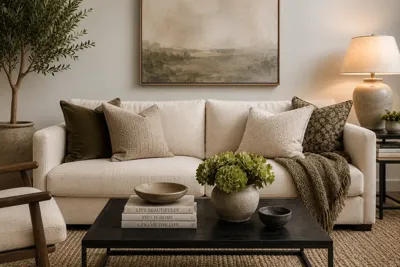
There comes a point in almost every living room when the sofa starts looking a little tired. The fabric has seen better days, the cushions no longer sit quite as proudly as they once did, and something about the whole room suddenly feels dated.
The instinct is to start shopping.
But an old sofa is not necessarily a bad sofa. If the frame is solid, the proportions still work in the room, and you genuinely find it comfortable, replacing it may solve a problem you do not actually have. Sometimes the smarter move is to change what you see rather than replace what is underneath.
A simple, well-proportioned sofa can be surprisingly easy to update. With the right changes, the piece you were ready to send away can look much more intentional.
First Decide Whether the Sofa Deserves Saving
Before spending money on a makeover, sit on the sofa and forget about its appearance for a minute.
Does it still feel supportive? Is the frame stable? Are the arms solid? Does the size work with your room? If the answer is yes, you probably have something worth working with.
A sofa with a broken frame, badly sagging suspension, persistent odors, or dimensions that never really suited the room is another matter. No amount of linen and decorative pillows will turn structural problems into good furniture.
This is also where upgrading rather than replacing can make practical sense. The EPA encourages repairing and reusing household goods as a way to reduce waste before items enter the disposal stream.
The objective is not to keep furniture forever. It is to recognize when the bones are still good.
Give the Upholstery a Second Chance
Fabric takes up most of the visual space on a sofa, which means changing it can create the most dramatic transformation.
If the upholstery itself is still in reasonable condition, a professional cleaning may be enough to restore color and texture. If the fabric is permanently stained, faded, torn, or simply no longer suits the room, reupholstery or a properly fitted replacement cover may be worth considering.
This is very different from tossing a loose generic slipcover over the furniture and hoping nobody notices.
A well-tailored cover follows the lines of the sofa and can completely change its personality. A tired gray sofa might become considerably more sophisticated in warm oatmeal, chocolate brown, soft olive, deep navy, or a textured neutral.
If you are choosing new fabric, order swatches first. A material that looks beautiful online can behave very differently across an entire sofa, particularly once it meets your flooring, wall color, rug, and natural light.
Fix Flat Cushions Before Hiding Them
One of the quickest ways for a sofa to look inexpensive is for its cushions to lose their shape.
Before replacing the entire piece, unzip the cushions if possible and inspect what is inside. Foam can compress with use, while loose fiber fill can migrate toward the edges and leave the center looking defeated.
Depending on construction, cushions may benefit from new foam, additional batting, replacement inserts, or simply having their existing fill redistributed. A local upholstery shop can often tell you quickly what is realistic.
This is money spent on something you actually feel as well as see.
The same principle applies when buying furniture in the first place. As we discussed in FINE's guide to choosing living room furniture, furniture has to work for the way the room is actually used, not merely look appealing in a photograph.
Look at the Legs
Sofa legs are easy to ignore until you notice what a difference they make.
Some sofas have small plastic or basic wooden feet that make the entire piece look less substantial. If the legs are removable and the construction permits replacement, a better-proportioned wood or metal leg can subtly elevate the whole sofa.
Match the upgrade to the furniture rather than forcing a completely different style onto it. Tapered wood legs suit many clean-lined sofas. Simple block feet can make a larger piece feel grounded. Darker wood can add contrast beneath pale upholstery.
Most important, make sure any replacement is structurally appropriate and correctly attached. Furniture should never become less stable in pursuit of looking better.
Stop Trying to Save It With More Pillows
When a sofa looks tired, the temptation is to cover it with decorative pillows.
Then add another throw.
Then perhaps another pillow because the first five somehow did not solve the problem.
Restraint usually looks more expensive.
Choose a small number of pillows that are properly scaled to the sofa and vary texture rather than introducing every available pattern. Linen, velvet, wool, bouclé, and subtle woven fabrics can create dimension without making the seating area look busy.
A throw should work the same way. One beautiful blanket casually folded over an arm or back cushion looks intentional. Three competing throws look like the sofa is being concealed.
Comfort still matters. FINE's guide to creating a living room that feels effortlessly comfortable explores why the rooms we actually want to spend time in balance appearance with the way people really live.
Upgrade What Surrounds the Sofa
Sometimes the sofa is receiving blame for problems elsewhere in the room.
A rug that is too small can make a substantial sofa look awkward. A tiny side table can throw off its proportions. Harsh overhead lighting can flatten beautiful upholstery, while a well-placed floor or table lamp brings out its texture.
Even repositioning the sofa can help.
Pulling furniture slightly away from the wall when space permits, anchoring the seating area with a generously sized rug, and introducing appropriately scaled tables can make an ordinary sofa feel like part of a designed composition rather than something that was simply placed in the room.
Artwork matters too. One properly scaled piece or a thoughtful grouping above the sofa generally has more impact than an assortment of small decorations competing for attention.
Know When to Leave Well Enough Alone
There is a difference between improving an inexpensive sofa and attempting to disguise it as something it is not.
You do not need to spend more customizing an aging sofa than a replacement you genuinely love would cost. The point is not to make inexpensive furniture pretend to be something else.
The goal is to make it look considered.
A solid sofa with refreshed upholstery, restored cushions, a few good textiles, and the right surroundings can look far more sophisticated than a costly piece drowning in trendy accessories.
Good rooms are rarely defined by what everything cost. They are defined by proportion, texture, comfort, restraint, and how thoughtfully the pieces work together.
Before carrying an old sofa to the curb, look at it one more time.
You may not need a new sofa.
You may simply need to give the one you already own a second life. If you are near Newport Beach use Newport Upholstery.

(0) comments
We welcome your comments
Log In
Post a comment as Guest
Keep it Clean. Please avoid obscene, vulgar, lewd, racist or sexually-oriented language.
PLEASE TURN OFF YOUR CAPS LOCK.
Don't Threaten. Threats of harming another person will not be tolerated.
Be Truthful. Don't knowingly lie about anyone or anything.
Be Nice. No racism, sexism or any sort of -ism that is degrading to another person.
Be Proactive. Use the 'Report' link on each comment to let us know of abusive posts.
Share with Us. We'd love to hear eyewitness accounts, the history behind an article.