
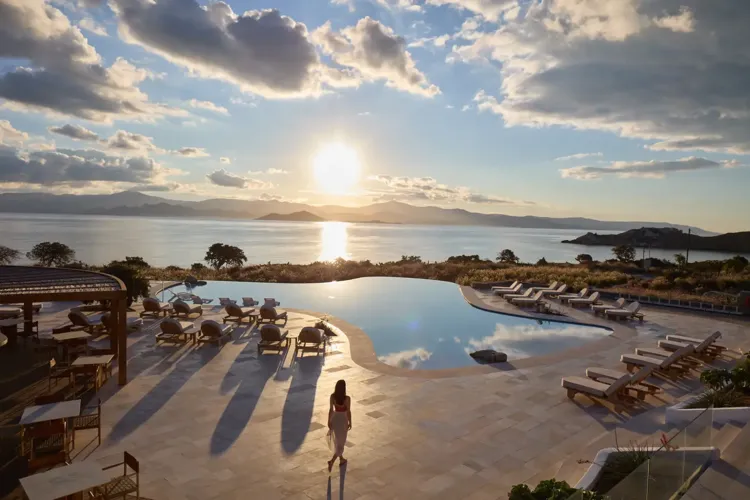
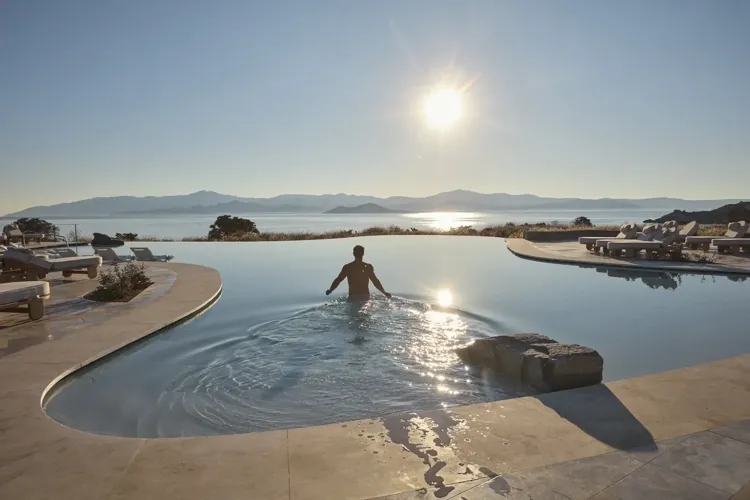

For decades, Greece’s luxury travel calendar seemed almost fixed. July and August meant whitewashed villages, crowded harbors, beach clubs and long afternoons beside the Aegean. By September, conventional wisdom suggested the season was already winding down.
That assumption is becoming increasingly outdated.
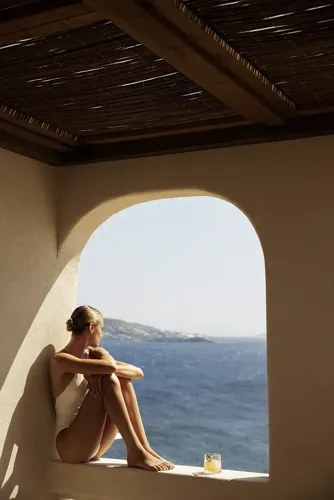
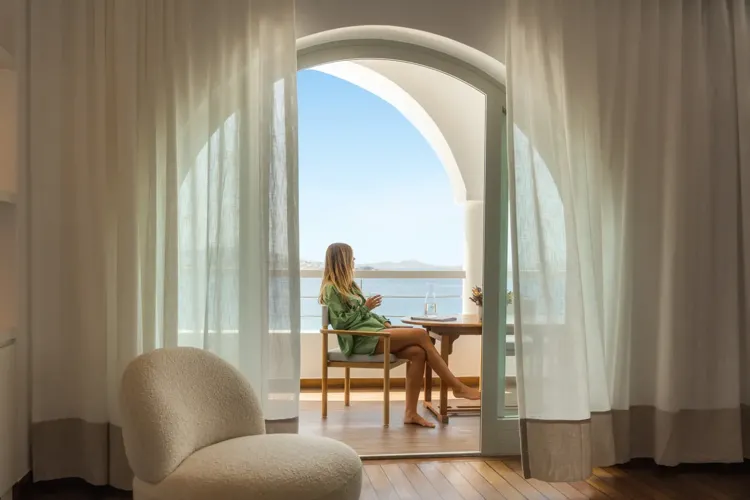
Across islands such as Paros and Mykonos, September is developing an identity of its own. The sea remains warm, restaurants and hotels are still open, and many of the experiences that can feel hurried during peak summer become easier to enjoy. At the same time, luxury travelers are looking beyond the familiar formula of a beautiful room, a pool and a beach. They want food with a connection to place, meaningful cultural experiences, wellness, privacy and hotels that help them understand the destination rather than separate them from it.
For Greece, that combination is helping reshape what an island escape can look like after August.
September Is No Longer Simply the End of Summer
SWOT Hospitality, which operates luxury properties across Greece, says the change is measurable. At its Paros hotels, revenue per available room increased 17 percent in September 2026 compared with the same month last year, while occupancy reached 88 percent through September 21. Across its five-star properties on the island, average daily rates have risen between 12 and 20 percent, with occupancy up between 10 and 15 percent.
Mykonos is showing a different but still positive pattern. SWOT reports volume growth of 5 to 10 percent and rates up as much as 5 percent following several years of softer demand and pricing. The company now describes September not as the final weeks of the Cycladic season, but as a major travel month in its own right, with much of the island season continuing through the first half of October.
The broader Greek tourism picture supports the idea that demand remains strong. According to the Bank of Greece, inbound traveler flows increased 8.6 percent between January and July 2026 compared with the same period in 2025, while travel receipts rose 12 percent to €13.5 billion. Average expenditure per trip also increased 2.9 percent.
Those figures do not mean every traveler is abandoning August, but they do suggest a tourism market with enough strength to support a longer and more varied luxury season.
Paros Is Building a Luxury Identity of Its Own

Paros was once positioned primarily as the quieter alternative to Mykonos or Santorini. That comparison now feels increasingly limiting.
The island has developed a more sophisticated luxury hospitality scene while retaining much of what originally made it appealing: villages, working harbors, local food traditions and a pace that feels noticeably different from the most commercialized Cycladic destinations.
SWOT says American travelers have become particularly important on Paros, accounting for nearly half of room nights and more than half of room revenue at its properties. Combined with travelers from the United Kingdom, Canada and Australia, English-speaking long-haul markets represent roughly two-thirds of its business.
The new generation of hotels reflects that shift. Parian Chronicle, a Destination by Hyatt hotel, is a 50-room property whose identity draws on the island’s history and famous marble. Rather than treating local heritage as surface decoration, the hotel incorporates Parian culture into guest experiences, including cooking with ingredients gathered from a family estate, sailing aboard a traditional wooden kaiki and working with local clay alongside an artisan.
For travelers interested in another side of Greek island luxury, FINE recently explored why Corfu offers a quieter alternative to Greece’s best-known islands. Paros represents a different version of that same broader shift toward destinations with a stronger sense of place.
Mykonos Feels Different When the Volume Comes Down

Mykonos does not need to reinvent itself completely. Its restaurants, beaches and nightlife remain part of its appeal. What changes in September is the balance.
SWOT’s data shows that the island continues to attract an international mix led by travelers from the United Kingdom, Germany and the United States, while Middle Eastern guests now account for around 14 percent of the company’s Mykonos revenue. Across Paros and Mykonos, SWOT says its hotels welcomed travelers from more than 80 countries this year.
The length of stay is relatively short, averaging 3.6 nights on both islands, but the way guests use those days changes outside July and August. With fewer peak-season crowds, travelers are more likely to spend mornings in villages, linger over lunch, book spa treatments or take boat trips rather than structuring the day around avoiding congestion. In Mykonos, that means retaining the island’s energy while making it easier to step away from it.
That distinction matters for travelers who still want Mykonos, just without the intensity of peak season.
Luxury Travelers Want Access Rather Than Isolation

One of the more important changes in high-end travel has little to do with thread counts or infinity pools.
“The beach, the pool and a beautiful room are now the starting point, not the full luxury experience,” SWOT told FINE. The company says affluent guests increasingly expect hotels to provide access to local culture, food and experiences rather than function as self-contained enclaves.
That can mean arranging a private boat at short notice, securing a table at a sought-after restaurant or tailoring a private chef menu around a guest’s preferences. Suites, villas and private pools remain in demand, but they are increasingly part of a larger expectation of flexibility and personalization. It is part of the same shift toward privacy, wellbeing and a stronger sense of place that FINE has explored in emerging luxury destinations such as Loreto.
Wellness is evolving in the same direction. At VIONÉ Paros, Dione Spa draws on Greek wellness traditions and marine-based therapies, while Parian Chronicle’s Nipson Spa takes a similar place-led approach. SWOT says guests are showing greater interest in sleep, recovery, stress management and longevity rather than treating the spa as an occasional add-on.
Food Is Becoming a Reason to Travel
September also brings something that midsummer cannot replicate in quite the same way: harvest season.
Across Greece, September brings grape harvests, late-summer produce and a slower dining rhythm that is difficult to replicate at the height of July and August. On Paros, wineries, cheesemakers and family-run tavernas provide a direct connection to the island’s agricultural traditions. SWOT says guests increasingly want to meet producers and understand where their food comes from rather than limiting their culinary experience to the hotel restaurant.
At VIONÉ, Pino by chef Luca Piscazzi combines Italian influences with Parian produce and local seafood. SWOT reports that guests spend an average of 18 percent beyond their room rate on dining and experiences, an indication of how central food has become to the overall trip.
The shift is subtle but important. A restaurant is no longer simply an amenity to return to after sightseeing. For some travelers, the producers, vineyards, tavernas and chefs are becoming part of the reason to choose the destination in the first place.
Greece’s Luxury Season Is Becoming Harder to Define
The most interesting change may be that there is no longer one obvious version of a luxury Greek holiday.
Paros is attracting travelers interested in a more understated Cycladic experience. Mykonos can offer the restaurants and energy that made it famous without quite the intensity of August. Food, wellness and cultural experiences are giving travelers reasons to move beyond the beach, while September’s warmer sea and quieter streets make it easier to explore at a different pace.
Heading into 2027, SWOT expects international luxury brands to continue entering Greece while May, June, September and early October become increasingly important parts of the travel calendar.
The appeal of Greece is not changing because travelers have stopped wanting beautiful beaches or Aegean sunsets. Those remain part of the promise.
What is changing is what comes after them.
For travelers willing to arrive when the height of summer begins to loosen its grip, Greece may feel less like a destination they have seen countless times before and more like one they are finally getting time to know.

(0) comments
We welcome your comments
Log In
Post a comment as Guest
Keep it Clean. Please avoid obscene, vulgar, lewd, racist or sexually-oriented language.
PLEASE TURN OFF YOUR CAPS LOCK.
Don't Threaten. Threats of harming another person will not be tolerated.
Be Truthful. Don't knowingly lie about anyone or anything.
Be Nice. No racism, sexism or any sort of -ism that is degrading to another person.
Be Proactive. Use the 'Report' link on each comment to let us know of abusive posts.
Share with Us. We'd love to hear eyewitness accounts, the history behind an article.