
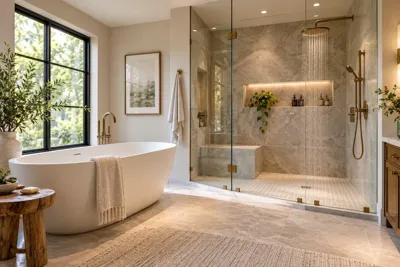

There is a moment in many bathroom remodels when the conversation stops being about tile and faucets and turns to a much bigger question: Do we really need this bathtub?
For homeowners who rarely take baths, removing an oversized tub can make room for a spacious walk-in shower, better storage or simply a bathroom that feels less crowded. But then comes the concern that has stopped more than a few remodels in their tracks. What happens when it is time to sell?
The latest bathroom remodeling data suggests homeowners are increasingly willing to rethink the traditional tub-and-shower formula. According to the 2026 U.S. Houzz Bathroom Trends Study, nearly half of renovating homeowners are enlarging their showers. When a bathtub is removed, 79 percent use the reclaimed space to make the shower larger.
That does not mean the bathtub is disappearing. It means homeowners are becoming more selective about where a tub belongs.
Walk-In Shower vs. Bathtub at a Glance
For everyday convenience, accessibility and efficient use of space, the walk-in shower has a clear advantage. For families with young children, people who genuinely enjoy soaking and homes where it would be the only bathtub, keeping a tub can still make considerable sense.
The decision becomes less about which feature is universally “better” and more about how the entire house functions.
A large primary bathroom with a luxurious shower and another bathtub elsewhere in the home presents a very different decision from a two-bedroom house with only one full bathroom.
That distinction matters.
Does Removing a Bathtub Hurt Your Home's Value?
There is no simple formula stating that removing a bathtub will reduce a home's value by a particular amount. Real estate value depends on the property, market, buyer and quality of the renovation.
The more useful question is whether removing the bathtub limits who might want to buy the house.
If another full-size tub remains elsewhere in the home, replacing an underused primary-bath tub with a generous walk-in shower may actually create a bathroom that feels more aligned with the way many homeowners live today.
Removing the only bathtub in the house deserves more consideration.
Families with babies and young children may strongly prefer one. Some buyers simply consider a bathtub part of a complete bathroom. In that situation, eliminating the tub can potentially narrow the buyer pool even if the new shower is beautiful.
Think about the entire home rather than judging one bathroom in isolation.
Why Walk-In Showers Are Getting Bigger
The oversized shower is no longer simply a luxury-hotel flourish.
Houzz reports that 49 percent of bathroom renovations now involve enlarging the shower, a significant increase from the previous year. Among homeowners who upgrade their showers, 58 percent increase their size.
There is a practical reason for the shift. A shower is often the feature homeowners use every day.
Removing an oversized tub can create room for a bench, handheld shower, multiple shower fixtures, better storage niches or simply more comfortable movement. Frameless glass can also preserve sightlines and make the bathroom feel more open.
FINE has previously explored why homeowners are switching from tubs to walk-in showers, but the strongest argument may now be less about following a design trend and more about putting valuable square footage where it will actually be used.
Walk-In and Curbless Showers Are Not Quite the Same
The terms are often used interchangeably, but a walk-in shower does not necessarily have to be curbless.
A traditional walk-in shower may have a small threshold or curb designed to help contain water. A curbless shower creates a nearly seamless transition between the bathroom floor and shower floor.
That minimal transition can look exceptionally clean, but designing it correctly requires more than eliminating the curb. The floor must be properly sloped toward the drain, waterproofing becomes critical and the layout has to control where water travels.
For some renovations, a low-curb shower offers a useful compromise between visual simplicity and easier construction.
These choices are also becoming part of long-term home planning. Houzz found that 71 percent of renovating homeowners address special needs during bathroom projects. Among those planning bathrooms around aging in place, low-curb and curbless showers, nonslip flooring and grab bars are among the features being incorporated.
Accessibility, in other words, is increasingly being designed in before it becomes necessary.
When Keeping the Bathtub Makes More Sense
There are still plenty of good reasons not to call the demolition crew.
If it is the only bathtub in the house, keeping it may preserve greater flexibility for future owners. The same is true for homes designed with families in mind.
And then there is the simplest reason of all.
If you take baths, the bathtub has value.
Interestingly, while many homeowners are removing tubs, those who are installing them are increasingly choosing tubs intended for the experience itself. The traditional built-in tub that sits unused is giving way to deeper soaking tubs and freestanding designs that serve as both functional fixtures and architectural focal points.
In a sufficiently large primary suite, having both a generous shower and a well-designed soaking tub can still be the most luxurious solution.
What a Tub-to-Shower Conversion Really Costs
Removing a bathtub may appear straightforward until plumbing, waterproofing and tile enter the conversation.
The visible fixtures are only part of the expense.
Changing the shower footprint can require relocating a drain, adjusting supply lines, rebuilding the shower pan, waterproofing walls and floors, installing new tile and adding custom glass. Older homes can reveal damaged subflooring or plumbing once demolition begins.
Moving plumbing is particularly capable of turning what looked like a modest renovation into a larger construction project.
Homeowners planning a complete remodel should look at the entire budget rather than comparing the retail price of a bathtub with the price of a shower enclosure. FINE's guide to what a bathroom renovation actually costs explains some of the less obvious expenses that can affect the final number.
Houzz's latest research puts median spending on bathroom upgrades nationally at $15,000, with major remodels involving at least a shower upgrade reaching a median of $25,000. Larger bathrooms and high-end projects can go considerably higher.
The Luxury Features Worth Considering
A successful luxury bathroom does not need to contain every available gadget.
In fact, the latest Houzz research offers an interesting reality check. Homeowners who remodeled their bathrooms identified cleanliness, a spacious shower and organized storage as the features most associated with relaxation.
That suggests luxury may have less to do with filling a bathroom with technology and more to do with designing the fundamentals exceptionally well.
A generously sized shower with thermostatic controls, a handheld fixture, thoughtfully positioned niches and a comfortable bench can feel luxurious every morning. Heated flooring, layered lighting and quality ventilation improve the experience without dominating the room.
For homeowners who enjoy a softer overhead shower experience, a well-chosen rainfall showerhead can add another layer of comfort, provided the home's water pressure and shower dimensions support it.
The goal should be a bathroom that functions beautifully rather than one that simply has the longest feature list.
So Which Should You Choose?
If there is another bathtub elsewhere in the home and the primary tub goes virtually untouched, replacing it with a well-designed walk-in shower can be an entirely sensible remodeling decision.
If you are considering removing the home's only tub, think more carefully. Your daily preferences matter, but so may the needs of future buyers.
If long-term accessibility is important, a low-curb or properly constructed curbless shower deserves serious consideration.
And if your bathroom has enough square footage for both without squeezing either one into an awkward corner, you may not have to choose at all.
The best bathroom remodels are not the ones that follow every trend. They are the ones that understand how the homeowners actually live and use valuable space accordingly.
Before removing a bathtub because showers happen to be popular—or keeping one purely because someone someday might want it—ask the more useful question.
Which option will make this particular home work better?

(0) comments
We welcome your comments
Log In
Post a comment as Guest
Keep it Clean. Please avoid obscene, vulgar, lewd, racist or sexually-oriented language.
PLEASE TURN OFF YOUR CAPS LOCK.
Don't Threaten. Threats of harming another person will not be tolerated.
Be Truthful. Don't knowingly lie about anyone or anything.
Be Nice. No racism, sexism or any sort of -ism that is degrading to another person.
Be Proactive. Use the 'Report' link on each comment to let us know of abusive posts.
Share with Us. We'd love to hear eyewitness accounts, the history behind an article.