
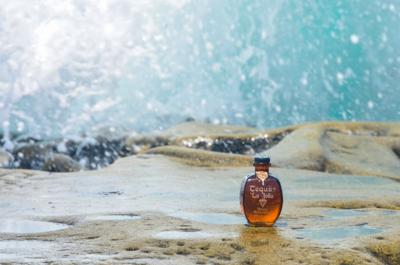
There’s a new tequila you’ll be sipping in San Diego bars next year. Some have called it distinctive, but trust co-founder Alexander Ciullo––it’s just like all the rest. I’ll explain in a moment...
Tequila La Jolla is presented in a cute, stout amber bottle with four rounded facets. Etched on the bottle is the "100% de agave" label, meaning it’s unflavored and untainted with additives. Mexico does permit flavored tequila to be called "tequila," but only a pure product bottled at an authorized point can wear the immaculate "100% de Agave." So Tequila La Jolla is the real deal.
Tequila La Jolla is a highland brand, with its agave hailing from the Mexican mountain region of Los Altos. The windy climate and red clay soil cultivates a sweet, feminine agave that Americans favor.
Alexander Ciullo and Jeff Smith are the founders and owners of the brand, receiving ample assistance from tequila veteran Carmina Morales. The three met through mutual friends in the sphere of the Baja off-road racing circuit. Ciullo graduated from SDSU with a degree in business and spent a good slice of his life touring with rock bands. Smith is a master of all mechanical trades; he owns Smith Motorsports and works as a fabricator and mechanic for Parkhouse Motorsports, a first class unlimited race team. He’s also a blacksmith and can, according to Ciullo, "take anything apart and put it back together." Carmina Morales completes the Tequila La Jolla trifecta. "She couldn’t help but come back to the industry," says Ciullo. "She just loved tequila too much... She knows every import and export fact, top to bottom." It goes without saying that her knowledge is invaluable to Smith and Ciullo.
The original intent of the brand was to make a house tequila for Smith’s racing events, occasionally manifesting itself as birthday gifts for friends and relatives. But people love Tequila La Jolla, so Ciullo and Smith went for it. At first they were importing the agave from Mexico and barreling it here, but now that the business is going full speed ahead, the team is making frequent trips to Jalisco and increasing their scale of production. They’re following all of the procedures, satisfying the tequila-making rules of the US and Mexico. "They pay extreme attention," says Ciullo, referring to the latter country. Just one example of the fist: in 1974, Mexico declared tequila their intellectual property to prevent tequila from being manufactured outside of the Tequila area.
Most of Tequila La Jolla’s development has been a slew of trial and error––about five years’ worth. Smith re-barreled and re-barreled, and Ciullo joined in two years ago and did his own share of re-barreling until the two found an expression that felt right. One thing they’ve learned is that wood is a huge factor. "Most tequila is made in barrels that have already been used for whiskey," Ciullo tells me. "[Whiskey barrels] give those tequilas their own flavor, but Jeff and I have been crafting our own hybrid barrels." Now that production is moving to Mexico, the team is switching to 200-liter barrels for efficiency.
So far Ciullo says, "The feedback has been phenomenal!" But the last thing Ciullo wants to do is distinguish himself from everyone else––significantly, at least. "These other top shelf brands aren’t our competitors," he says. "I revere and drink them all. We’re part of a community of the spirit, a celebration of the entire industry. It’s not like ‘here I am, beat my chest, I’m the top dog.’"
"These are all great products," he continues. "This is like the NFL. It doesn’t matter what team you’re on, you’re still in an elite fraternity. We’re looking to bring in something a little different, but also 100% in line with and in accordance with an añejo [aged tequila]."
Tequila possibly originated with the Olmecs, the first major civilization in Mexico, in 1000 BC. Aside from inventing the concept of zero on their own, the Olmecs also loved to ferment agave sap. By 200 AD, the Aztecs were doing it too, calling it pulque and worshipping two relevant gods: Mayahuel, the goddess of agave, and Patecatl, the god of pulque.
In 1519, Hernán Cortez captured Tenochtitlan. Since there was no beloved brandy in the Americas, the Spanish took cues from pulque and created mezcal with agave and mud. Mezcal is still around today; it’s a distilled alcohol made with any type of Mexican agave––tequila included, of course. Other types of mezcal include tobalá and tepeztate; these two coveted drinks usually go for $100+ a bottle.
Jose Antonio Cuervo began commercially distilling tequila in 1758, making tequila the first commercially produced alcohol in North America. Production took off in 1821 when Mexico gained its independence from Spain. By 1880, the Cuervo fields had 3 million agave plants.
Tequila became a symbol of national pride during the Mexican Revolution in the 1910s. Then tequila became very popular during the prohibition, and people would drive down to Mexican bars. It also became a hero during WW2, when European spirits were difficult to import. And here we are today: tequila’s had its fair share of the "trashy" connotation, and it’s in the middle of doing a 180. Ciullo has a lot to say about this:
"In my generation, your generation, the younger generation coming up, the perception on tequila has changed. When I was 23 and going out to clubs, it was always vodka. But when I go out now, it’s tequila as well about 45% of the time... I used to say I’m not a tequila drinker since there’s an undertone that’s it’s an uncultivated beverage. But it’s not. Just look at the process: you grow the agave, harvest it, bake it, crush it, ferment it, barrel it––there’s so much that goes into it."
Tequila haters take note: the drink is a cultured thing to sip on its own. The most expensive tequila was $225,000, and its makers earned a Guinness World Record.
I think we can all learn something from Tequila La Jolla. Life and its disciplines can’t always be a claw to the top. Think about going slowly, think about honoring tradition, and join a community in which you adore the work of everyone involved. Tequila La Jolla is more than an alcohol; it’s a reminder of how to take a deep breath and do something for its own sake.
For Related Articles Try:
Amazing Alcohol at the Del Mar Plaza's Haute 2 Trot


(0) comments
We welcome your comments
Log In
Post a comment as Guest
Keep it Clean. Please avoid obscene, vulgar, lewd, racist or sexually-oriented language.
PLEASE TURN OFF YOUR CAPS LOCK.
Don't Threaten. Threats of harming another person will not be tolerated.
Be Truthful. Don't knowingly lie about anyone or anything.
Be Nice. No racism, sexism or any sort of -ism that is degrading to another person.
Be Proactive. Use the 'Report' link on each comment to let us know of abusive posts.
Share with Us. We'd love to hear eyewitness accounts, the history behind an article.