
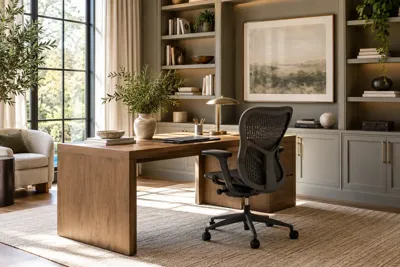

A home office can go wrong in surprisingly expensive ways. The desk is beautiful but too shallow for the monitor. The chair provides excellent support but visually takes over the room. The cabinetry looks impressive until there is nowhere convenient to plug in a laptop. What appeared to be a beautifully furnished office gradually reveals itself as a collection of pieces that were chosen individually rather than as a working environment.
The better approach is to treat office furniture the same way you would furniture in any other important room of the home. It should suit the architecture, reflect how you actually live, and remain comfortable after the novelty of the installation has worn off. Function matters, but function no longer has to look corporate.
Start With the Way You Actually Work
Before choosing furniture, take inventory of what happens during a typical workday. Someone working primarily from a laptop has very different spatial requirements from someone using two monitors, reviewing architectural plans, holding video conferences, or working with physical samples and paperwork.
Consider what needs to remain within reach and what can disappear behind a cabinet door. A printer used twice a month does not deserve prime desk space. A notebook opened several times an hour probably does. Designing around real habits rather than an imagined version of an impeccably tidy office generally produces a room that stays organized much longer.
Give the Chair More Attention Than Almost Anything Else
Of all the furniture in a working office, the chair has the most direct relationship with your body. Seat height, depth, lumbar support, arm position, and the ability to change posture matter considerably more after several hours than they do during a five-minute showroom test. OSHA's computer workstation guidance recommends seating that supports the back, allows appropriate leg positioning, and can be adjusted to the individual and workstation.
Fortunately, serious ergonomics no longer automatically mean an enormous black executive chair. The Herman Miller Mirra 2 is one example of the newer approach. Its relatively open, sculptural profile incorporates adjustable options for lumbar support, seat depth, arms, and tilt, while breathable materials and a flexible back are designed to accommodate movement. Herman Miller also offers different back and finish configurations, making the chair easier to integrate into a residential interior rather than treating it as equipment that happens to live there. :contentReference[oaicite:1]{index=1}
The important lesson is not that every office needs one particular chair. It is that appearance should be evaluated alongside adjustability, movement, materials, and fit. For a deeper look specifically at this shift in office seating, FINE's guide to the new home office chair explores why ergonomic furniture is becoming considerably more design-conscious.
Choose the Desk by Proportion Rather Than Size Alone
A larger desk is not necessarily a better desk. In a home office, scale can determine whether the room feels composed or crowded. Measure not only the available wall space but also the circulation around the desk, the position of the chair when pulled out, nearby doors, and the distance from shelving or cabinetry.
Depth deserves particular attention. A beautiful narrow writing desk may work perfectly for a laptop but become uncomfortable once a large monitor and keyboard are added. Conversely, an oversized executive desk can dominate a modest room and create unnecessary distance between the user and surrounding storage. The best size is the one that accommodates the equipment you actually use while leaving the room visually balanced.
Let Storage Disappear Into the Room
Traditional offices often announce their storage with filing cabinets, utility shelving, and rows of matching drawers. A residential workspace can be considerably subtler. Built-in cabinetry, credenzas, bookcases, decorative boxes, and furniture originally intended for living areas can conceal the less attractive necessities of working from home.
The most useful storage is also positioned according to frequency. Everyday materials belong close to the desk. Archived documents, spare technology, paper supplies, and rarely used equipment can move farther away or behind doors. This prevents the desktop from becoming the storage system by default and allows decorative objects, books, or art to have some visual breathing room.
Consider What the Furniture Looks Like From Outside the Office
This is particularly important when a workspace sits inside a bedroom, living area, landing, or open-plan room. The office may be visible for far more hours than it is actively being used. Look at the furniture from the doorway and from adjacent spaces, not merely from the desk chair.
Backs, bases, cords, unfinished sides, and bulky equipment suddenly become much more important. A desk with a beautifully finished rear panel may be worth the investment if it floats in the room. A chair with an elegant silhouette matters when its back faces the hallway. Even the placement of a power strip can determine whether an otherwise sophisticated office looks finished or improvised.
Use Materials That Connect the Office to the Rest of the Home
There is no requirement that home-office furniture come from an office collection. Walnut, oak, stone, leather, woven textiles, lacquered cabinetry, and restrained metal finishes can help establish continuity with neighboring rooms. Repeating one or two materials already found elsewhere in the home often makes a workspace feel intentional rather than inserted.
This does not mean every piece should match. In fact, matching desk-chair-cabinet suites can make a residential office look more commercial. A better result often comes from coordinating proportions, undertones, and materials while allowing individual pieces to have their own character.
Do Not Forget Lighting, Power, and Technology
Furniture decisions also determine where technology can live. Before ordering a desk, know where electrical outlets are located, how monitor cables will be routed, where devices will charge, and whether floor or wall outlets are needed. Cable management is considerably easier to plan before a 200-pound desk is in place.
Lighting should be equally layered. Natural light is valuable, but it should be supplemented with appropriate task lighting rather than relying exclusively on an overhead fixture. A good desk lamp can improve the work surface while also functioning as a decorative object. FINE's guide to building a home office that feels as good as it works looks more broadly at creating a workspace around everyday comfort and routine.
Spend More Where the Difference Is Felt Every Day
A thoughtful office budget does not need to be divided evenly. Furniture that affects the body or is used constantly generally deserves the larger investment. A supportive chair, properly proportioned desk, effective task lighting, and durable storage are likely to influence the experience of the room far more than decorative accessories.
That also makes longevity important. Adjustable mechanisms, replaceable components, durable surfaces, and warranties may not be particularly glamorous purchasing criteria, but they can matter substantially over time. Herman Miller, for example, lists a 12-year warranty for the Mirra 2, illustrating how premium office furniture can be evaluated partly through expected service life rather than appearance or initial price alone. :contentReference[oaicite:2]{index=2}
A Home Office Should Still Feel Like Home
The strongest home offices do not look as though a corporate furniture catalog has been installed inside a spare bedroom. Nor are they decorated so carefully that working in them becomes inconvenient. They occupy the middle ground where good design and practical decisions reinforce one another.
Choose the chair for the body and the room. Choose the desk for the work and the available space. Conceal what does not need to be seen, give lighting and technology proper consideration, and allow the materials to connect with the rest of the house. When those decisions are made together, office furniture stops feeling like necessary equipment and simply becomes part of a well-designed home.
(0) comments
We welcome your comments
Log In
Post a comment as Guest
Keep it Clean. Please avoid obscene, vulgar, lewd, racist or sexually-oriented language.
PLEASE TURN OFF YOUR CAPS LOCK.
Don't Threaten. Threats of harming another person will not be tolerated.
Be Truthful. Don't knowingly lie about anyone or anything.
Be Nice. No racism, sexism or any sort of -ism that is degrading to another person.
Be Proactive. Use the 'Report' link on each comment to let us know of abusive posts.
Share with Us. We'd love to hear eyewitness accounts, the history behind an article.