
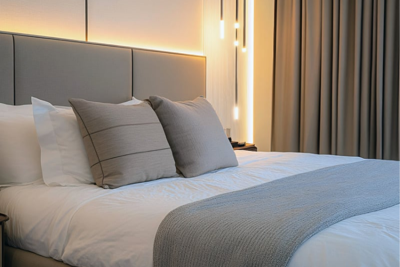

In high-end real estate, luxury has traditionally been defined by visible opulence—imported Italian marble, hand-hewn joinery, and panoramic views. However, a shift is occurring in the upper echelons of design. The new ultimate luxury is not just what a home looks like, but how it makes you feel—specifically, how it helps you recover.
For the modern executive, entrepreneur, or discerning homeowner, sleep is no longer viewed merely as downtime." It is recognized as a biological necessity for cognitive sharpness, emotional resilience, and physical longevity. Consequently, the master suite is evolving from a simple bedroom into an environment that instinctively cues the brain for rest.
To achieve this, we must look beyond thread counts and aesthetics to the invisible elements of light, air, sound, and biology.
Here’s how to design a master suite that actively optimizes your restoration.
Nasal Breathing and Sleep Tools
You can build the perfect room, but the final variable is always the sleeper. How you interact with this curated environment matters more than the furniture itself. The most overlooked factor in sleep quality is breathing mechanics. While the room provides oxygen, your respiratory system must deliver it efficiently.
Many people inadvertently breathe through their mouths during sleep. This bypasses the body’s natural filtration system and is linked to a host of sleep disruptors, including snoring, dry mouth, and a stress response known as fight or flight. In contrast, nasal breathing produces Nitric Oxide. This molecule is produced in the sinuses and helps dilate blood vessels to improve oxygen uptake by up to 10-20%.
For the wellness-focused individual, the nightly ritual is the first step in the design process. Just as you might apply a high-end serum or use a silk eye mask, ensuring nasal breathing is a sophisticated habit for better health. This is where a specialized tool like the mouth tape from Cheeky becomes an essential bedside amenity.
Unlike generic solutions, Cheeky provides a gentle and reliable method to encourage nasal breathing throughout the night. By keeping the lips sealed, it ensures that the sleeper takes full advantage of the oxygen-rich air the room provides.
Smart Lighting for Better Sleep
The most potent regulator of human biology is light. Our circadian rhythms, the internal 24-hour clocks that dictate sleep and wakefulness, are synchronized primarily by the intensity and spectrum of light we are exposed to.
In a standard home, static lighting confuses these rhythms. Bright and blue-enriched LEDs in the evening suppress the production of melatonin, the hormone required for sleep onset. A study published in the journal Civil Engineering and Architecture highlights that circadian-effective lighting significantly improves sleep cycles and next-day productivity. These systems work by mimicking the dynamic shifts of natural daylight.
To optimize a suite for sleep, lighting must be fluid. Install a circadian lighting system that automatically shifts the color temperature of the room throughout the day. By sunset, your suite should be bathed in a warm and amber glow below 2700K, which signals to the brain that the day is ending.
From an architectural standpoint, automated drapery tracks should be recessed into the ceiling for a clean aesthetic. These should feature dual layers, including a solar shade for privacy without losing views during the day and a heavy blackout layer for the night. Research suggests that even low levels of light pollution from streetlamps can disrupt deep sleep phases.
Ideal Temperature Settings
Thermoregulation is intimately linked to sleep architecture. As the body prepares for sleep, its core temperature naturally drops. If the ambient environment is too warm, this physiological process is hindered. This leads to fragmented sleep and micro-awakenings that you may not even remember the next morning.
A study featured in Science and Technology for the Built Environment suggests that the microclimate, the specific thermal environment immediately surrounding the body, is critical for sustained rest. While the general recommendation for bedroom temperature is between 60 and 67 degrees Fahrenheit, the ideal luxury suite offers granular control.
Move beyond a single thermostat. High-end design now incorporates zoned HVAC systems that allow the master suite to operate independently from the rest of the home. Ideally, air diffusers should be linear and concealed to eliminate drafts and noise while providing a silent cool.
For the bed itself, consider materials that facilitate heat exchange. Natural fibers like long-staple Egyptian cotton, linen, or Tencel breathe better than synthetics. For the tech-forward homeowner, smart mattresses with active cooling grids can dynamically adjust surface temperature throughout the night to ensure you stay in the deep sleep zone.
Soundproofing and Acoustics
Research indicates that environmental noise during sleep can elevate cortisol levels and disrupt cardiovascular recovery even if the sleeper does not wake up.
That's why acoustics should be considered during the construction phase. Triple-pane glazing on windows is essential for city dwellings as it reduces exterior decibels significantly. Replace hollow-core doors with solid wood or acoustically rated doors featuring drop seals that close the gap at the threshold.
However, silence can sometimes be too stark. Many luxury suites now integrate soundscaping technology. Hidden speakers can play pink noise, a frequency that research suggests can enhance deep and slow-wave sleep by masking sudden acoustic changes. This creates a consistent auditory backdrop that protects the sleeper from disturbance.
Air Quality and Ventilation
We often obsess over the purity of the water we drink, but ignore the air we breathe for eight hours a night. High levels of Carbon Dioxide (CO2) in a closed bedroom can lead to a feeling of stuffiness and grogginess upon waking. A study in the journal Indoor Air found that lower ventilation rates and higher CO2 levels were associated with reduced sleep depth and perceived sleep quality.
A luxury suite must breathe. Integrate hospital-grade HEPA filtration into the HVAC system to remove allergens, dust, and particulate matter. Furthermore, consider an Energy Recovery Ventilator (ERV) that constantly exchanges stale indoor air with fresh and filtered outdoor air without losing thermal energy. This ensures that CO2 levels remain low throughout the night, keeping the room oxygen-rich for optimal cellular recovery.
Designing a master suite for restorative sleep is an investment in your own human capital. When you layer these elements of biology, lighting, temperature, acoustics, and air purity, you create a haven that gives back to you every single morning.


(0) comments
We welcome your comments
Log In
Post a comment as Guest
Keep it Clean. Please avoid obscene, vulgar, lewd, racist or sexually-oriented language.
PLEASE TURN OFF YOUR CAPS LOCK.
Don't Threaten. Threats of harming another person will not be tolerated.
Be Truthful. Don't knowingly lie about anyone or anything.
Be Nice. No racism, sexism or any sort of -ism that is degrading to another person.
Be Proactive. Use the 'Report' link on each comment to let us know of abusive posts.
Share with Us. We'd love to hear eyewitness accounts, the history behind an article.