
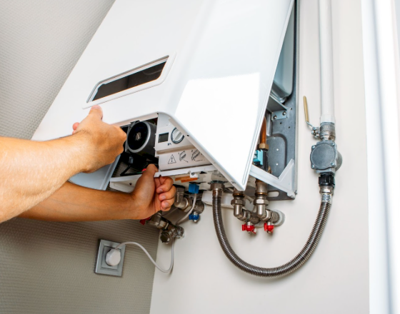
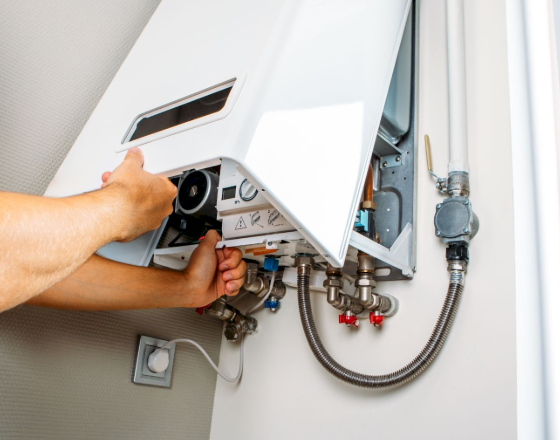
Boilers hold a big weight on their metaphorical shoulders. They’re largely responsible for keeping the insides of buildings significantly more pleasant than the outside world, especially during winter, and they’re most visible in the moments when they stop working.
There are a few things that can go wrong, one of which is the loss of pressure. Here, we take a quick look at what some of the main causes of pressure loss in boilers tend to be, from simple system leaks to faulty valves.
System leaks
For your boiler to maintain pressure, it needs to be installed in a fixed system. As soon as that system gains any kind of leak, pressure can start to drop, and you won’t be able to repressurise the system until the leak is fixed.
In some cases, these leaks may be obvious, but in others - with slow leaks - they can be a lot more difficult to identify.
You can check for water coming from the pipes, or around the boiler. If you can’t see visible build-ups, then you can place a sheet of paper under the boiler and use that to check if water is dropping at a slower rate.
Bleeding radiators
When you bleed the radiators in your home, removing the air can mean that you also remove pressure from the system, and that space will need to be filled with new water.
In some cases, you may need to manually add this water - we describe how to do this in a bit more detail below.
Valve failure
There are also normally valves in modern boilers that are necessary to maintain a steady pressure. A failure in one of these valves - normally the expansion valve - is another fault that can lead to a big pressure drop in the system.
If you suspect this might be the case, you’ll probably have to get a boiler engineer over from somewhere like Able Plumbers, to assess and potentially replace the valve.
What to do if there’s pressure loss
If you’ve spotted on the pressure gauge (located on the front of most boilers) that you’ve lost significant amounts of pressure, you can try to repressurise the system.
Before doing this, you’ll need to turn the boiler off, and wait around an hour for the water to cool down. Then, you’ll attach the filling loops, opening both valves to allow water to enter the system.
You’ll need to check the pressure gauge while doing this, waiting until it reaches around 1.5 bar before stopping. It’s worth checking your boiler’s manual, to see whether the advised pressure might be slightly higher or lower than that.
The causes behind drops in boiler pressure can be a pain to identify and fix, but there’s also a chance that you’ll be able to get it all dealt with easily. If you have any uncertainties, then it’s worth contacting a boiler technician, so that they can make sure the system is safe and fully operational.


(0) comments
We welcome your comments
Log In
Post a comment as Guest
Keep it Clean. Please avoid obscene, vulgar, lewd, racist or sexually-oriented language.
PLEASE TURN OFF YOUR CAPS LOCK.
Don't Threaten. Threats of harming another person will not be tolerated.
Be Truthful. Don't knowingly lie about anyone or anything.
Be Nice. No racism, sexism or any sort of -ism that is degrading to another person.
Be Proactive. Use the 'Report' link on each comment to let us know of abusive posts.
Share with Us. We'd love to hear eyewitness accounts, the history behind an article.