
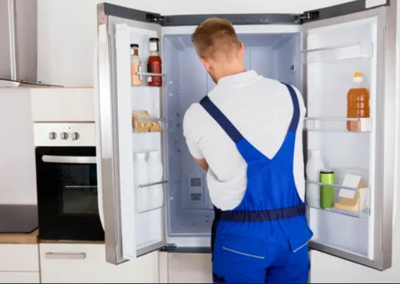

Let's be honest: no one thinks about their fridge until it breaks down. It quietly sits in the corner of your kitchen, buzzing and doing its thing. Then one morning you go for the milk and it's warm. All of a sudden, the appliance you haven't thought about in years is all you can think about.
Living in Atlanta makes refrigerator problems extra frustrating. Our summers are brutal—95 degrees with humidity so thick you could cut it with a knife. Your fridge has to work overtime just to keep things cold, and that stress takes a toll. When something breaks down, most folks start looking for Atlanta appliance repair right away. The same five problems show up again and again in homes across the city. Here's what goes wrong and what the repair guys actually do about it.
The Fridge Isn't Cold Anymore
This is the big one. The worst-case scenario. When you go home from work and open the fridge, you get struck with air that is the same temperature as the room. The cheese is dripping. The food that is left over smells strange. And you stand there wondering how much food you have to get rid of.
First thing a technician checks? The thermostat. Sounds too simple, right? But people bump that dial all the time without realizing it. Kids mess with it. Someone reaches for something in the back and accidentally turns it.
Next up: the condenser coils. These are usually behind the fridge or underneath it, and they get filthy. Dust bunnies, pet hair, kitchen grease—all of it builds up. When those coils get caked with gunk, heat can't escape. The fridge runs and runs but never actually gets cold. A good cleaning with a brush and vacuum fixes this more often than you'd think.
Things get harder if cleaning doesn't work. It could be that the compressor is broken. You might hear a click and then nothing. Or the refrigerant level could be low, which usually suggests there is a leak. You need to be certified by the EPA to work with refrigerant, so you can't do it yourself.
Frost Taking Over the Freezer
Here's a weird one. You've got a frost-free freezer, but somehow there's an inch of ice coating the back wall. What gives?
Every few hours, a modern freezer's defrost system melts the ice that has built up.Frost builds up quickly when it breaks. The heater, the thermostat, and the timer are the three main parts of the setup. The technician uses a meter to check each one to verify if the heater works and if the thermostat works.
Nine times out of ten, one part has failed and needs replacing. Pretty straightforward swap once you know which one. A good tech will also check the door seals while they're at it. Worn-out gaskets let humid air leak in, and that moisture turns straight to frost.
Water Leaking Onto the Floor
Nothing ruins your morning like stepping barefoot into a cold puddle. Beyond the mess, water means potential damage to your flooring—and in humid Atlanta, mold becomes a real concern quick.
Where's the water coming from? Usually the defrost drain. During the defrost cycle, water runs through a short tube into a pan under the fridge when the ice melts. This technique is easy to use and works well, however it can get clogged up.
Food particles, mineral buildup, even algae can block it.Water backs up, falls out of the fridge, and ends up on the floor of your kitchen. Hot water, a pipe cleaner, or a burst of compressed air can be used to unclog the drain. It's not glamorous work, but it gets the job done quickly and addresses the problem.
The other common culprit? The water line to your ice maker. That little tube running from your wall can develop leaks at the connections, or the tubing itself can crack. Technicians check the fittings, replace damaged sections, and verify the water pressure isn't too high.
Ice Maker Stopped Working
In Atlanta, a broken ice maker feels personal. It's July, hot as blazes outside, and your fridge won't give you any ice. Come on.
Ice makers are actually pretty simple. Water comes in through a valve, fills a mold, freezes, and gets dumped into the bin. When something in that cycle breaks, production stops.
Water supply issues cause a lot of problems. The inlet valve might be stuck or clogged with mineral buildup—Atlanta water leaves deposits over time. Not enough water means no ice, or small hollow cubes that aren't useful.
Sometimes the ice maker has a mechanical issue. The motor might have burned out, or a sensor gives bad readings. Or—this happens more than you'd expect—a single cube got stuck and jammed everything up. Almost embarrassing to pay for, but at least it's cheap.
Temperature matters too. The freezer needs to be around 0°F for ice production. If it runs warmer, you'll get slow or no ice.
Strange Sounds
Refrigerators aren't silent. There's always some humming, maybe a gurgle now and then. That's normal. But new noises—or old noises getting way louder—usually mean something's wearing out.
Buzzing often comes from fan motors on their last legs. There's one by the condenser coils and another inside the freezer compartment. The bearings inside wear down over time and start making noise. Clicking can happen when blades hit ice that's built up where it shouldn't be.
Then there's the compressor. Grinding or loud rattling that shakes the whole unit? That's concerning. The compressor is basically the heart of your refrigerator.
Repair techs track down sounds by listening carefully and pulling off panels to watch what's happening. Fan motors are usually easy swaps. A noisy compressor is different—depending on your fridge's age, the tech might suggest putting that money toward a new unit instead.
When Should You Call Someone?
Here's the thing—not every fridge problem needs a professional to fix it. Cleaning condenser coils? Do it yourself. Changing a water filter? Easy. Even manual defrosting just takes time and towels.
But when your refrigerator keeps acting up—temperature won't stay stable, water keeps appearing, weird noises won't stop—that's when you want someone who knows what they're doing. Small problems turn into big problems when ignored. A cooling issue today becomes a dead compressor next month.
If you're dealing with ongoing troubles, scheduling refrigerator repair in Atlanta sooner rather than later saves money. A trained tech can figure out what's actually wrong, fix it right, and get your kitchen back to normal—even when Atlanta summer is doing its worst outside. Most repairs take an hour or two, and you'll sleep better knowing your food is staying cold the way it should.

(0) comments
We welcome your comments
Log In
Post a comment as Guest
Keep it Clean. Please avoid obscene, vulgar, lewd, racist or sexually-oriented language.
PLEASE TURN OFF YOUR CAPS LOCK.
Don't Threaten. Threats of harming another person will not be tolerated.
Be Truthful. Don't knowingly lie about anyone or anything.
Be Nice. No racism, sexism or any sort of -ism that is degrading to another person.
Be Proactive. Use the 'Report' link on each comment to let us know of abusive posts.
Share with Us. We'd love to hear eyewitness accounts, the history behind an article.